

Manuel Mogato | September 24, 2026
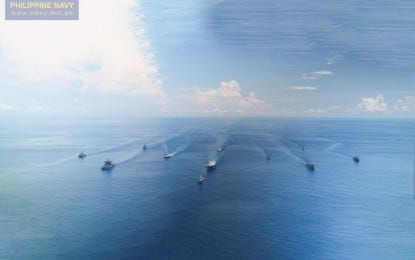
West Philippine Sea — Eleven warships from seven like-minded states joined the Philippines in the first large-scale naval drills in a disputed sea.
From Zambales province, on the western coast of the main island of Luzon, warships from the Philippines, Australia, Brunei, India, Japan, New Zealand, Singapore, and the United States sailed into the disputed waters, coming as close as 45 nautical miles to the Chinese-occupied Bajo de Masinloc.
China sent its warships to monitor and shadow the drills, an activity under this year’s ASEAN Defense Ministers’ Meeting-Plus (ADMM-Plus) Experts’ Working Group on Maritime Security (EWG-MS).
A Philippine warship invited the Chinese vessel to join the drills, but received no response on the radio. (Also read: China holds naval drills inside Philippine waters)
The Philippine Navy’s guided-missile frigate BRP Jose Rizal led a column formation during the exercises, as the eleven warships practiced coordinated maneuvering and navigation at sea.
The multilateral maritime activity is designed to sustain and strengthen regional security cooperation.
ASEAN neighbors Brunei and Singapore sent one vessel each, while India and New Zealand contributed two vessels
QUAD members Australia, Japan, and the United States also sent a vessel each. (Also read: Philippines holds naval drills with US, Australia)
The Philippine Navy AW159 helicopter also simulated a medical evacuation (MEDEVAC) during the activity.
As part of the exercise, the helicopter transported a simulated casualty from the Japan Maritime Self-Defense Force’s helicopter destroyer, JS Ise, to the Philippine Navy’s BRP Jose Rizal, where the casualty was received for further medical assessment and treatment.
The At-Sea Phase forms part of the ADMM-Plus EWG aims to strengthen interoperability, facilitate knowledge exchange, and enhance practical cooperation in the maritime domain.
Through the activity, the Philippine Navy continues to strengthen interoperability and cooperation with regional and international partners in support of a secure, peaceful, and resilient maritime region.
