

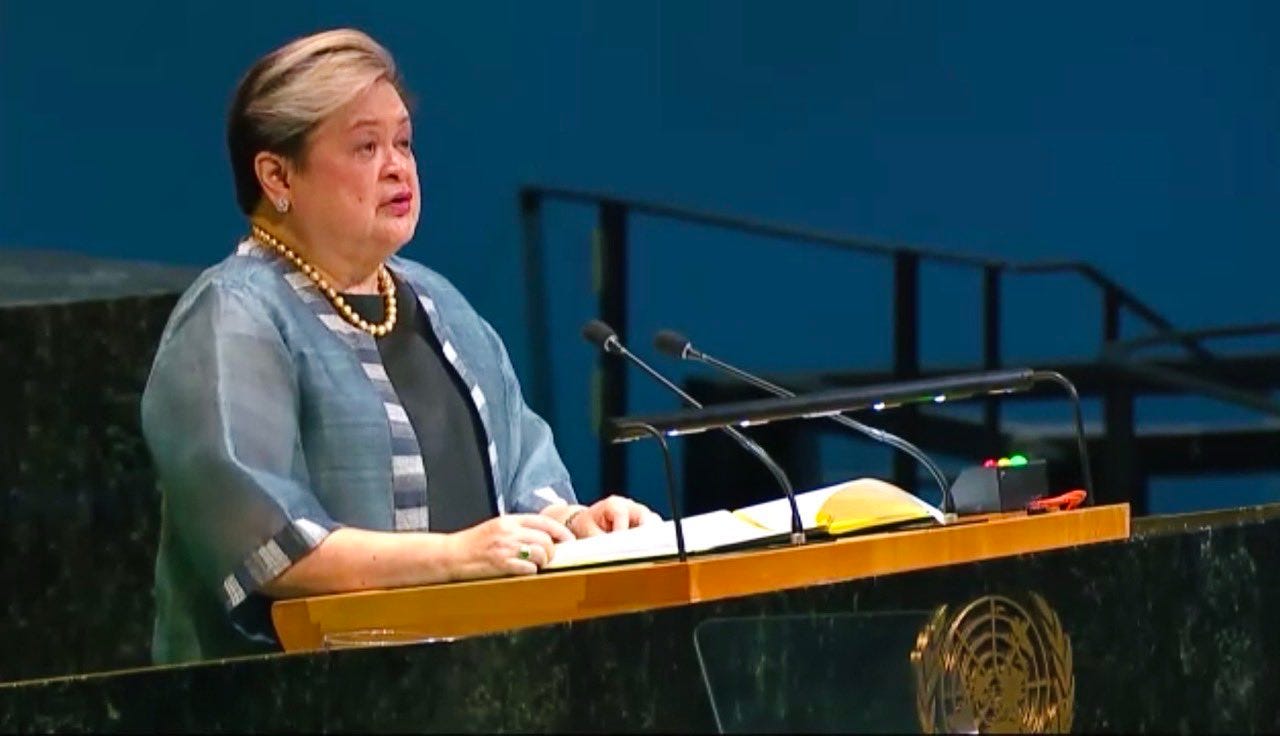
Foreign Affairs Secretary Ma. Theresa Lazaro delivering her statement during the UNGA80 General Debate last September 28, 2025. Photo from SFA Lazaro’s X account.
Anna Mogato | June 4, 2026
MANILA — The Philippines failed to get enough votes for the coveted non-permanent seat in the powerful United Nations (UN) Security Council, as Kyrgyzstan was elected to represent Asia.
After four rounds of voting, the United Nations announced the countries that won seats at the UN Security Council, including the Central Asian republic, Kyrgyzstan, which will sit on the council for the first time since joining the world body in 1992.
The other four countries that won seats were Austria, Portugal, Trinidad and Tobago, and Zimbabwe. All five countries will begin their two-year terms on January 1, 2027.
Nuclear weapons-states, such as China, France, Great Britain, Russia, and the United States, are the five permanent members of the UN Security Council, imposing sanctions on UN member-states and intervening in conflicts.
In a statement, Foreign Affairs Secretary Maria Theresa Lazaro thanked the international community for their support during the Philippines’ candidacy.
“Our campaign was anchored on our longstanding commitment to peace, dialogue, international law, and cooperation among nations,” Lazaro said.
“These remain principles that the Philippines will continue to uphold and advance in the global community.”
“The Philippines remains committed to working with all nations in pursuing peace, stability, sustainable development, and a rules-based international order,” Lazaro added.
Lazaro also congratulated the Kyrgyz Republic for winning a seat for the Asia-Pacific Group.
The Philippines has long campaigned for a non-permanent seat on the UN Security Council, with the intention of amplifying the interests of the Global South, such as climate change and migration.
Lazaro, in a previous media engagement, said that earning a seat could be an opportunity for the Philippines to champion a rules-based order, especially involving maritime territories.