


Manuel Mogato | Published: May 15, 2024
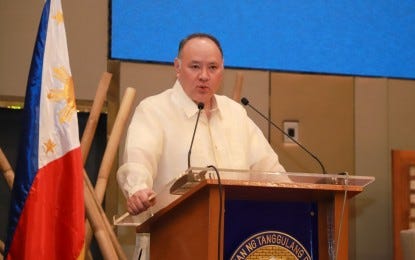
Manila – Defense Secretary Gilberto Teodoro Jr has proposed to increase the annual defense spending to at least 2 percent of the country’s gross domestic product, at par with other Southeast Asian states.
Teodoro said the military could not upgrade its equipment, bases, and soldiers’ skills with a budget of only 0.89 to 1.2 percent of GDP. Most Southeast Asian states spent about 2 to 2.5 percent of their GDP, except Singapore, which has a higher defense spending.
“We admit our capabilities are not optimal at the current time because we have begun our modernization in a way that needs more structuring, more inoperability, more sustainability, and more foundations,” Teodoro said at a Maritime Security Symposium in Quezon City, admitting the modernization program was “earnestly late in the day.”
“The rule that we learn is that a day that you postpone for increasing your military capabilities means perhaps two to three times more costs, not only in acquisition but in sustainment.”
He said China, the main threat in the West Philippine Sea, has been spending on defense capabilities by 7 percent even when its economy was cooling down. Its defense budget is about $232 billion.
Teodoro said the defense department would suggest to the president that the military budget be increased modestly, considering what the economy can afford. He did not give a figure.
However, Defense spokesman Arsenio Andolong said they propose increasing defense spending to 1.8 percent to 2 percent of the GDP. Based on official data, the Philippines’ GDP is nearly 6 trillion pesos. There were also reports the country’s GDP is about $370 billion.
The Philippines has less than 200 billion pesos in defense budget, with 60 to 70 percent going to personnel salary and allowances. Only about 20 to 30 percent went to operations and maintenance. The remaining 10 percent is allocated for capital outlay to build structures and facilities.
However, the military capability upgrade is covered by a separate trust fund. In 2012, Congress approved a 300 billion pesos modernization fund.
In December 2023, President Ferdinand Marcos Jr approved an ambitious 1.9 trillion pesos 10-year modernization plan under the third horizon to implement the Comprehensive Archipelagic Defense Strategy, enhancing its anti-access and area denial (A2AD) capabilities.
Teodoro said the Philippines is also getting support from allies, like the United States, Australia, Canada, and Japan, to train and equip local troops.
“We aim to enter into more partnerships with like-minded nations, enter into more status of visiting forces agreements with other countries,” Teodoro said.
“There are states that share the same values. They are aligned with our values that support our position in the West Philippine Sea and our stand against unilateral, illegal action by a theater actor that tries to bully us, change the narratives, and even subvert us within our own country.”
The Philippines has a Status of Forces, or Visiting Forces Agreement (VFA) with the US and Australia. It is negotiating a similar arrangement with Japan, called the Reciprocal Access Agreement.
These agreements provide a legal framework for the conduct of military exercises and training.
The Philippines regularly gets annual military aid from the United States through foreign military financing, excess defense articles, and other security programs.
From 2015 to 2022, the Philippines got $1.4 billion in small arms, drones, ships, and planes from the United States.
By next year, the Philippines is expecting to receive about $1 billion from two US Congress legislations, on top of the annual military aid from the Biden administration.
Australia and Canada have provided military education and training, particularly submarine training. Canberra also promised two Guardian-class coastal patrol boats.
Japan has provided 600 million yen aid to install air defense radars under its Official Security Act. In the past, it has donated five surveillance planes and 1 billion peso-worth of helicopter spare parts and airframes.