


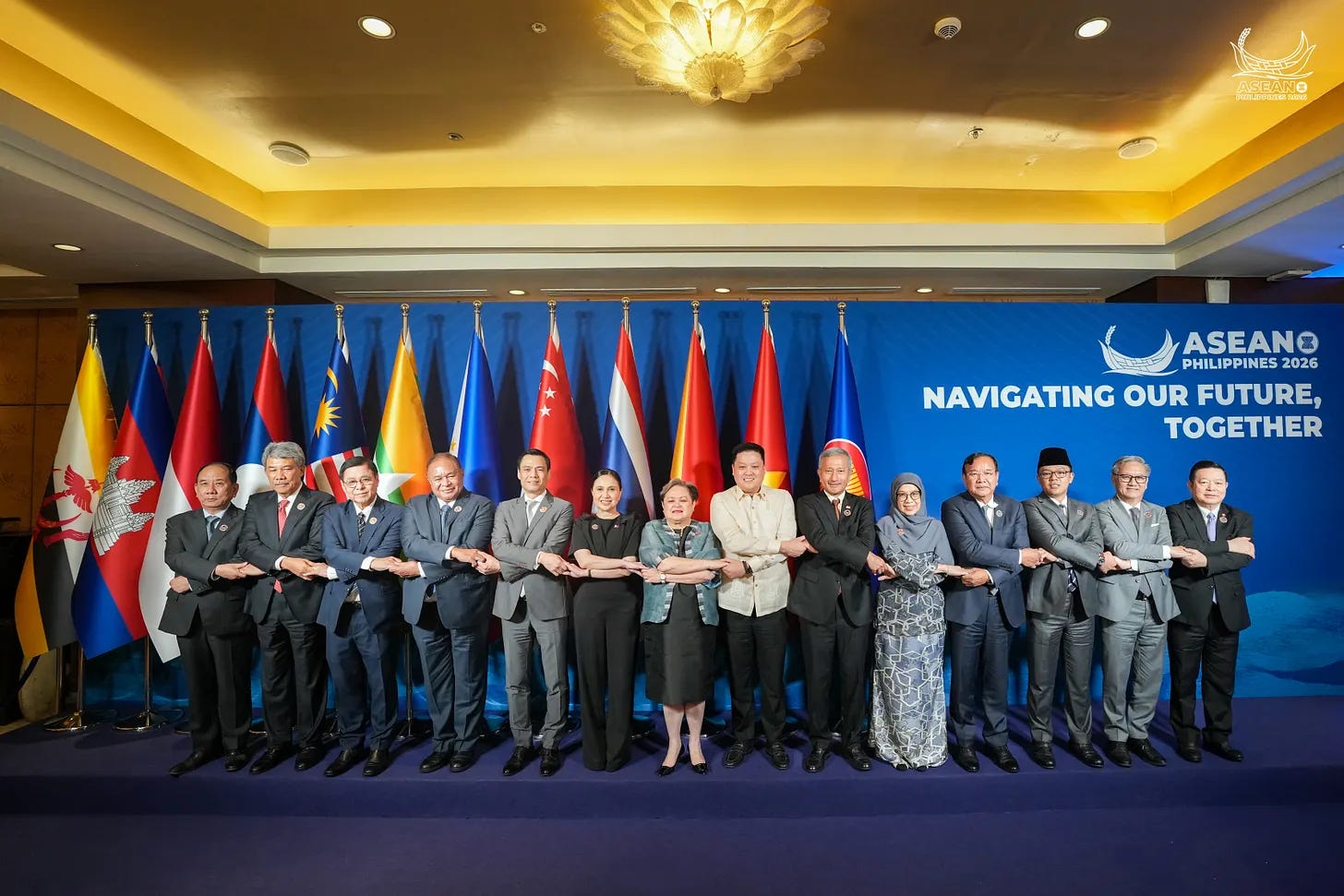
ASEAN Foreign Ministers pose during the 38th ASEAN Coordinating Council (ACC) Meeting. Official handout
Anna Mogato, Manuel Mogato | November 13, 2026
MANILA — President Ferdinand Marcos Jr. is expected to push for regional agreements to boost the economy at next week’s 49th Association of Southeast Asian Nations (ASEAN) Leaders’ summit.
Dominic Xavier Imperial, spokesman for ASEAN affairs, said the Philippines will focus on the digital economy, energy and food security, and protecting Filipino workers from scam hubs in Myanmar, Cambodia, and Laos.
On energy security, Imperial said ASEAN leaders are also expected to discuss setting up a regional oil stockpile to avoid energy supply issues brought by conflict in the Middle East and Eastern Europe.
During the 48th ASEAN Summit in May, Imperial recalled ASEAN agreed to prioritize energy security following the closure of the Strait of Hormuz, a crucial route for crude oil trade. Tight energy supply also impacts food security, he added.
“The leaders in May approved a study to be done on the oil stockpiling… and we hope for the identified center and agency to come up with the results of the study so that can also be fed into the results of this summit,” Imperial told a press briefing at the International Media Center.
“As for APSA (ASEAN Petroleum Security Agreement), the ratification process of each member state is ongoing. The Philippines was the first to ratify it, as a sign of our commitment. And I understand that, at the moment, there are now four or five countries that have ratified.”
Foreign Affairs Secretary Maria Theresa Lazaro told a radio interview that ASEAN ministers will sign a regional framework agreement on the digital economy that could benefit Filipino businessmen, tapping a $3 trillion market by 2030.
Lazaro said the ASEAN Digital Economy Framework Agreement (DEFA) could cut the cost of reaching regional customers and open new growth opportunities.
It would also give local entrepreneurs a stronger foothold in Southeast Asia’s expanding digital market, particularly small and medium enterprises (SMEs) traditionally held back by high costs and trade barriers.
Lazaro said the agreement seeks to make cross-border e-commerce easier and more accessible, allowing local manufacturers, exporters and smaller merchants to scale operations and compete for regional customers without costly overseas expansion.
Lazaro said ASEAN ministers also planned to take stronger actions against scam hubs in Cambodia, Laos, and Myanmar to protect workers trafficked into these illegal and criminal networks.
About 100 Filipino workers stranded in Myanmar sought assistance to be repatriated, victims of illegal recruitment in these countries.
Lazaro said ASEAN leaders will also agree on about 100 documents at the summit, including a review and decision on the five-point consensus in Myanmar, the adoption of the concept note and terms of reference for the planned establishment of an ASEAN maritime center, and transboundary haze.
ASEAN will also discuss regional security issues, including maritime security and territorial disputes, when ASEAN leaders meet with dialogue partners, such as China, Japan, South Korea, Australia, India, New Zealand, Russia, and the United States.
Marcos will also hold bilateral meetings with five world leaders, including US President Donald Trump, who is expected to stay in Manila only for a few hours on Tuesday.
Trump is also attending the Asia-Pacific Economic Cooperation (APEC) in China on Wednesday.