


Manuel Mogato | September 16, 2026
MANILA — The Philippines’ foreign ministry rejected China’s demand to pullout a rusting warship on a disputed shoal based on an agreement.
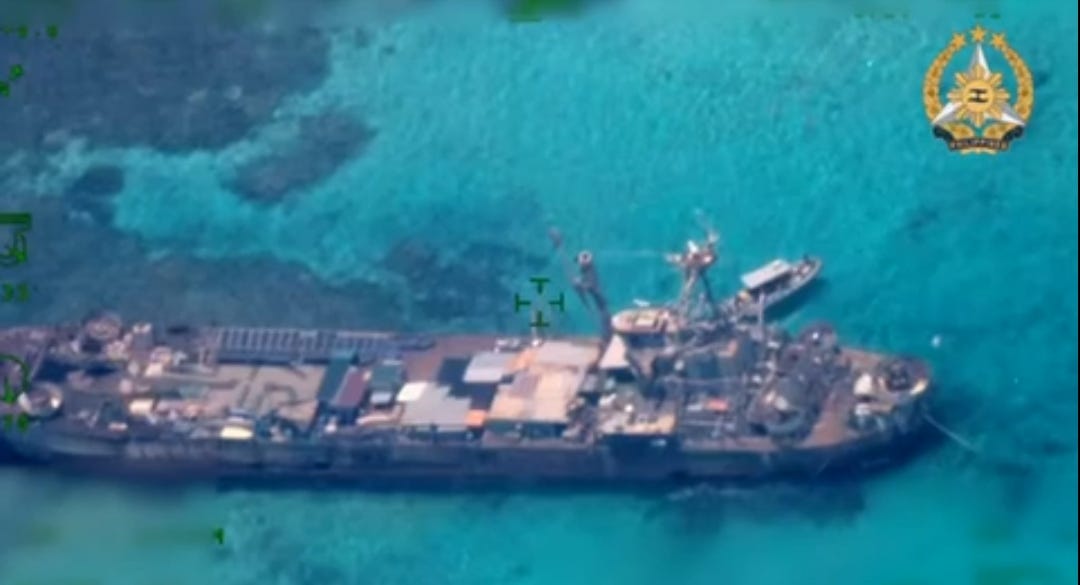
In a statement, the Department of Foreign Affairs (DFA) said the Philippines did not make a promise to remove BRP Sierra Madre on Ayungin Shoal. The old naval transport was deliberately grounded on the shoal in 1999.
“There is no agreement between the Philippines and China obligating the Philippines to remove the BRP Sierra Madre, a commissioned Philippine naval vessel permanently stationed in Ayungin Shoal,” the DFA said, responding to a Chinese embassy statement. (Also read: Marcos defends two-year deal with China on Ayungin)
“The Department reaffirms that Ayungin Shoal forms part of the exclusive economic zone and continental shelf of the Philippines, in accordance with the United Nations Convention on the Law of the Sea (UNCLOS) as upheld by the 2016 South China Sea Arbitral Award.”
The DFA said Ayungin is a low-tide elevation, and is not capable of generating maritime entitlements of its own and can neither be the subject of a sovereignty claim nor is it capable of appropriation under international law. (Also read: Philippines still seeks diplomatic route over South China Sea conflict)
It also said “China’s exercise of maritime law enforcement powers infringes on Philippines’ sovereign rights and jurisdiction in Ayungin Shoal and are violations of international law.”
China claims almost the entire South China Sea, a strategic waterway where $3 trillion trade passes annually. (Also read: Philippines demands China cease illegal occupation of Mischief and Subi Reefs)
Brunei, Malaysia, the Philippines, Taiwan, and Vietnam also have conflicting clams on the body of water believed to have rich deposits of energy and mineral resources.
The DFA said it also rejected the Chinese Embassy’s mischaracterization of the Philippine Maritime Zones Act (Republic Act No. 12064).
“The Act is an exercise of the Philippines’ sovereign prerogative to define and establish its maritime zones consistent with UNCLOS and international law,” it added.
Furthermore, DFA said the 2016 Arbitral Award is final and binding on the Philippines and China.
It was rendered by an arbitral tribunal constituted under Annex VII of UNCLOS — to which both the Philippines and China are States Parties.
“The Philippines calls on China to respect and fulfill its obligations under international law,” the DFA said.
The DFA also said the Philippines “remains committed to dialogue, diplomacy, and the peaceful settlement of disputes in accordance with international law. At the same time, it will continue to exercise its rights responsibly and peacefully and to undertake lawful activities to uphold its sovereignty, sovereign rights, and jurisdiction.”
