


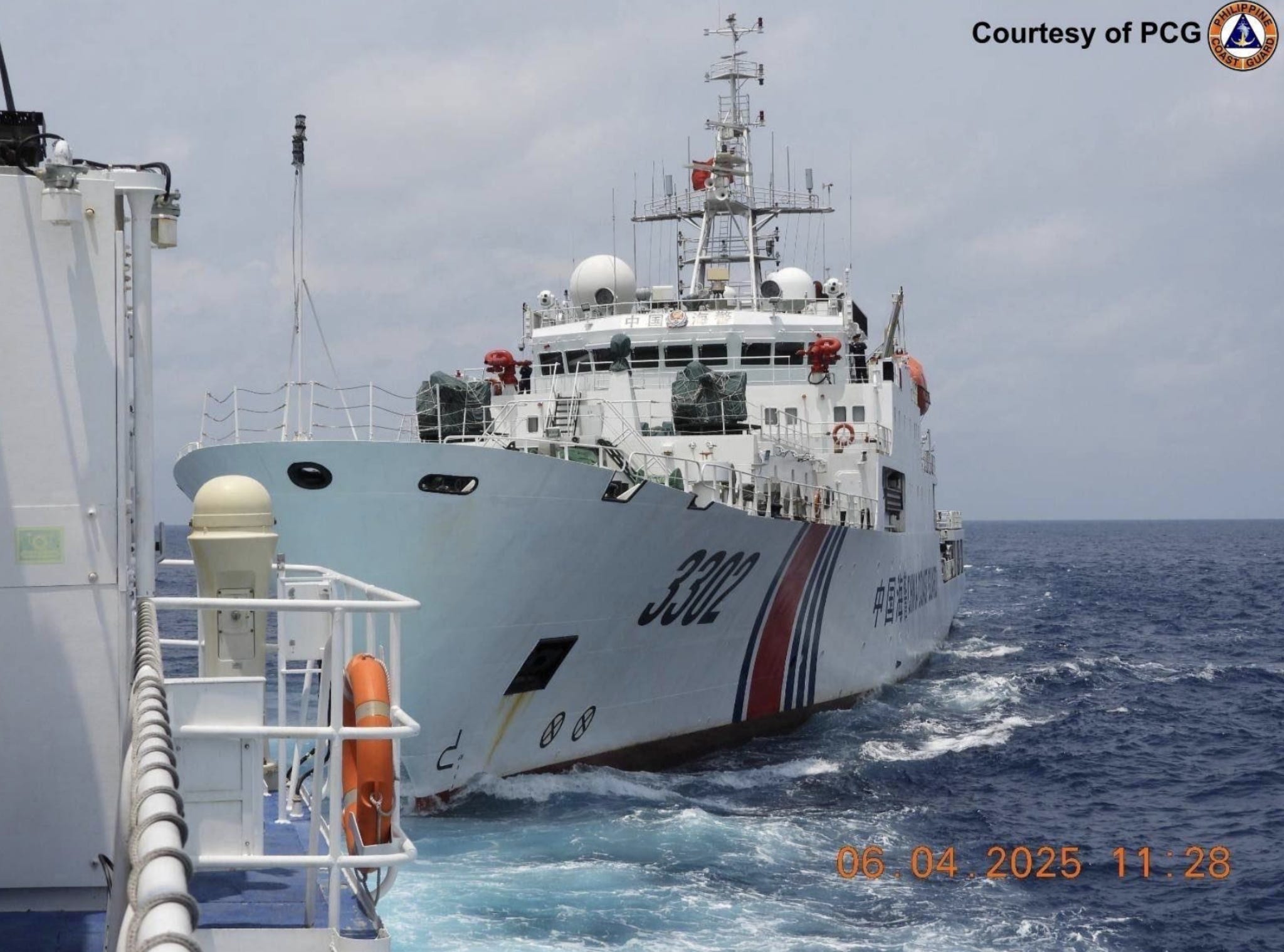
A Chinese Coast Guard vessel tailing a Philippine Coast Guard vessel. Photo from Philippine Coast Guard.
Manuel Mogato | March 17, 2026
Manila — The Philippines flatly rejected China’s repeated sovereignty claim on the West Philippine Sea, insisting it has no basis under international law.
Chinese Coast Guard vessels have been harassing Filipino public and fishing vessels, driving them away from Bajo de Masinloc by firing water cannons and ramming the smaller Philippine boats.
“The Philippines flatly rejects China’s assertion of indisputable sovereignty over the entire South China Sea,” Rogelio Villanueva, foreign affairs deputy assistant secretary and spokesperson for maritime affairs, said in a statement.
“This claim has no basis in fact, no basis in history, and no basis in international law.”
Villanueva was responding to the Chinese embassy’s “erroneous and misleading” statement on social media about China’s claim on Bajo de Masinloc and the Kalayaan Island Group. (Also read: Can The Philippines Peacefully Settle Territorial Disputes With China In West Philippine Sea?)
“The Department of Foreign Affairs firmly underscores the Philippines’ indivisible, incontrovertible and longstanding sovereignty over Bajo de Masinloc and the Kalayaan Island Group,” Villanueva said.
“Sovereignty is not merely claimed — it is exercised.”
A former soldier before he joined the foreign service, Villanueva said Bajo de Masinloc is part of the Philippines’ territory based on an 18th century map as well continuous and uninterrupted sovereignty and jurisdiction on the disputed areas.
He said the Philippines used before the Bajo de Masinloc as an impact area for maritime live fire training and blew up structures in the area in the past.
He said China could not show evidence of sovereignty and jurisdiction over Bajo de Masinloc before 2012.
“China must be reminded that maritime and territorial claims are subject to established international legal procedures and dispute settlement mechanisms — not to unilateral proclamations or social media posts,” he added.
Villanueva said China could not defend legally its sovereignty claim.
“China’s persistent evasion of proper international legal scrutiny speaks volumes: it betrays the utter baselessness of its positions,” he said.
“China’s conduct is a tacit admission that its claims cannot withstand legal scrutiny.”
China has seized control of Bajo de Masinloc in June 2012 after a three-month standoff with the Philippines.
Washington brokered a deal with Beijing to pull out from Bajo de Masinloc. Manila withdrew from Bajo de Masinloc but Beijing did not honor the deal. (Also read: Philippines challenges China in a “Go” game in the West Philippine Sea)
For more than a decade, China has deployed dozens of Navy, Coast Guard, and militia vessels around the disputed shoal, even after the Permanent Court of Arbitration (PCA) awarded the Philippines jurisdiction on Bajo de Masinloc in 2016.
