


Manuel Mogato | October 13, 2026
MANILA — The Philippines sent a Coast Guard aircraft and vessel to a disputed feature in the West Philippine Sea to challenge a Chinese vessel illegally conducting a research within the country’s maritime zone, a spokesman said.
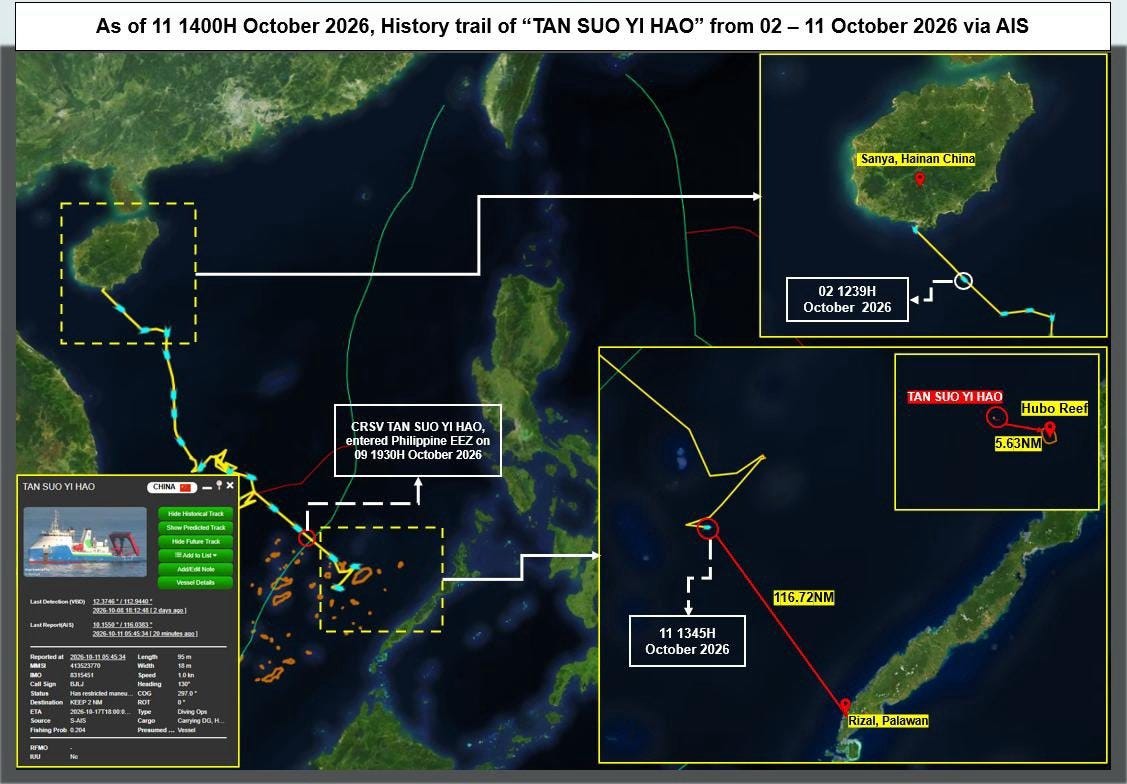
Rear Admiral Jay Tarriela said the Coast Guard dispatched a maritime law enforcement vessel to Hubo Ree, about 115-120 nautical miles from Rizal town, Palawan, to challenge a Chinese research vessel, Tan Suo Yi Hao, which is operating without authorization from the foreign ministry.
The Department of Foreign Affairs has confirmed that no request for consent was received from China for any marine scientific research to be conducted by Tan Suo Yu Hai in the Philippine EEZ. (Also read: Philippine Coast Guard challenges Chinese research vessel near Batanes)
Tarriela said the Coast Guard “challenged and disrupted the Chinese illegal marine scientific research (MSR), constantly sending radio challenges.”
The Philippines was alerted by the presence of Tan Suo Yi Hao in its exclusive economic zone (EEZ) by the Canadians through their satellite-based Dark Vessel Detection (DVD) and AIS tracking.
It immediately sends a surveillance plane to locate the exact position of the research vessel. (Also read: Chinese vessel conducts one month research in Bajo de Masinloc)
Based on the Dark Vessel Detection (DVD), the Coast Guard said the Chinese vessel left a port in Sanya, Hainan on October 2, passing through the western side of the South China Sea, and entered the Philippines’ maritime zone on October 9.
On October 10, the Chinese vessel was lying-to approximately 12 nautical miles northwest of Katimugan Bank, and declared through its AIS that it was engaged in diving operations with restricted maneuverability, while directing other vessels to keep two nautical miles clear.
It also declared an estimated time of arrival of 17 October 2026, indicating its intent to remain in the area for at least another week, Tarriela said.
But the Chinese vessel suddenly disappeared from the Coast Guard’s monitoring when the research vessel’s AIS went silent.
Tarriela said Tan Suo Yi Hao is operated by the Institute of Deep-sea Science and Engineering of the Chinese Academy of Sciences, based in Sanya.
It serves as a mothership for China’s deep-sea manned submersibles, including the Fendouzhe, and is equipped with deep-sea winches, sounding systems, and sediment collection devices for seabed investigation.
He said the Chinese research vessel was the first to openly declare diving operations inside the Philippine EEZ, and the one operating farthest into the southern portion of the West Philippine Sea.
The aircrew found the Chinese vessel approximately five nautical miles west-northwest of Hubo Reef, slowly navigating eastward.
Tarriela said it had not deployed submersibles, equipment, or lines in the water at the time of the overflight.
The aircraft issued multiple radio challenges to the Chinese research vessel, but all of which went unanswered, Tarriela added.
During the same flight, the aircraft also monitored China Coast Guard vessel CCG 5306 approximately 6.8 nautical miles south of Hubo Reef, and another China Coast Guard vessel approximately 12.7 nautical miles southwest of Hubo Reef.
Two People’s Liberation Army Navy vessels were likewise monitored in the surrounding waters, one approximately 22.8 nautical miles northeast of Escoda Shoal and the other approximately 11.3 nautical miles south-southeast of Katimugan
Coast Guard commander, Admiral Ronnie Gavan ordered the deployment of several vessels to directly challenge Tan Suo Yi Hao and disrupt its illegal activities within the Philippine EEZ.
The presence of a research vessel was the second time the Philippines monitored this month after driving another vessel in Batanes.