


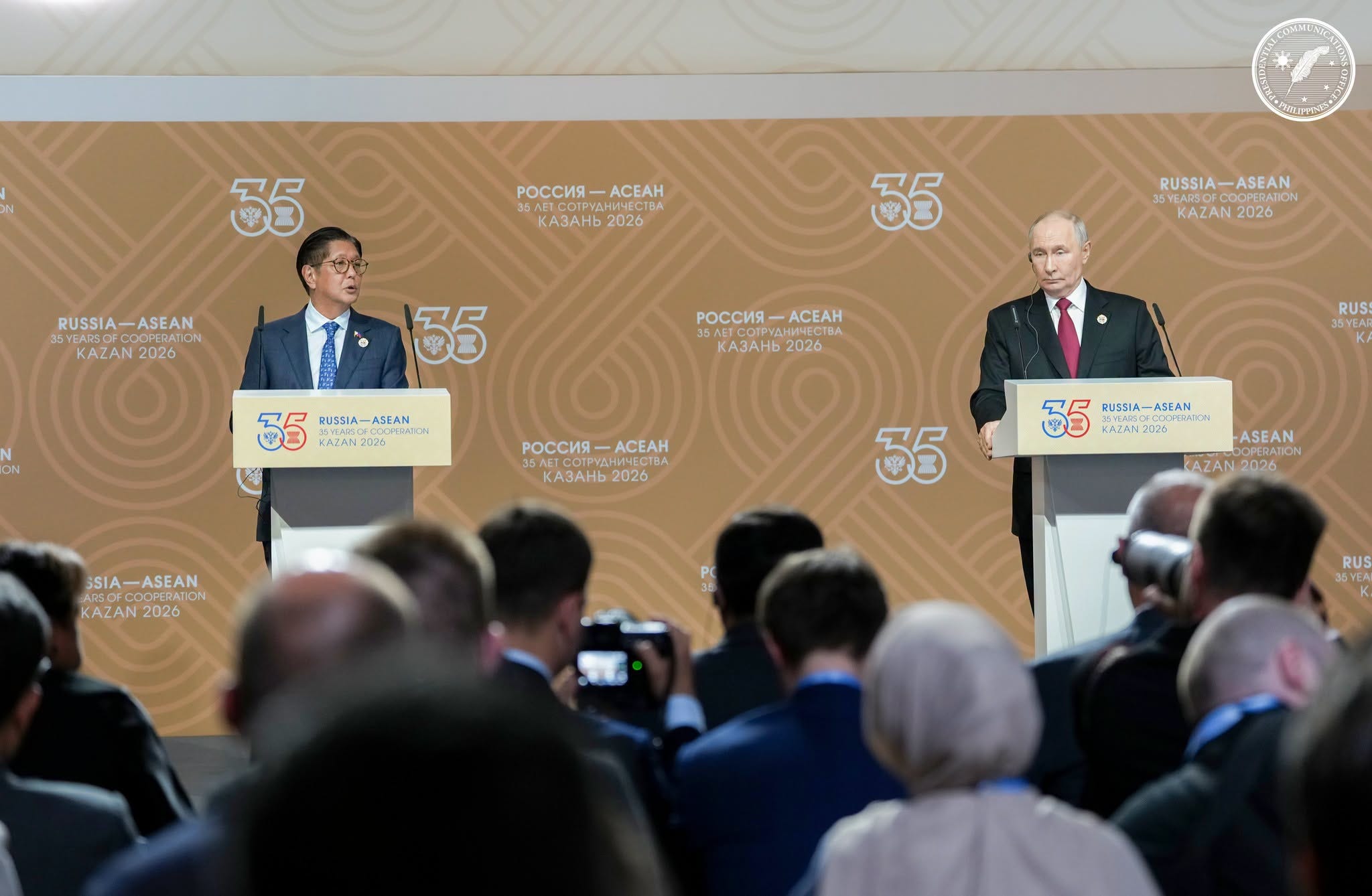
President Ferdinand Marcos Jr and President Vladimir Putin share the outcome of the ASEAN-Russia summit documents signed on Thursday, June 18. Official handout.
Manuel Mogato | June 21, 2026
MANILA — At the sidelines of the 35th commemorative relations between ASEAN and Russia in Kazan, President Ferdinand Marcos Jr and Russian leader Vladimir Putin held discussions on trade, energy, and food security, and more importantly, security.
Foreign Affairs Secretary Maria Theresa Lazaro mentioned the two leaders discussed the conflict in Ukraine. (Also read: Russian visit: Philippines expanding and diversifying relations)
Lazaro did not elaborate on the talks between the two leaders on Ukraine during her brief interview with state television done by Malacanang’s Radio-TV crew.
Of course, the Philippines is not taking sides in the four-year conflict, which has killed thousands and destroyed billions of properties and infrastructure.
The Philippines must only join the international community to call for an immediate end to the conflict and provide humanitarian assistance to the affected population.
The conflict only brought misery to the people in the two countries. It also affected the world as food and energy supplies were disrupted, fueling price increases, accelerating inflation, and slowing the growth rate.
But, somehow, Manila has been dragged into the war because Filipinos had been recruited by some foreign private military contractors (PMCs) to fight as mercenaries on both sides of the fence.
And some obscure and small Filipino companies have been unwittingly sending non-lethal supplies to European companies directly supporting the war.
There had been speculations that Putin only wanted the Philippines not to get directly or indirectly involved in the war, dangling oil and fertilizer supplies in exchange for staying neutral in the Ukraine conflict.
It is no secret that the United States and its European allies, through the North Atlantic Treaty Organization (NATO), have been trying to get more states, including those in the Indo-Pacific region, to be involved in the conflict.
They wanted other countries to provide military equipment and supplies to Ukraine, impose economic sanctions on Russia, or simply support political statements against Russia in the United Nations and other fora.
Uninterrupted military supplies to Kyiv not only prolong the conflict but inevitably spread weapons in Europe and other regions, possibly in the hands of extremist and criminal groups.
Some of these small weapons might end up in the southern Philippines, where small Islamist militant groups remained active. (Also read: Rebels raise funds using the ‘Toboso’ firefight)
A Trump administration official has warned that NATO arms earmarked for Ukraine find their way into the weapons black market.
For instance, a Pentagon official, Robert Storch, had earlier said it was impossible to track the location of portable missile systems, drones, and small arms.
In the Philippines, the Marcos administration must impose tight export restrictions to prevent small and medium-sized weapons and military supply enterprises from indirectly supplying the conflict through a third country with small arms, military gear, and combat equipment, including medicines.
The Philippines should avoid dragging itself into the conflict, on either side, and eventually damage its image as an independent state and as ASEAN chair. (Also read: The dangerous arms black market)
Ukraine has been offering to cooperate with the Philippines to build and mass-produce tactical drones, which may find their way into the European conflict.
The Philippines, of course, wanted to develop its own capabilities to manufacture drones, as the autonomous and unmanned aerial and surface vehicles are proven effective in conflicts, as shown in Venezuela, Iran, and Ukraine.
But it makes sure that exporting drones built with the help of Ukraine does not get into Eastern Europe.
The Philippines still has a long way to go in developing drones, but it can do it alone or with some technical assistance from Japan.
Marcos’ security discussions with Putin must be an eye-opener in dealing with the conflict in Ukraine. The Philippines must remain neutral. It should not let the United States, the European powers, or even Russia dictate its foreign policy.
As ASEAN chair, the Philippines must preserve the bloc’s centrality and neutrality and remain in the driver’s seat to navigate its direction.
