


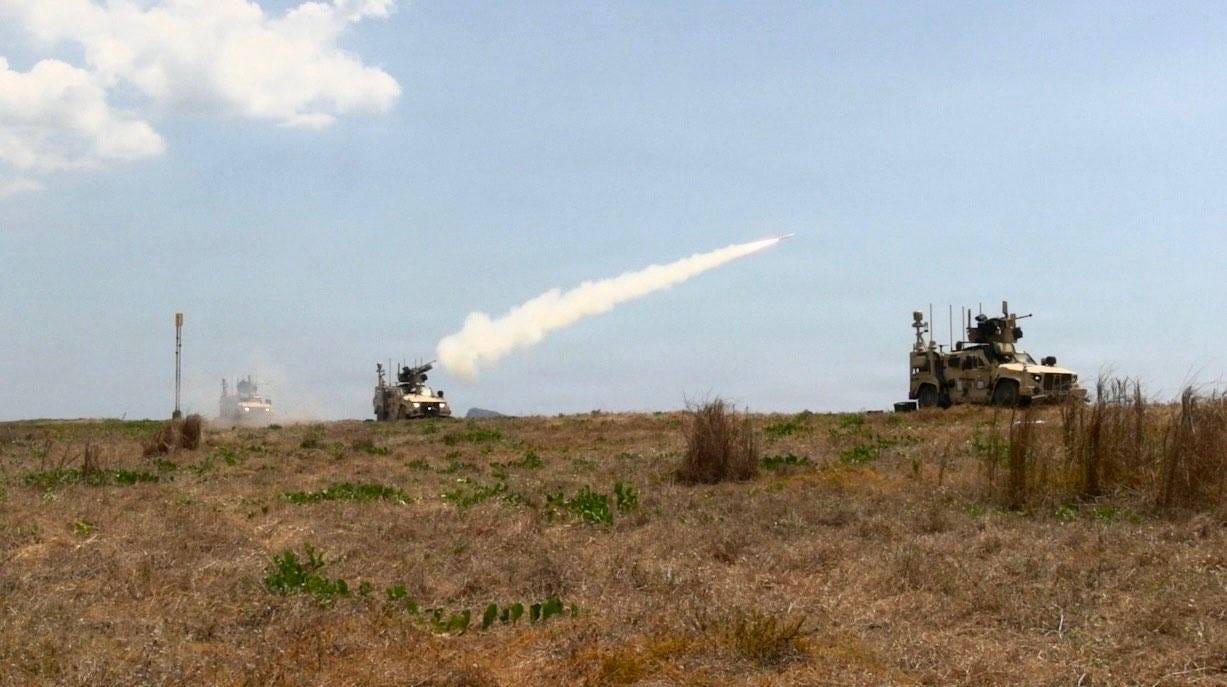
Photo from Exercise Balikatan Facebook page.
Manuel Mogato | April 30, 2026
SAN ANTONIO, ZAMBALES — The Philippines tested its Israeli-made air defense missiles against an imaginary enemy drones during an integrated air and missile defemse drills in northern Luzon, an Army spokesman said.
Major Anthony Pueblas, head of the Balikatan information bureau, said the Americans deployed the US Army’s AN/TWQ-1 Avenger while the US Marines used its Marine Air Defense Intergrated Systems (MADIS) to shoot down a swarm of imaginary drones during an exercise. (Also read:The Philippines needs counter-drone aircraft)
During the exercise, Pueblas said Philippine and US forces collaborated to detect, track, and engage simulated targets through a seamless sensor-to-shooter process.
“Early warning data from radar systems were analyzed and relayed to tactical units, enabling rapid engagement using the Philippine Air Force SPYDER Air Defense System alongside U.S. assets such as the U.S. Army’s Avenger and the U.S. Marine Corps’ Marine Air Defense Integrated System (MADIS),” he said.
“The integration of counter-unmanned aerial systems (c-UAS) technologies further enhanced the capability to counter aerial threats”.
Pueblas said the training brought together key air defense units, including the 3rd Light Air Defense Artillery Battalion (LAAB), E/6-52 35th Air Defense Artillery (ADA), and the 960th Air and Missile Defense Warning Detachment (AMDW). The exercise was observed by Japan Air Self-Defense Force (JASDF), reflecting a shared commitment among like-minded nations to regional stability and collective security.
He said: “The IAMD exercise underscored how coordinated, ground-to-air defense systems provide a robust defense against increasingly complex aerial threats”.
He said the training activities like IAMD continue to enhance interoperability and operational readiness among allied forces, ensuring a synchronized, responsive, and mission-ready defense of national airspace.