

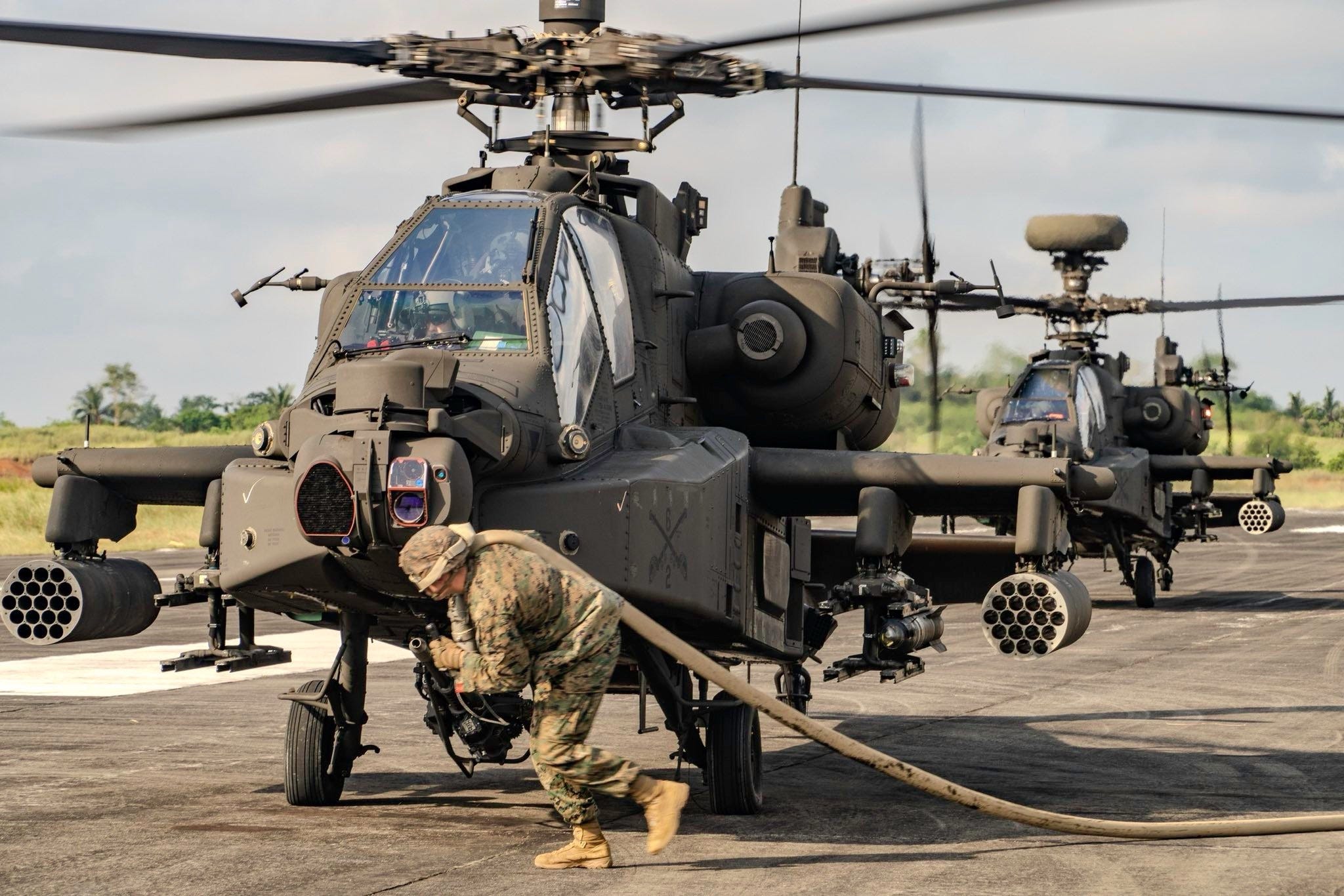
A soldier about to refuel a helicopter in Camp Melchor F. dela Cruz, Isabela province. US Marines with Marine Wing Support Squadron 174 and Army Aviators from the 25th Infantry Division refueled AH-64 Apaches and CH-47 Chinooks on May 8, 2025. Photo from Exercise Balikatan Facebook page.
By: Joe M. Reyes| Published: May 8, 2025
Reading Time: 4 minutes
Manila — Hundreds of Philippine and American troops sprang into action to repulse a “hostile force” attempting to land on the country’s shores, part of the 19-day annual joint “Balikatan” drills in northern Luzon.
Army Brigadier General Mike Logico, the Balikatan exercise director, said Filipino and American ground troops, backed by Sabrah light tanks, armored vehicles, 105mm and 155mm howitzers, pushed back the “hostile” amphibious forces in Aparri, Cagayan.
“In rapid response, joint Philippine-US forces executed a coordinated counter-landing operation to prevent them from establishing a foothold in the area, demonstrating combined strength and seamless interoperability,” Logico said.
Logico said the two sides “demonstrated the precision and combat readiness of allied forces and reinforced their shared resolve to protect strategic coastal areas and uphold maritime security in the Indo-Pacific region.”
The US deployed several F-16 multi-role fighters and AH-64 Apache attack helicopters to help ground troops repulse a landing force, played by an amphibious task group from the US and Philippine Navies.
Logico said the exercises started when a US surveillance plane, a P8 Poseidon aircraft, detected the amphibious task group about 50 miles off Cagayan’s coast line.
Subscribe to the API Newsletter
Bite-sized updates sent straight to your inbox.
Success!
First Name
Last Name
By signing up, you agree to our User Agreement and Privacy Policy & Cookie Statement. This site is protected by reCAPTCHA and the Google Privacy Policy and Terms of Service apply.
The US and Philippine ground forces sent columns of armored vehicles and light tanks on the shore to prevent a hostile landing.
The 105mm self-propelled howitzers and Autonomous Truck-Mounted Howitzer System (ATMOS155mm) opened fire at the amphibious task group.
Logico said it was the second live-fire simulation of a counterlanding drill after a similar activity last week in Palawan.
Military experts and observers said the counterlanding drills demonstrated the Philippines’ increasing anti-access and area denial (A2AD) capability under the Comprehensive Archipelagic Defense Concept.
In a way, the US also tested its countermeasures in case China invades the self-ruled island north of the Philippines.
To further demonstrate its advanced A2AD capability, the two militaries simulated a drill to sink an old warship off the coast of Zambales.
“We hope to achieve joint and combined interoperability and show the lethality of our weapon systems,” said Logico.
During the sinking exercises (Sinkex), US and Philippine assets took turns in striking the decommissioned BRP Miguel Malvar, a World War II destroyer escort vessel.
“We engaged it beyond 12 nautical miles (territorial sea), approximately 30 to 40 nautical miles off the coast of Zambales,” said Logico. “We will be engaging it using our combined and joint assets.”
Logico said the Philippine military sent its F-50 fighter jets and A-29 Super Tucano light attack aircraft.
The Philippine Navy tested its short-ranged Spike NLOS (Non-Line of Sight) missile system installed at its Acero-class fast attack interdiction craft.
The South Korean-made frigate, BRP Antonio Luna, fired its C-Star surface-to-surface cruise missile.
Logico said the US military had several F-16 and F-18 fighter jets and bomber aircraft.
The US Marines did not test-fire its NMESIS (Navy-Marine Expeditionary Interdiction System) anti-ship missile system.
The NMESIS arrived in the Philippines on April 14 and was deployed to Batan Island, Batanes, last April 26.
The Balikatan information bureau said this provided the two sides a “flexible and expedient sea denial capacity, contributing to the collective defense of both countries.”
This was the third maritime strike training under Balikatan since 2023, when BRP Lake Caliraya and BRP Pangasinan served as targets.
The post Philippines, US test joint counterlanding operations appeared first on asiapacificinsights.com.