

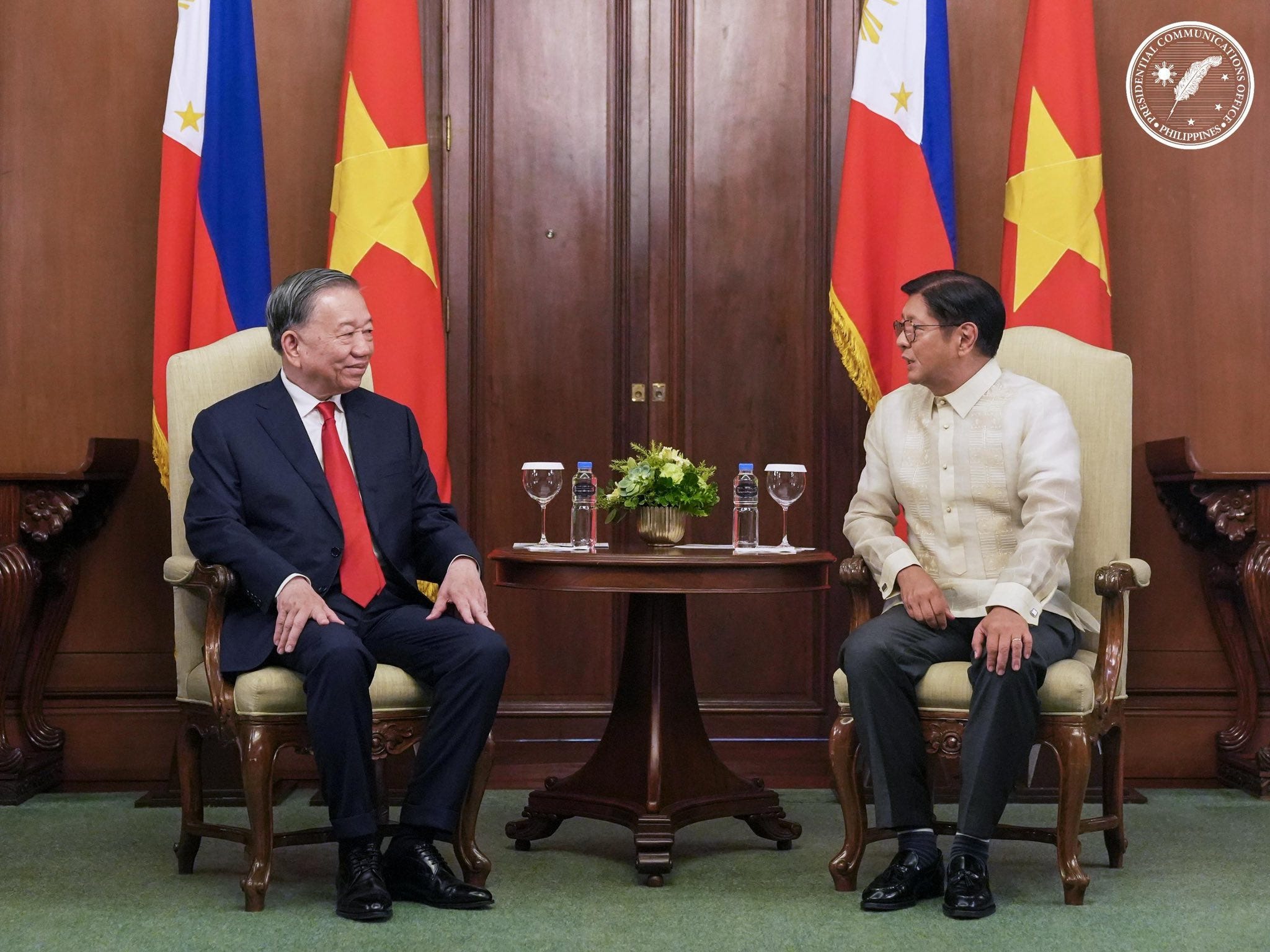
Vietnamese President Tô Lâm and Philippine President Ferdinand Marcos Jr. meet in Malacañang during President To’s first official state visit to the Philippines on Sunday, May 31. Official handout
Anna Mogato | June 1, 2026
MANILA — Southeast Asia’s two fiercest critics of Chinese expansion in the region agreed to raise bilateral relations to an enhanced strategic partnership, reaffirming shared commitment to peace and stability in the South China Sea.
The two Southeast Asian states, both claimants in the South China Sea, also agreed to strengthen joint capabilities in maritime security, disaster risk reduction and management, and military education. (Also read: Vietnam seals $700 million Brahmos deal with India)
In a statement, President Ferdinand Marcos Jr. said maintaining peace, stability, and freedom of navigation and overflight in the South China Sea “remains non-negotiable.” (Also read: Friends to all, enemies to no one)
“We stand resolute in our commitment to the peaceful resolution of disputes, grounded firmly in international law, particularly the 1982 United Nations Convention on the Law of the Sea (UNCLOS) and the 2016 South China Sea Arbitral Award,” Marcos said at a joint press conference with Vietnam’s President Tô Lâm.
Marcos hosted Tô for his first two-day visit to the Philippines since Tô became the general secretary of the Vietnamese Communist Party last year.
In a separate press statement, the two countries said they have agreed “to broaden collaboration in the defense industry and expand cooperation in areas such as military medicine, military logistics, defense trade, search and rescue operations, humanitarian assistance and disaster relief (HADR), maritime and aviation security, counter-terrorism, and peacekeeping efforts”.
Both the Philippines and Vietnam bore the brunt of the Chinese illegal, coercive, aggressive, and dangerous actions in the South China Sea. (Also read: South China Sea Must Avoid Becoming Hormuz)
Marcos said closer cooperation with Vietnam would boost deterrence as the two sides were committed to upholding international law, particularly the United Nations Convention on the Law of the Sea (UNCLOS).
Both countries agreed to institutionalize and sustain joint activities between “military services and maritime authorities, exchange of port calls and visits, and joint activities to respond to security issues at sea.”
The Philippines, currently serving as this year’s ASEAN chair, is looking to finalize the signing of the ASEAN-China Code of Conduct in the South China Sea. Vietnam has welcomed the 2016 UNCLOS arbitral tribunal ruling, which had sided with the Philippines. (Also read: ASEAN: Finding relevance in a burning world)
“They further reaffirmed the importance for all parties to exercise self-restraint in the conduct of activities that could escalate tension, which in turn could affect peace and stability in the South China Sea,” the statement read.
The statement added that the state leaders agreed to enhance existing maritime cooperation mechanisms and to “resolve maritime incidents through peaceful and amicable means in accordance with international law.”
Marcos and Tô are expected to meet again during the upcoming ASEAN Future Forum 2026 in Ha Noi next week.
State leaders will discuss regional resilience amid the changing geopolitical landscape.