


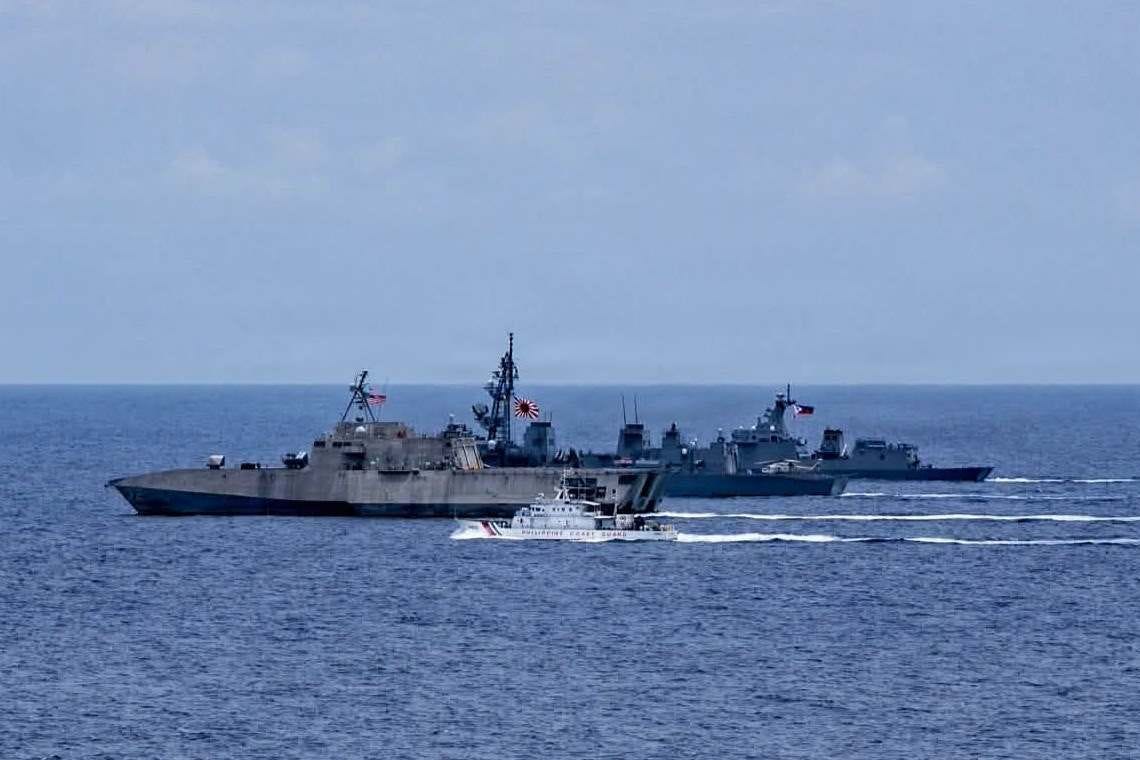
The U.S. Navy littoral combat ship USS Santa Barbara, second from front, sails in formation with the Philippine Coast Guard patrol vessel BRP Malabrigo, front, and the Japan Maritime Self-Defense Force destroyer JS Yudachi, third from front, and frigate BRP Antonio Luna, back, during a multilateral maritime cooperative activity in the Philippines' exclusive economic zone, July 24, 2026. Photo by Navy Petty Officer 2nd Class Caylen McCutcheon.
Manuel Mogato | August 10, 2026
MANILA — The Philippines ignored China’s demand to abandon its “lawful” activities near Bajo de Masinloc, insisting the disputed shoal is within its maritime zone under international law.
In a statement, defense spokesman Arsenio Andolong said Manila rejected the Chinese Ministry of National Defense’s call to abandon the Philippines’ initiatives and position regarding Bajo de Masinloc (BDM)
Beijing has “patently and falsely characterized Philippines’ lawful actions in Bajo de Masinloc actions, which is within Philippine territory and maritime areas, Andolong added. (Also read: China removes “floating platform” near Bajo de Masinloc)
“BDM is an integral and longstanding part of the Philippine national territory, and its maritime zones and entitlements, as established by the Philippines, are strictly in accordance with the United Nations Convention on the Law of the Sea (UNCLOS) and the final and binding 2016 Arbitral Award,” he said in a statement. (Also read: Philippines still seeks diplomatic route over South China Sea conflict)
“The recent submission by the Philippines of the updated nautical chart to the United Nations provides the necessary legal clarity and due publicity to the international community on the geographical limits of our maritime zones in Bajo de Masinloc.”
Frictions increased near Bajo de Masinloc between the Philippines and China, with water cannon incidents and Chinese Coast Guard dangerous maneuvers.
“The Philippines will continue the lawful exercise of its sovereignty over BDM,” Andolong said. “We will not be deterred by China’s false narratives and hooliganism, as evidenced by its continued aggressive activities and attempts to distort history and the rules-based international order.”
China claims almost the entire South China Sea, a strategic sea lane where $3 trillion goods pass annually.
Brunei, Malaysia, the Philippines, Taiwan, and Vietnam also have conflicting claims in the South China Sea, believed to have rich deposits of energy and mineral resources. (Also read: Philippine Defense Secretary calls on ASEAN to support a rules-based order in the South China Sea)