


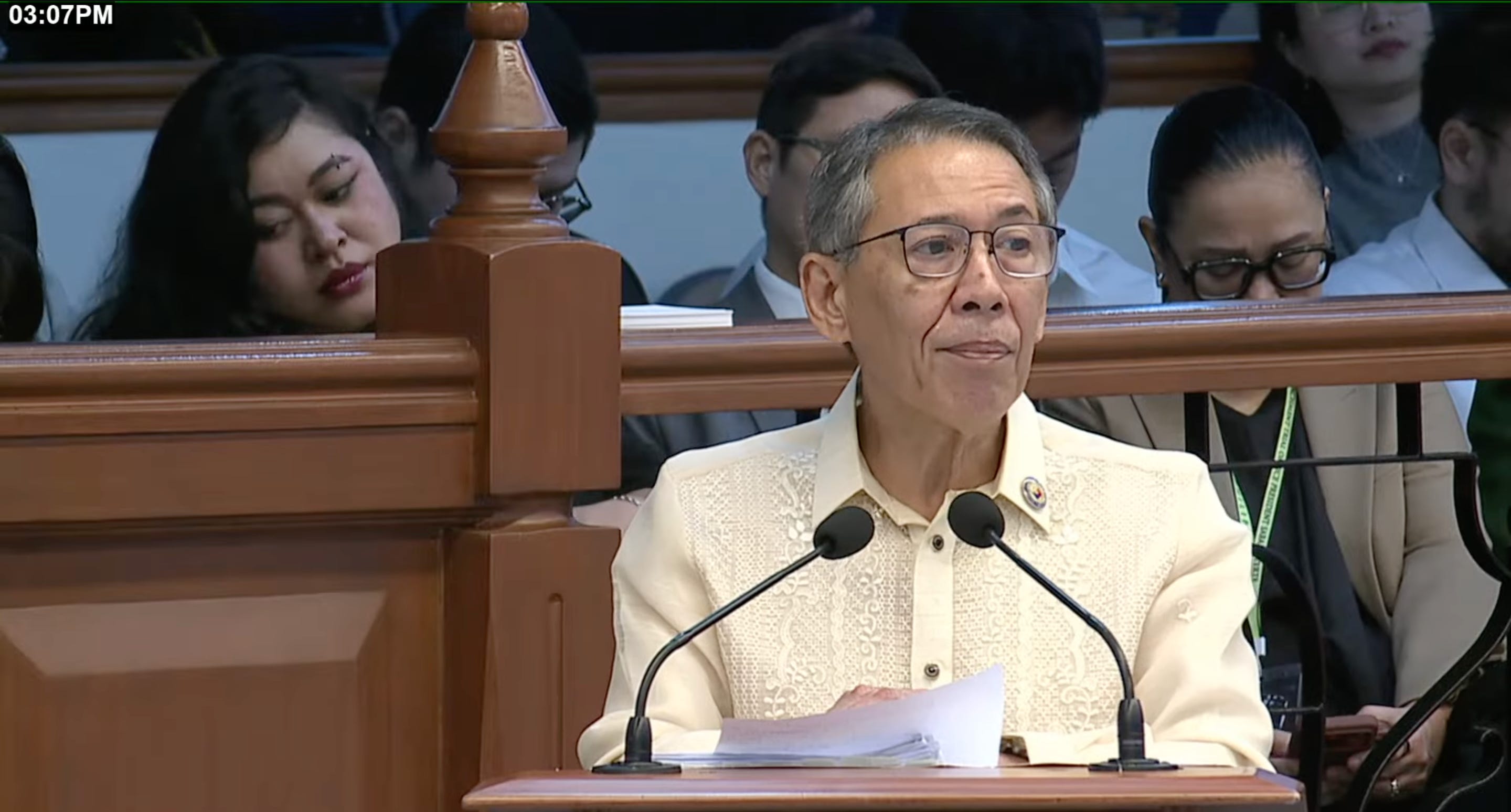
Akbayan Partylist representative Jose Manuel Tadeo "Chel" Diokno spoke on behalf of the House Prosecution panel to convince the Senate Impeachment Court to approve the subpoena of Vice President Sara Duterte’s bank and tax records. Screengrab from livestream.
Manuel Mogato, Anna Mogato | July 15, 2026
MANILA — Representatives from the prosecution and defense argued on Wednesday before the Senate impeachment court on the approval to subpoena bank and tax records of Vice President Sara Duterte.
The bank and tax records being requested by the prosecution panel are to show that Duterte had allegedly amassed ill-gotten and unexplained wealth from two decades in public office.
The evidence falls under the case on unexplained wealth, the third article of impeachment against the vice president. The Senate Impeachment Court will deliver its decision whether to supboena the bank and tax records on Monday.
House prosecutors urged the impeachment court to approve their request for subpoenas covering Vice President Sara Duterte’s bank records, tax documents, and records from the Anti-Money Laundering Council (AMLC).
House prosecutor Rep. Chel Diokno said the documents are essential in establishing the facts behind the allegations against the Vice President.
Diokno argued the request aims to ensure the court has access to all relevant evidence needed to determine the truth.
“Ang hiling ng prosecution ay mailabas ang buong katotohanan, so that this Court may know the truth, the whole truth, and nothing but the truth,” Diokno said.
(The prosecution’s request is to release the whole truth, so that this Court may know the truth, the whole truth, and nothing but the truth.)
The defense, meanwhile, objected to the prosecution’s motion seeking subpoenas for Duterte’s bank, tax, and AMLC records. (Also read: Defense panel tries to discredit prosecution’s witness at impeachment trial)
Defense counsel Atty. Michael Poa opposed the prosecution's request to issue subpoenas for Vice President Sara Duterte's bank records, tax documents, and AMLC records, arguing that such a move violates the principles of due process.
“When a subpoena becomes oppressive, when it is unreasonable, and when it is merely issued for the very purpose that there is a hope, that somewhere, somehow, something incriminating will come out, it ceased to be an instrument of justice,” Poa said.
“It becomes a weapon of a fishing expedition, and that is exactly what confronts this very court today, and that is why the defense has taken the position that the prosecution’s request must be denied.”
Poa said that the evidence must be present to support each and every accusation against the Vice President, but noted that the complaints filed against Duterte at the House of Representatives accusing her of amassing unexplained wealth did not include a “single financial transaction record, not even a single [Statement of Assets, Liabilities, and Net Worth].”
“In our legal system , it is not permitted to accuse now, and then just look for proof later on. That is not how due process works,” Poa added.
The Defense panel also noted that accessing records from as early as 2007, when Duterte was still serving as Davao City vice mayor, should not be included as that position is not an impeachable office.
Diokno, however, said that there is an exception for impeachment to counter the Defense’s claim that there is not provision to allow bank and tax records to be made public.
“And in fact, during the Corona impeachment trial, the president, at that time, did order, and that is why this court admitted the BIR documents,” Diokno added.
“Your Honors, it is easy to say that the information and documents are confidential, it’s easy to teach the law. But what the impeachment court is looking for now, in the coming days, weeks and months, is the truth, and the goal is to hold accountable.”
“Confidentiality, Your Honor, should not be the prevailing principle in this proceeding. Truth is not confidential.”