


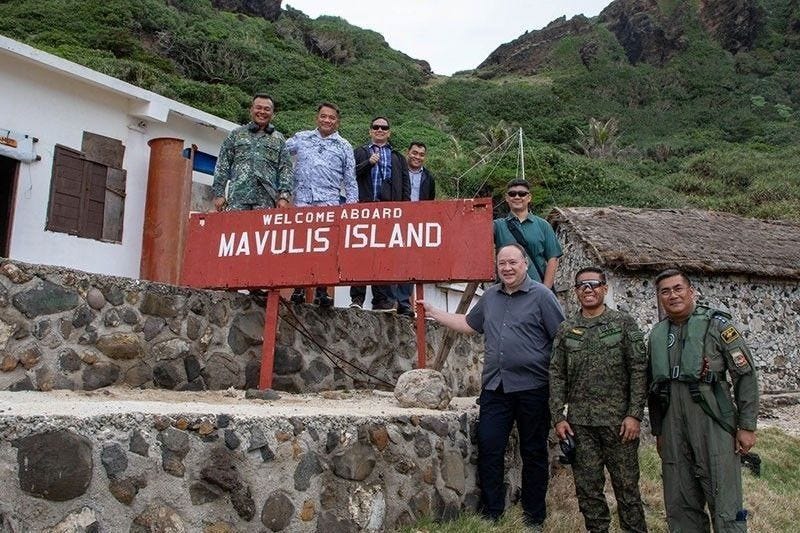
Defense Secretary Gilberto Teodoro Jr. with military officials in Mavulis Island, Batanes last February 6, 2024. Official handout.
Rommel C. Banlaoi | September 10, 2026
While the recent Global Times article has questioned Philippine sovereignty over Batanes, the Philippines must respond with clarity. Sovereignty over Batanes is firmly grounded in international law, historical treaties, and daily lives of the Ivatan people.
The legal foundations of Philippine sovereignty are solid. The Treaty of Paris of 1898 ceded to the United States “the archipelago known as the Philippine Islands” within a set of geographic coordinates. Batanes lies within those boundaries, and its inclusion in Philippine territory was later clarified by the 1900 Treaty of Washington, which covered any islands not specifically named in the 1898 treaty.
Upon independence in 1946, the Philippines inherited full sovereignty over its territory, recognized by the international community. Since then, Batanes has been governed continuously under Philippine law, with its people participating in national elections and enjoying the rights and responsibilities of Filipino citizenship. Effective administration and recognition are the decisive criteria of sovereignty, and the Philippines meets both beyond reasonable doubt.
While cultural and historical ties between Batanes and Taiwan are undeniable, they do not determine claims to sovereignty. The Ivatan people share Austronesian roots with communities in southern Taiwan, and centuries of trade brought Chinese artifacts to Batanes. (Also read: Teodoro calls China’s claims on Batanes a “joke”)
Yet cultural affinity and historical contact do not equate to political ownership. Sovereignty is determined by treaties, governance, and recognition. To suggest otherwise would destabilize borders across Southeast Asia, where cultural overlaps are the norm rather than the exception.
Importantly, the Ivatan people are Filipinos not only by citizenship but also by genetic and ethnolinguistic identity. Studies show that they are closely related to other ethnic groups in Northern Luzon, reinforcing their place within the Philippine nation. At the same time, they share close linguistic and cultural affinities with the Tao people of Orchid Island in Taiwan.
This dual identity highlights the richness of Austronesian heritage, but it does not diminish their Filipino nationhood. Rather, it underscores the Philippines’ role as a bridge between cultures, where diversity strengthens unity.
While inaccurate narratives of some Chinese scholars may attempt to challenge Philippine sovereignty, the Ivatan people themselves strongly affirm their Filipino identity. They elect local and national leaders, serve in the Philippine armed forces, and contribute to the nation’s cultural richness. To cast doubt on their citizenship is not only legally untenable but also dismissive of their deeply sedimented Filipino identity. Sovereignty is embodied in the daily lives of citizens who identify as part of the Philippine nation.
While defending sovereignty is paramount, friendship with China remains essential. Centuries of interaction have created deep bonds between our peoples. Trade, migration, and cultural exchange have enriched both societies. Today, common concerns such as maritime safety, fisheries management, disaster preparedness, and regional stability demand collaboration. These are areas where Philippine–Chinese cooperation can flourish, provided it rests on mutual respect and equality.
While some may view sovereignty and cooperation as contradictory, they are in fact complementary. The Philippines must pursue a balanced foreign policy: firm in defending sovereignty, yet open to dialogue and cooperation. Friendship with China is essential, but it cannot be built on narratives that delegitimize Philippine territory. Cooperation must be grounded in clarity, law, and respect asserting rights while building bridges.
While the Global Times article is a reminder that narratives can shape perceptions, the Philippines must respond with facts, law, and the daily realities of its people. Batanes is unequivocally Philippine territory. At the same time, the Philippines must continue to engage China constructively, recognizing shared interests and common concerns.
Sovereignty and friendship are not mutually exclusive. By defending one and pursuing the other, the Philippines can contribute to peace, stability, and cooperation in the region.
Rommel C. Banlaoi, PhD, is Director of the PhilippinesChina Studies Center at Diliman College and President of the Philippine Society for International Security Studies. He also served as President of the Philippine Association for Chinese Studies.