

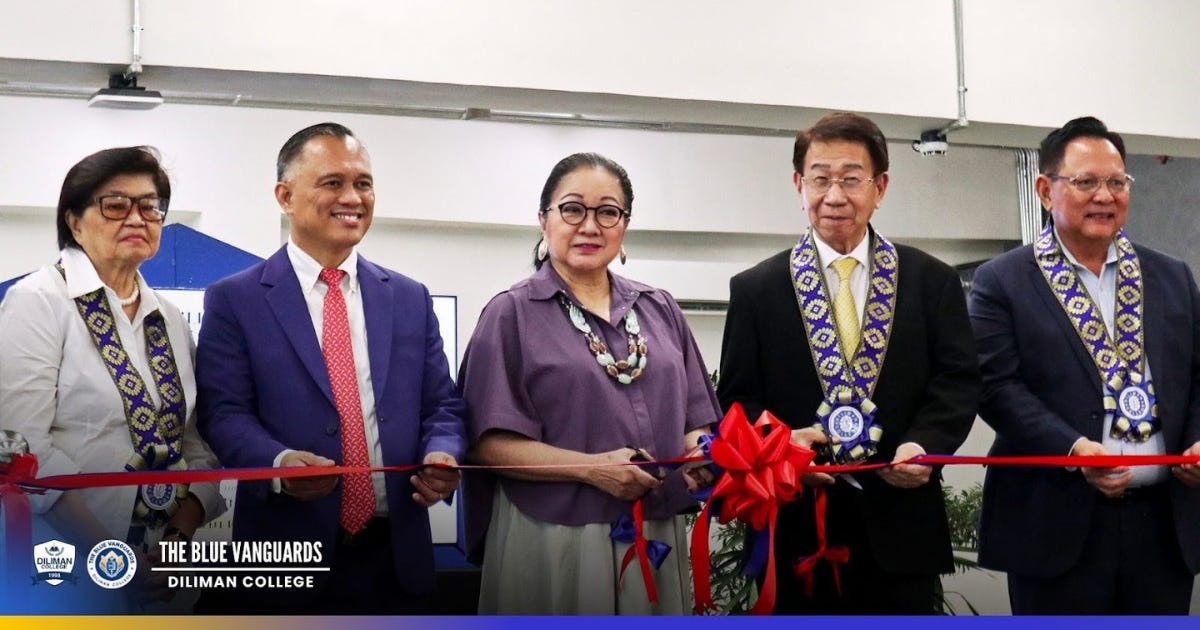
Ribbon cutting ceremony of the Philippine-Chinese Studies Center at Diliman College, Quezon City. L-R: Former national security adviser Clarita Carlos, PH-Chinese Studies Center Director Rommel Banlaoi, Diliman College President Nikki Coseteng, Federation of Filipino-Chinese Chambers of Commerce and Industry, Inc. President Victor Lim, and Association for Philippines-China Understanding Chairman Raul Lambino. Photo from Diliman College.
By: Manuel Mogato | Published: November 4, 2025
Reading Time: 3 minutes
Manila – A school in the capital opened an academic center that will promote better understanding of China at a time of rising tensions in disputed areas in the South China Sea.
Rommel Banlaoi, director of the Philippine-Chinese Studies Center at Diliman College in Quezon City, said the research institution aims to create awareness and understanding of China’s culture, politics, and economy.
Banlaoi said the Philippine-Chinese Studies Center aimed “to overcome the extent of Filipino public ignorance” and generate “real empirical knowledge essential to promote mutual understanding.”
“There is so much misunderstanding, and to be blunt, enormous ignorance of the Filipino people on the various aspects of Philippines-China relations.”
He said it could be why Filipinos have a very negative attitude towards China, based on opinion surveys. (Also read: Philippines wins more support against China as it celebrates the 9th anniversary of the tribunal victory)
Subscribe to the API Newsletter
Bite-sized updates sent straight to your inbox.
Success!
First Name
Last Name
By signing up, you agree to our User Agreement and Privacy Policy & Cookie Statement. This site is protected by reCAPTCHA and the Google Privacy Policy and Terms of Service apply.
The research center will facilitate academic collaboration, policy dialogues, and people-to-people exchanges between the Philippines and China to foster greater understanding, Banlaoi added.
The research center opening last month came at a time when China’s influence operations face heightened scrutiny in various parts of the world, including in the Philippines, where concerns are intensified by the West Philippine Sea dispute, maritime confrontations, and reported Chinese interference and espionage activities.
The Chinese government-funded language and cultural education centers known as Confucius Institutes — mostly located in universities worldwide — have been criticized for being used as political and propaganda tools.
Banlaoi was a former defense department assistant secretary and deputy national security adviser but was removed when senior military officials complained that he had a pro-China view.
The post Reshaping China’s image through education appeared first on asiapacificinsights.com.