

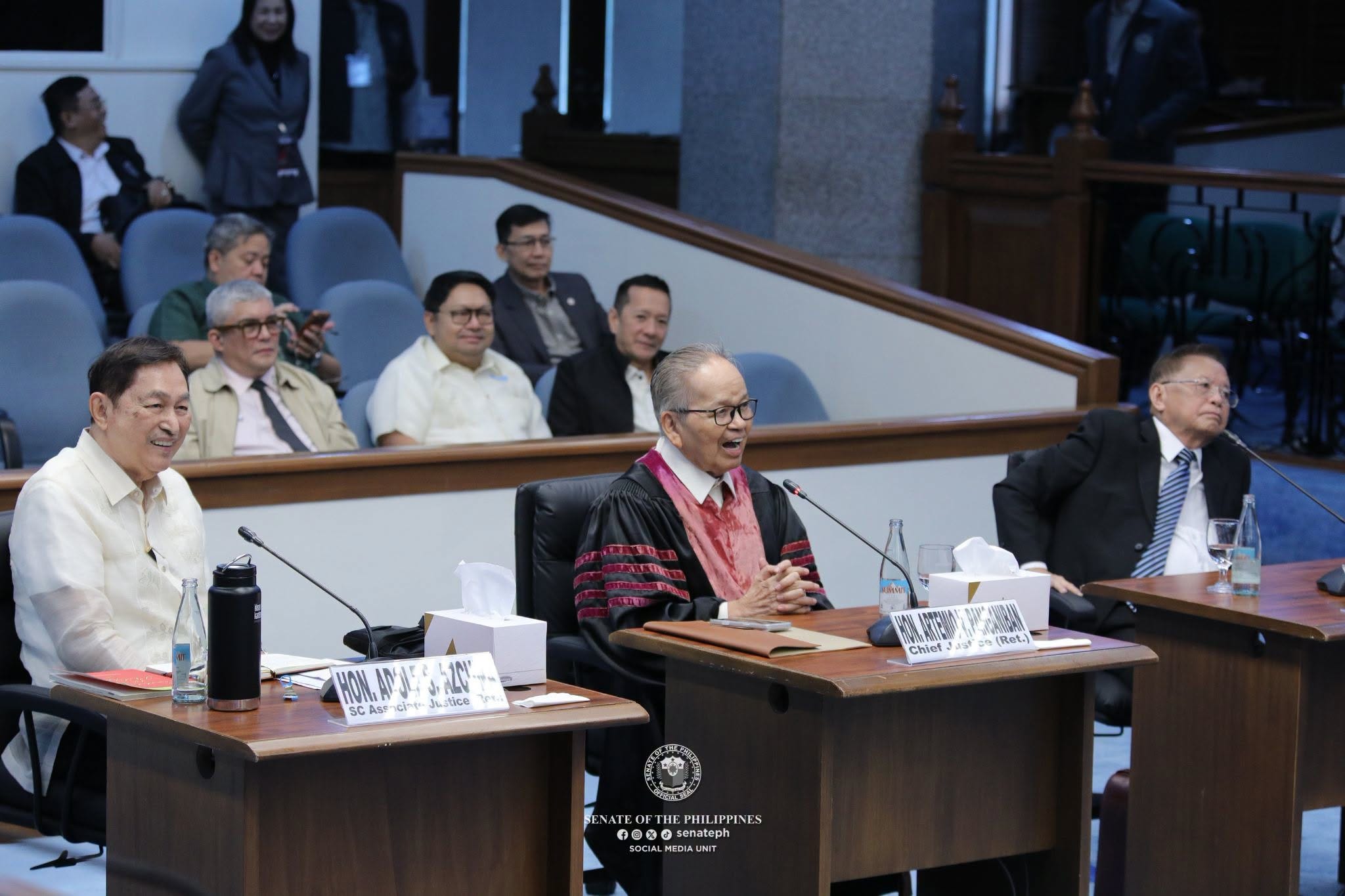
Former Chief Justices Artemio Panganiban and Reynato Puno, and retired Associate Justice Adolf Azcuna shared their opinion on the two-thirds voting threshold of the Senate impeachment court on Wednesday, September 16, 2026. Photo by Wendell Alinea | Senate Social Media Unit.
Manuel Mogato | September 17, 2026
MANILA — Retired Supreme Court justices said the high court cannot intervene on the Senate impeachment court’s decision on the case of Vice President Sara Duterte as a co-equal branch of government.
The Senate impeachment court took a break from the trial and asked legal experts to weigh in on the issue after Senator Erwin Tulfo questioned an earlier ruling of the presiding chair, Francis Escudero, to set the threshold at 16.
The senator-judges will decide next week to settle the issue.
The Senate impeachment court has asked three former chief justices who served under former President Gloria Macapagal Arroyo, and a retired senior associate justice to help guide the senator-judges decide to lower the voting threshold to convict the vice president.
Under the 1987 Constitution, two-thirds are required to convict an impeachable official, including the president and the vice president.
There are 24 elected senators and, therefore, 16 are needed to convict and eight are needed to acquit the impeachable official.
However, three of the retired chief justices, invited as amici curae or friends of the court, believed the voting threshold is movable because not all senators have been participating in the trial.
Two are under detention for plunder charges, one is hiding after an arrest warrant was issued by the International Criminal Court (ICC), and a fourth was outside the country seeking medical treatment.
They said it is absurd to allow these senators to vote when they did not hear and see the witnesses’ demeanor during trial.
One retired chief justice argued that the Constitution should have set the threshold at 16 votes but it set at two-thirds, a movable and flexible number.
One argued the voting threshold should remain at 16 votes unless a senator is expelled, permanently incapacitated, or died.
However, he is leaving to the senator-judges to allow absent members of the Senate to vote or not.
The retired justices said the Supreme Court cannot intervene and the Senate court’s decision is final.
One former magistrate said the Senate is not under the Supreme Court and the proceedings is not purely legal but political.
Besides, the senator-judges are not jurists or lawyers, but would decide on the case on the basis of accountability.