


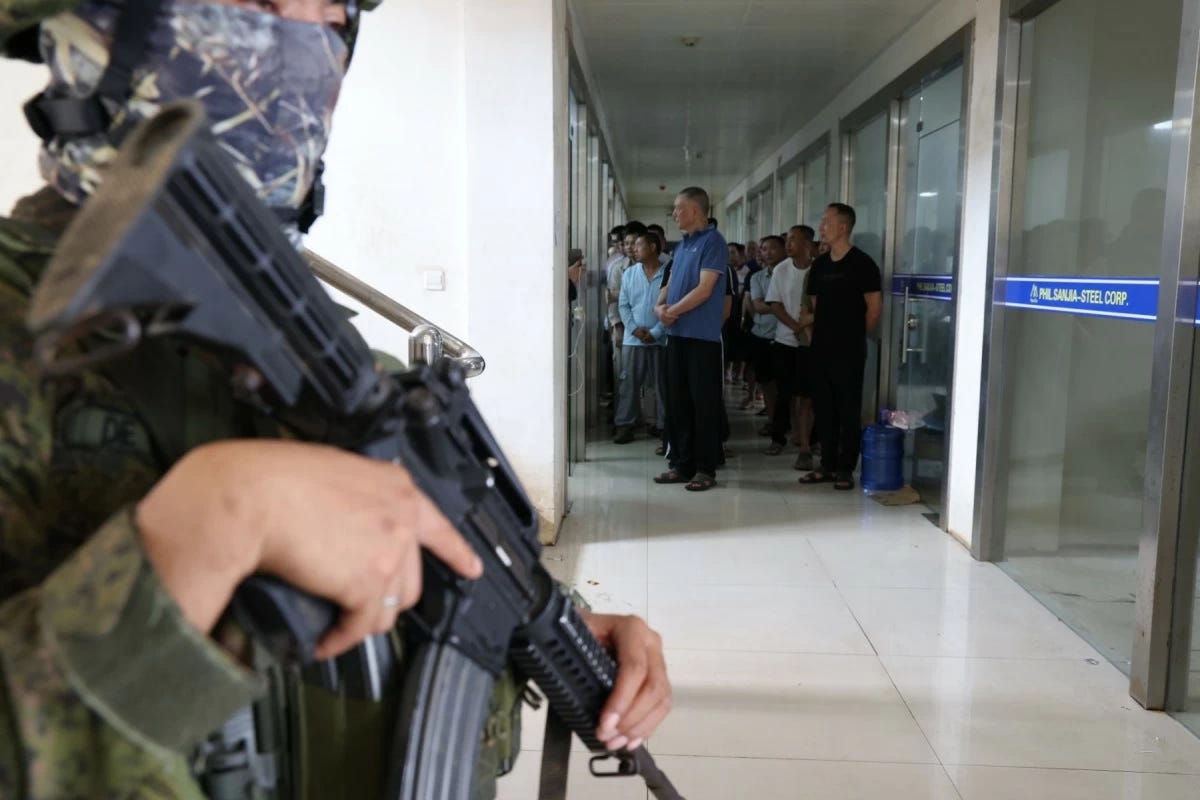
Law enforcement authorities raided the Philippine Sanjia Steel Corporation manufacturing plant in Misamis Oriental last May 16, apprehending 69 undocumented Chinese workers in the steel site along with one Filipino national. Official handout.
Rommel C. Banlaoi | September 3, 2026
Though the controversy surrounding Philippine Sanjia Steel Corporation in Misamis Oriental began as a straightforward law enforcement action, it has since evolved into a diplomatic flashpoint. What was initially framed as a raid against alleged violations of labor, immigration, and nuclear safety laws now involves Manila, Beijing, and Washington underscoring how domestic regulation can quickly intersect with geopolitics.
Philippine authorities accused Sanjia Steel of importing radioactive scrap metals from China and producing substandard rebars that threaten public safety. Dozens of Chinese workers were arrested, the plant was closed, and its environmental compliance certificate revoked. The Bureau of Philippine Standards found its rebars failed to meet national standards. These actions were presented as evidence-based enforcement.
Yet, the Chinese Embassy strongly denounced the raid as selective enforcement, portraying it as undue harassment against Chinese nationals. This reflects Beijing’s enormous sensitivity to the treatment of its citizens abroad and its broader narrative of defending Chinese enterprises.
China’s position deserves closer examination. The Embassy emphasized that Chinese workers were unfairly singled out, suggesting discriminatory application of Philippine law. Beijing framed the arrests as part of a pattern of “selective enforcement,” echoing its global posture of protecting its diaspora and enterprises.
By portraying the Sanjia case as harassment, Beijing sought to shift the discourse from regulatory compliance to fairness and human rights, raising the controversy as racial discrimination rather than mere industrial safety.
The issue deepened when reports surfaced of U.S. military personnel visiting the Sanjia site in preparation for next year’s Balikatan exercises. While the Armed Forces of the Philippines and the U.S. Embassy clarified the visit was routine, the Chinese Embassy raised suspicions of a possible military conversion of the facility. Such suspicions illustrate how even industrial zones can be interpreted through the lens of strategic competition.
For the Philippines, the Sanjia Steel case highlights three important imperatives:
First, the government must uphold regulatory standards to ensure public health and infrastructure integrity. The discovery of radioactive isotopes in steel bars is a serious safety issue that could compromise buildings nationwide.
Second, immigration and labor laws must be enforced fairly, without appearing to target any nationality.
Third, the government must manage the diplomatic consequences of actions that, while domestically justified, carry international implications. These imperatives are difficult to reconcile, particularly when foreign powers interpret local enforcement through geopolitical frames.
A balanced approach therefore requires transparency and consistency. It is essential for Philippine agencies to demonstrate that enforcement actions are evidence-based and applied uniformly across all firms, foreign or local.
At the same time, Manila should further engage Beijing diplomatically to explain its regulatory decisions, while reassuring Washington that Philippine sovereignty remains paramount. (Also read: Teodoro accuses China of “interference” in Philippine affairs)
By doing so, the Philippines can avoid being cast either as hostile to Chinese investment and government or overly dependent on U.S. military support. Credibility rests on enforcing standards without prejudice while resisting external pressures that seek to turn domestic issues into geopolitical battlegrounds.
China’s concerns are understandable. Beijing’s insistence that its nationals are being unfairly treated reflects genuine concerns about the welfare of its citizens abroad. It also reflects China’s broader strategy of portraying itself as a defender of fairness in international relations.
The Philippines must acknowledge these concerns diplomatically without compromising regulatory integrity in order de-escalate current tensions in bilateral ties. Dialogue that emphasizes transparency and adherence to law can reassure Beijing that enforcement is not politically motivated, while reinforcing Manila’s sovereign right to regulate industries. (Also read: Pragmatic Nationalism: A Philippine Foreign and Security Policy Framework)
Apparently, the Sanjia Steel controversy goes beyond industrial compliance. It raises issue on how the Philippines manages relations with two major powers while safeguarding national interests.
President Ferdinand Marcos Jr.’s recent announcement of a “reset” to stabilize relations with China, provides the prudent approach. Stabilizing ties with Beijing does not mean abandoning sovereignty or compromising safety standards but creating needed diplomatic spaces where disputes can be managed responsibly, cooperation pursued in areas of mutual benefit, and misunderstandings reduced before they further escalate.
Rommel C. Banlaoi, PhD, is Director of the Philippines–China Studies Center at Diliman College and President of the Philippine Society for International Security Studies. He served as President of the Philippine Association for Chinese Studies.