

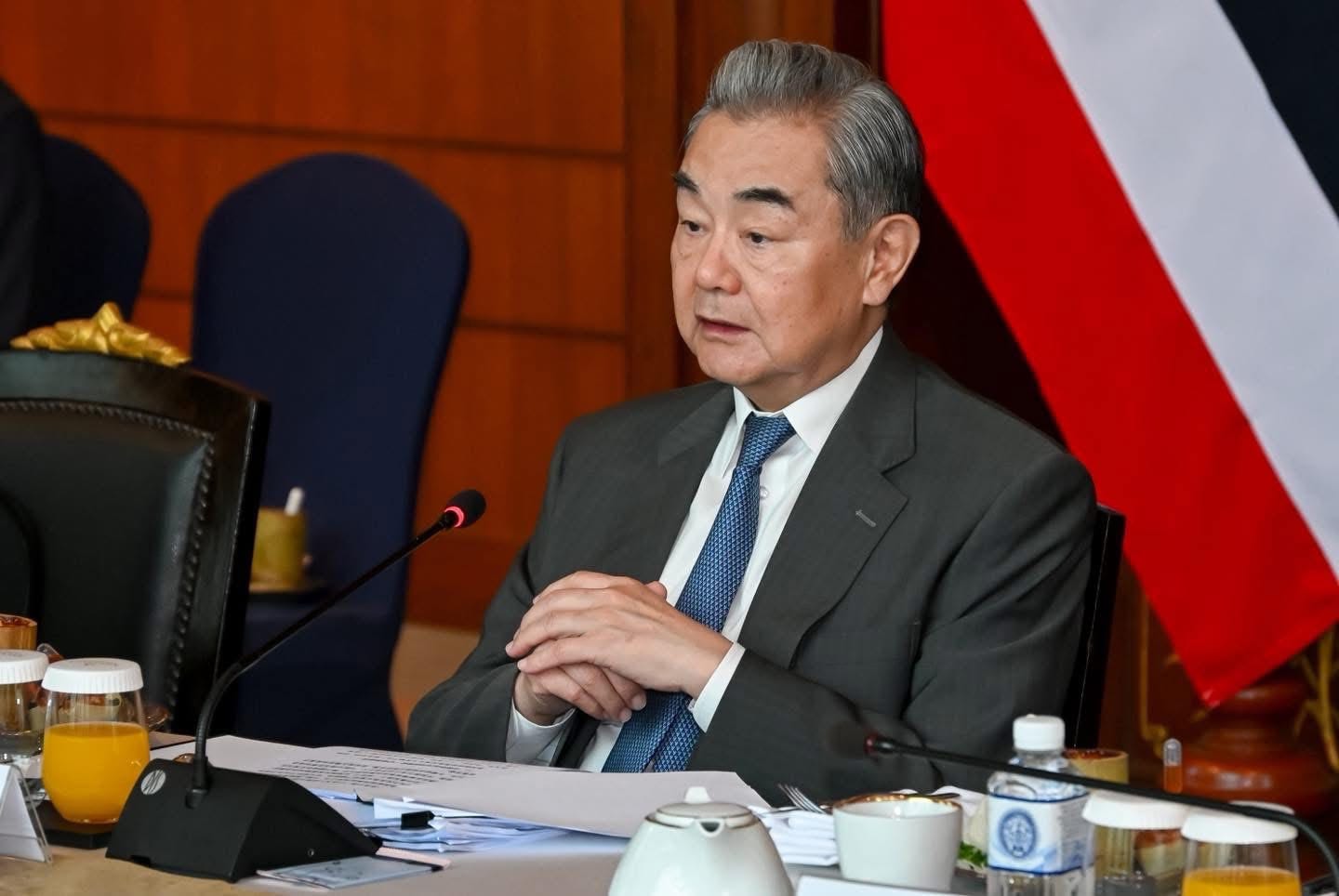
Chinese Foreign Minister Wang Yi met with Thailand's Deputy Prime Minister and Minister of Foreign Affairs Sihasak Phuangketkeow during the 3rd Thailand-China Foreign Ministers’ Consultation Mechanism Meeting in Thailand last April 25. Photo from Thai Government.
Prapapoom Eiamson | May 12, 2026
BANGKOK — While the United States often relies on the “loud boast” of direct mediation and transactional pressure, China has cultivated a more nuanced “Asian way” of navigating the complex frictions in mainland Southeast Asia.
This subtle approach has been particularly evident in Beijing’s handling of the recent Thailand-Cambodia border disputes and the internal violence in Myanmar following the 2021 coup.
A recent tour of mainland Southeast Asia by Chinese Foreign Minister Wang Yi had served another important objective: the restoration of peace.
China’s role as a “subtle mediator” stands in stark contrast to the U.S. approach under the Trump administration, which viewed these nations through a low-stakes lens—withdrawing aid from Myanmar as part of a global retrenchment and threatening Thailand and Cambodia with punitive tariffs to force a ceasefire.
China, conversely, leans into a diplomatic style that is economically driven, emphasises non-interference, and provides a neutral platform for conflict resolution.
China’s handling of the 2025–2026 Cambodia-Thailand border crisis
The Thailand-Cambodia border crisis illustrates this commitment to a non-forceful approach while providing the high-level diplomatic talks necessary for rebuilding trust.
For instance, during a special meeting convened under Malaysia’s ASEAN Chairmanship in July 2025, China served as a critical “observer-mediator” alongside the US.
More recently, at the 48th ASEAN Summit in Cebu, China facilitated informal talks between Thai PM Anutin Charnvirakul and Cambodian PM Hun Manet, extending the mandate of the ASEAN Observer Team at the border. (Also read: President Marcos says Cambodia, Thailand reached agreements, discussed ways forward in talks arranged by the Philippines)
Similarly, Beijing’s engagement with Myanmar has focused on pushing the junta toward de-escalation and alignment with the ASEAN Five-Point Consensus. (Also read: Philippine Statement on the transfer of Daw Ang Suu Kyi to house arrest)
Since early 2025, China has utilised a security mechanism between China, Thailand, and Myanmar to safeguard border stability.
Through these high-level dialogues, Beijing is actively empowering Bangkok to take a regional lead within ASEAN.
The goal is to shepherd Myanmar back into the international fold through a managed peace process, rather than leaving the nation in isolation.
For China, regional stability is not a moral preference but a strategic prerequisite for its survival as a global trade superpower.
Beijing does not view Thailand, Cambodia, or Myanmar as isolated entities, but as vital links in a singular infrastructure chain designed to penetrate the heart of the Indo-China peninsula.
Through grand projects like the Belt and Road Initiative (BRI) and the Lancang-Mekong Cooperation (LMC), China seeks to secure high-speed rail and maritime resources management essential for its regional dominance. By acting as a patient developmental partner rather than a global policeman, China is weaving the region into its “Community of Common Destiny.” (Also read: The Philippines as ASEAN Chair Should Build Bridges of Cooperation Through a Code of Conduct in the South China Sea)
This intense diplomatic maneuvering is the final push to complete a grand infrastructure puzzle.
The BRI has evolved beyond simple roadworks; it is now a quest to create a permanent land link to the Bay of Bengal, allowing China to bypass the vulnerable Malacca Strait — the world’s second-busiest waterway after the Strait of Hormuz.
Simultaneously, the Lancang-Mekong framework secures a path through the peninsula to the Gulf of Thailand. Without peace between these three neighbours, China’s dream corridors cannot be fully realised.
Finally, maintaining neutrality is a delicate balancing act. While China appears to share a closer bond with Cambodia, it must remain a trusted partner to all, ensuring it does not push Thailand back into the arms of its Cold War ally. Despite Washington’s perceived indifference to Thailand’s recent energy concerns, the U.S. remains a significant partner for Bangkok through massive military exercises like Cobra Gold and long-standing trade ties.
Furthermore, keeping Myanmar’s resolution within the ASEAN mechanism ensures no other global power establishes a foothold at China’s front door—a pertinent concern as Myanmar, under Min Aung Hlaing, attempts to balance its power by cozying up to Russia.