


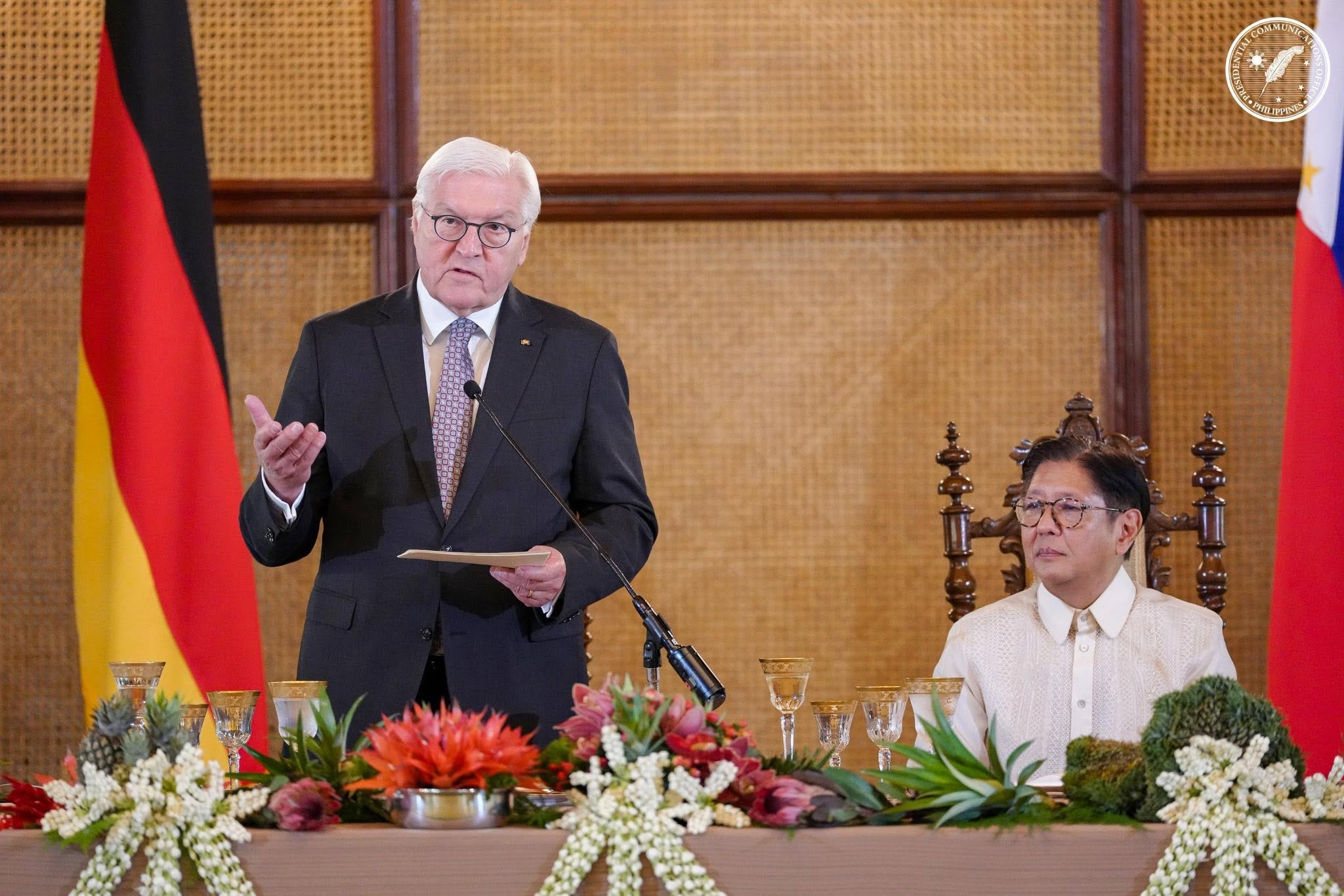
German President Frank-Walter Steinmeier (left) during his state visit in Manila last June 16, 2026 said many German companies are looking to invest in the Philippines. Official handout.
Rodney J. Jaleco | June 23, 2026
WASHINGTON, D.C. — The West has often seen the Philippines as the “sick man of Asia”, a relatively weak strategic actor compared with its neighbors. But with the strategic calculus changing, the goal has become to help build a more resilient Philippines, one capable of contributing to regional stability and preventing any single power from dominating the region.
As competition between the US and China intensifies, the Philippines occupies a critical geographic position along the so-called First Island Chain, linking allies and partners from Japan through Taiwan to the South China Sea and onward toward Australia. Its proximity to flashpoints such as the Taiwan Strait and the South China Sea has elevated its strategic importance.
As a result, countries including Japan, Germany, Australia and the US are not merely strengthening defense ties with the Philippines. They are also increasing investment, development assistance, infrastructure cooperation, supply-chain partnerships and maritime capacity-building. The objective is not only military deterrence but also improving the country’s economic resilience and state capacity.

US strategic investments in the Philippines are heavily focused on securing supply chains, advanced technology manufacturing, and maritime security. Through initiatives like Pax Silica, the US and Philippines established a 1,600-hectare Economic Security Zone in Central Luzon — principally the former US military bases at Clark and Subic — to produce semiconductors and accelerate AI. (Also read: Pax Silica: Is the Philippines willing to give up its sovereignty in Clark?)
The Subic shipyards — once used by the US to service warships during the Vietnam War — has been acquired by the New York-based Cerberus Capital Management which has a reputation for turning around distressed conglomerates. More significantly, the US International Development Finance Corporation has signaled its readiness to provide debt financing and political risk insurance for American companies investing in these priority areas.
Japan has committed about $3.4 billion-worth of strategic investments in the Philippines, particularly in infrastructure and energy. They’re funding high-impact infrastructure projects, railways, and ports modernization. (Also read: Japan may transfer lethal weapons to the Philippines)
Major Japanese companies are actively expanding operations across Philippine industrial hubs (Laguna and Cebu). This includes an investment worth nearly $1 billion by Furukawa Electric for heat sink modules used in AI data centers, alongside expansions by Sumitomo Electric, Minebea Mitsumi, and Tunesi Group.
Australia’s strategic investment in the Philippines focuses on expanding defense infrastructure, clean energy manufacturing and regional economic partnerships. Brisbane-based StB Capital Partners is investing in a $346 million lithium iron phosphate battery factory, the first in the Philippines, to support renewable energy storage.
Canada joined the Philippines, US and Japan trilateral framework, initially investing $5 million to support technical assistance and develop a strategic manufacturing and logistics hub in the Luzon Economic Corridor. (Also read: Philippines, Canada expand security ties)
In his Manila sortie earlier this month, German Pres. Frank Walter Steinmeier formalized strategic projects in the Philippines. Lufthansa Technik Philippines (a joint venture with MacroAsia Corp.) is building a second base maintenance facility at the former at Clark, Pampanga. German renewable giant wpd AG is developing $6.7 billion worth of offshore wind projects in Ilocos Norte, Mindoro and Northern Samar that are projected to generate 3,260 MW of electricity and will become one of the largest offshore wind projects in Southeast Asia.
Strategic security investments are increasingly becoming an economic driver for the Philippines, not just a defense policy.
Still, security spending alone does not guarantee growth. The Philippines must also address long-standing challenges such as corruption, excessive red tape, infrastructure gaps and relatively high energy costs. Experts believe that economic gains are maximized when defense investments are integrated with broader development strategies.
The Philippines is spending anywhere from 1.3 to 1.4 percent of GDP for national defense, below the two percent NATO threshold even as US Defense Secretary Pete Hegseth urges allies to raise defense spending to 3.5 percent of GDP. The Philippines will have to figure out if plowing more of its scarce resources for national defense will be worth it, and ideally deliver added dividends for the economy.