

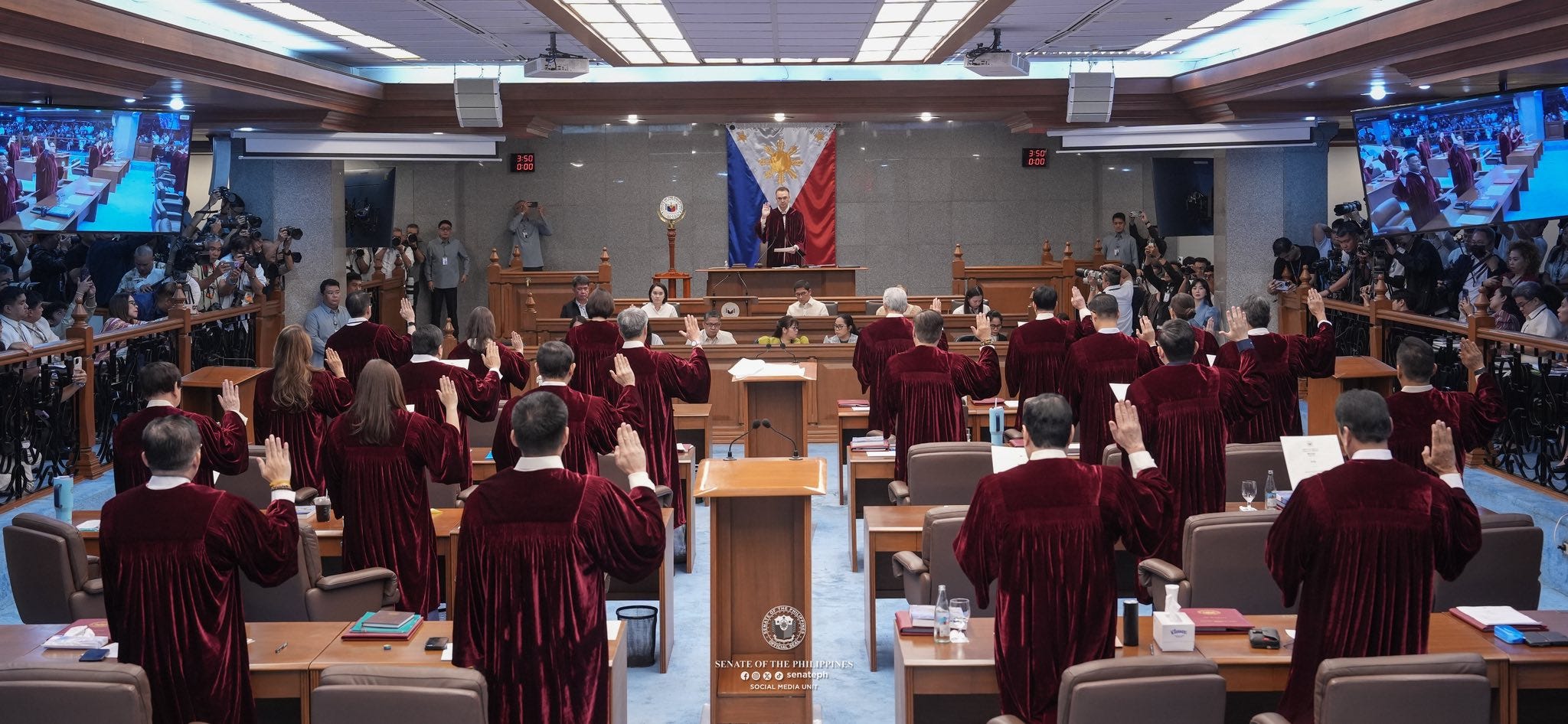
Senators take their oath as Senator Judges on Monday, May 18, marking the start of Vice President Sara Duterte’s pre-trial impeachment proceedings. Photo from the Senate of the Philippines Social Media Unit.
COL (R) Dencio S. Acop, PhD, CPP | May 25, 2026
The Filipino people have just witnessed the most brazen obstruction of justice happening right in the highest place where laws of the Philippines are decided. Thirteen (13) senators managed to stage a coup to control the upper chamber just when the lower house impeached Vice-President Sara Duterte for misuse of public funds, unexplained wealth, corruption and bribery, and assassination threats against the President.
To garner the majority number, even fugitive senator, Ronald Dela Rosa, who has been hiding for six months, suddenly showed-up, stumbling all over himself as NBI agents tried to serve him a warrant issued by the International Criminal Court for alleged crimes against humanity in former president Rodrigo Duterte’s illegal drug war which killed thousands. Duterte himself is now undergoing trial in The Hague.
Why did the thirteen senators do what they did? This article argues that they did it to exonerate themselves from criminal charges, especially those stemming from the massive flood control anomalies, as well as other corruption-related charges, using their government powers to do so. (Also read: Sandiganbayan orders arrest of former congressman tagged in flood control corruption)
Fearful of the truth coming out which would convict them, they have resorted to technicalities exploiting the “letter” of the law to subvert its “substance.” By also exonerating the vice-president from any indictment of wrongdoing removing her from power, they hope to see their political ally win the 2028 presidential elections so they will not be indicted for their own crimes which will end their political careers and put them behind bars.
The only problem with this scheme is that it plays right into the hands of China. A presidency by another Duterte would formally pivot back the Philippines to the orbit of China as what happened in 2016-2022. (Also read: Duterte’s Gentleman’s Agreement)
Because of the inroads made possible by the Duterte administration to China, the Chinese Communist Party has been able to plant seeds using money and coercion to convince Philippine officials and some citizenry to view China as the “future.” This winning over of Filipinos to their side is why some of us, especially the “Die-hard Duterte Supporters” (DDS), seem to look the other way in China’s intrusions and robberies into the Philippines’ maritime territories and exclusive economic zones in the West Philippine Sea.
Sadly, even some of our senators can now be assumed to be right inside the pockets of Chinese officials and interests by their very own actions and pronouncements. The article likewise argues that consistent with China’s strategy to win over its enemies, including the Philippines, without having to fire a single shot, subtle joint ventures like the “Build, Build, Build” and flood control projects can also perfectly tie-in to China’s scheme to subvert the Philippines from within. If corruption has ballooned in the Philippines, it is because corruption is a favorite strategy of China to destroy its enemies from the inside and simultaneously advance Chinese national interests in the process. Corruption is the “means” used by China and how the Chinese Communist Party applies this “means” to break the enemy’s will to resist to achieve its “ends” (advancing Chinese national interest) is its “ways.”
China’s aim is not necessarily to win on the battlefield. Today, such would be too disruptive and destructive even for China. Applying not just Carl von Clausewitz’s treatise but Sun Tzu’s as well, the aim of China is not to be victorious on the battlefield, but to win the war well before the battle is fought. Corruption already existed in the Philippines manifested by Filipino political dynasties which are rampant. It has become embedded in the larger Filipino culture becoming a sub-culture itself. While there are formal institutions and policies in place, it is really the actual implementation that defines the effectiveness of these formalities. And this reality includes the informal corruption which appears to satisfy the “letter” of the law but not its “spirit.”
It is the insidious nature of corruption that gave rise to the Filipino culture of “dualism.” It allowed China to merely exploit these dysfunctional dynamics in Filipino society to advance her own national interests. The magnitude and pervasiveness of corruption in the Philippines can be sized up in the number of political dynasties that exist. While there is no exact count, nearly 250 political families control almost all the country’s 82 provinces, with dynastic clans holding over 70% of incumbent local government and legislative posts. These dynasties are either “thin” or “fat.”
The former includes relatives who hold the same political seat in succession. The latter includes multiple relatives holding different government positions simultaneously. Eleven of the 13 senators who supported the recent coup come from corrupt political dynasties and some of them have already been indicted or convicted of crimes ranging from illegal possession of firearms to plunder and crimes against humanity. A Chinese ally, Duterte willingly played into the hands of China handing his country over on a silver platter. Now, half of the country, including the 13 senators, are complicit in China’s ongoing game. In this game, however, China wins but the Philippines loses.
Consider these ongoing and historical facts. The first point that can be inferred is that five out of the thirteen coup-plotting senators are involved in the massive flood control scams. Young and ambitious, Mark Villar played a key role. Appointed as Secretary of the Department of Public Works and Highways (DPWH) by Duterte, Villar implemented the “Build, Build, Build” program which tied into the global “Belt and Road Initiative” program of China, which funded infrastructure projects and grants. While some were real projects, later investigations also uncovered “ghost projects.”
Villar now heads the list of current senators directly implicated in the ongoing and widening multibillion-peso flood-control project scandals, which includes current fellow senators Jinggoy Estrada, Joel Villanueva, Francis Escudero, and Bong Go; as well as former senators Bong Revilla, Nancy Binay, Grace Poe, and Cynthia Villar. In 2025, former DPWH officials executed sworn affidavits claiming that Jinggoy Estrada received massive commissions (25-30%) from multimillion-peso flood-control projects in Bulacan.
The second point is that all 13 senators are somehow involved in alleged crimes or anomalies throughout their political and public careers. Three senators are subjects of past, current, and future indictments. One was convicted and served time in jail until he got pardoned. And one was held civilly liable in a court of law. Alan Cayetano is suspected of indirect corruption links to flood control and ghost projects implemented in 2025-2026 due to questionable 869 million pesos worth of projects awarded to Taguig City where the mayor is his wife. As chair of the Philippine Southeast Asian Games Organizing Committee, Cayetano faced scrutiny when the Commission on Audit flagged anomalies and irregularities in billions of pesos worth of contracts including the controversial P50 million cauldron in New Clark City. The P71 million donation he gave to Duterte’s presidential campaign in 2016 was highly suspicious as it heavily exceeded the net worth he declared in his Statement of Assets, Liabilities, and Net Worth at the time. In 2014, he and his wife faced multiple graft and plunder complaints filed before the office of the Ombudsman for misusing his Priority Development Assistance Fund and participating in the procurement of overpriced multi-cabs.
Legarda has been linked to several corruption and conflict-of-interest scandals. In 2025-2026, her name is included in documents relating to budget insertions for flood control projects handled by the DPWH. Her own son, Batangas Representative Leandro Leviste, claimed that Legarda is one of the senators linked to roughly PhP1 billion in project allocations. Legarda faced multiple graft complaints filed before the Ombudsman by public interest advocate Louis Biraogo. She was accused of violating the Anti-Graft and Corrupt Practices Act for allegedly failing to declare a PhP36 million condominium in New York City and a multi-million-peso mansion in Forbes Park. Aside from these, she has faced criticism for conflict-of-interest concerns regarding her son’s business interests related to legislative franchises.
Villanueva is also currently linked to several corruption scandals, primarily the multi-billion-peso flood control corruption scandal, which is ongoing, and the pork barrel scam. Whistleblowers and the Independent Commission for Infrastructure accused Villanueva of receiving a 30% kickback (amounting to an estimated P150 million) from P600 million worth of flood control projects in Bulacan in 2023. As a result, the ICI recommended filing of plunder, graft, and bribery charges against Villanueva to the Ombudsman. In 2015, Villanueva was also involved in the infamous PDAF scam orchestrated by Janet Lim Napoles. He was accused of misusing PhP10 million in pork barrel funds while serving as a party-list representative. While the Ombudsman originally ordered his dismissal from government in 2016 for grave misconduct and malversation, he was subsequently not charged because his case allegedly faced complicated, legal hurdles.
While not formally charged or directly implicated, Pia Cayetano has faced public scrutiny and political backlash for defending her family and colleagues during investigations into alleged government irregularities. She drew criticism and clashed with fellow senators when she defended her brother Alan relative to the 2019 SEA Games funding anomalies and irregularities in billions of pesos worth of contracts including the controversial P50 million cauldron in New Clark City. She has also faced further scrutiny by association during recent legislative probes into the escalating multi-billion-peso costs of the New Senate Building and alleged anomalies within the 2025 national budget.
Dela Rosa was indicted by the ICC in an arrest warrant unsealed on May 11, 2026. The ICC charged him with crimes against humanity for his alleged role in extrajudicial killings as the chief of the Philippine National Police during Duterte’s deadly “war on drugs”. Dela Rosa has also been involved in several controversies and irregularities primarily centered on his tenure as PNP chief. Prosecutors have pointed out his violent rhetoric where he openly encouraged police and citizens to target and kill drug suspects.
While Dela Rosa manifested no respect for the law by his own words and actions, he sought protective custody in the Philippine Senate when it was his turn to be arrested by National Bureau of Investigation agents. His evasion culminated in a chaotic shootout inside the Senate. Following the incident, he again went back into hiding. However, the Department of Justice has just issued a public statement that the NBI and the PNP can now arrest the fugitive lawmaker. Contrary to claims by Duterte supporters that the ICC cannot supersede local laws, the Philippines has a law, crafted by some opposing senators themselves, that aligns with the ICC’s prosecutorial process. Due to his prolonged absence from official sessions and activities, the Alliance of Concerned Teachers and other government watchdog groups filed ethics complaints against Dela Rosa accusing him of dereliction of duty and abuse of privilege.
For his part, Escudero is currently facing two major corruption-related investigations involving plunder, graft, and bribery complaints. He is being investigated by the Ombudsman for allegedly receiving hundreds of millions of pesos in kickbacks tied to government-funded flood control projects. The anti-graft court Sandiganbayan has issued a Precautionary Hold Departure Order barring him from leaving the country due to the gravity of his case. In another case, a lawyer filed a criminal complaint before the Ombudsman against the lawmaker and other provincial officials for alleged financial irregularities amounting to PhP352 million during his term as provincial governor of Sorsogon (2019-2022).
Jinggoy Estrada has been indicted and arrested multiple times for major corruption and plunder charges throughout his political career. In 2001, he was indicted and detained alongside his father, former President Joseph Estrada, for allegedly amassing ill-gotten wealth. But he was acquitted of this charge in 2007. In 2014, he was again indicted for plunder and multiple counts of graft for allegedly pocketing PhP183 million in kickbacks by funneling discretionary funds through bogus NGOs. In 2024, the Sandiganbayan acquitted him of plunder. While he was initially convicted of bribery, the court eventually reversed these convictions in 2024. However, his 11 related graft trials have proceeded. In 2026, the DOJ recommended new plunder and graft charges against Estrada and former DPWH Secretary Manuel Bonoan for allegedly receiving millions in kickbacks from regional flood control projects in Bulacan.
Go is primarily linked to two major controversies: a public works infrastructure scandal, and the ICC’s investigation into the war on drugs. Go and his patron, Duterte, were named in a plunder complaint filed by former Senator Antonio Trillanes IV. The complaint alleges that construction firms owned by Go’s father (CLTG Builders) and his half-brother (Alfrego Builders) cornered billions of pesos in government contracts during the Duterte administration. The controversies specifically link Go’s family’s construction firms to joint venture contracts with St. Gerrard Construction, a company at the center of the Philippine government’s investigation into the massive, anomalous awarding of flood mitigation and road projects. Meanwhile, in its investigation into the “war on drugs” during the Duterte administration, the ICC has named Go as an alleged co-perpetrator in the crimes against humanity case. Go was identified as one of eight current and former Philippine officials in official ICC filings outlining his alleged co-conspiracy. Court documents name the other Philippine officials as: Vitaliano Aguirre II (former Justice secretary), Oscar Albayalde (former PNP chief), Vicente Danao (former PNP chief and former Davao City police chief), Camilco Cascolan (former PNP chief who passed away in 2023), Dante Gierran (former NBI director), and Isidro Lapena (former PDEA chief). Former Senator Trillanes has publicly stated he expects an arrest warrant to follow for Go, citing his role as a key aide to former President Duterte during the “drug war”.
Marcoleta is primarily linked to political and financial controversies surrounding his campaign finances, the multi-billion-peso flood control anomalies, and past pork barrel issues. As chair of the Senate Blue Ribbon Committee, he came under heavy scrutiny for defending the immunity of key contractors (the Discaya couple) and was accused of conflict-of-interest due to his wife serving as an independent director and audit committee chair at insurance companies that provided multi-million-peso bonds for those same contractors. Following his 2025 senatorial campaign, Marcoleta faced scrutiny for under-declaring campaign contributions in his Statement of Contributions and Expenditures. He declared zero campaign contributions despite reporting expenditures of over PhP112 million while only declaring a personal net worth of PhP52 million. By his own admission, he accepted millions in undeclared “donations” prompting fellow Senator Panfilo Lacson to say that Marcoleta’s actions could constitute indirect bribery under Philippine law. Marcoleta was implicated in the “Napolist” by the COA which alleged that he channeled PhP15 million of his PDAF to dubious, non-existent NGOs between 2007 and 2009 during the time he served as a representative for the Alagad Party-list (2004-2013).
Imee Marcos has been linked to the massive flood control scandal, alleged pork-barrel disbursements under her brother’s administration, and historical ill-gotten wealth. She was civilly held liable by a Honolulu US district court in the 1993 Trajano v. Marcos Case for the 1977 torture and killing of 21 y/o Mapua Institute of Technology student Archimedes Trajano who was seized, tortured, and beaten to death by her bodyguards. She was a presidential daughter at the time who was assigned full-time security escorts from the Presidential Security Command. Arrogantly responding to the district court, Marcos said: “Yes, Archimedes Trajano was tortured and killed but it’s none of your business.” While Marcos has attacked even her own brother (President Marcos Jr.) and first cousin (former House Speaker Martin Romualdez) of involvement in the massive flood control scam, other administration officials like Senator Lacson, have accused her of trying to shift the blame, pointing out her own history of bypassing budget oversights and refusal to sign the national budget. During her term as Ilocos Norte governor (2010-2019), she faced a House investigation regarding the highly irregular use of PhP45 million in provincial tobacco excise taxes to purchase 115 motor vehicles without mandatory public bidding. As the eldest child of the late dictator Ferdinand Marcos, she is historically linked to the systemic plunder of the Philippine treasury and the concealment of ill-gotten wealth – issues that have been ruled upon by multiple international and Philippine courts.
Of all the senators, Padilla is the only one so far who has been convicted of a crime. He was convicted in 1994 for illegal ownership of multiple firearms after sideswiping a balut vendor along MacArthur Highway. He served four years in prison, granted conditional pardon by President Fidel Ramos in 1998, and given absolute pardon by Duterte in 2016. He has remained a loyal Duterte supporter ever since.
Camille Villar, alongside her brother Mark, is among several incumbent senators tied to the ongoing investigations into alleged anomalies in government flood-control projects. These inquiries involve allegations that specific infrastructure projects disproportionately benefited the Villar family’s property and business interests. Villar, alongside her family and executives at Villar Land Holdings Corp., is facing a criminal complaint for alleged market manipulation, insider trading, and misleading disclosures. The Securities and Exchange Commission alleges that company disclosures distorted share prices and over-valued land assets, and that Villar specifically engaged in insider trading by purchasing company shares just before a major corporate disclosure in 2017.
Finally, Mark Villar is primarily linked to two major corruption and financial controversies during his time heading the DPWH and his family’s business dealings. In hearings on the flood-control scams, DPWH officials revealed that Villar “oversaw a massive kickback system”. “Whistleblowers claimed that Villar received a percentage of kickbacks on multibillion-peso flood-control and infrastructure projects”, allegedly funneled through his cousin, contractor Carlo Aguilar. The DOJ has also investigated the Villar family for “prohibited interest” regarding roughly PhP18.5 billion in government contracts awarded to firms owned by their relatives. In April 2026, the SEC filed criminal complaints against Villar Land Holdings Corp. and its directors – including Villar, his parents, and sister – over allegations of insider trading, market manipulation, and misleading disclosures that distorted share prices.
Third point is the fact that eleven of the thirteen senators belong to political dynasties. It must be pointed out that the 1987 Philippine Constitution contains a mandate in Article II, Section 26 to “prohibit political dynasties as may be defined by law”. While this requires an enabling statute from Congress to take effect, such law banning political dynasties still does not exist to this day.
While bills have been filed in both houses, they have encountered stiff hurdles. Since the legislature has historically been dominated by members of political clans, no such law has ever been successfully passed. To become a finalized law, the measures must pass third reading in the House, be approved by the Senate, and be reconciled in a bicameral conference committee before being signed by the President. Until then, political clans remain a persistent fixture in both local and national Philippine politics.
The problem of systemic corruption is in part related to political dynasties which invite nepotism and other illegalities into the business of governance ending in conflicts-of-interest wherein personal, vested interests compete with a public servant’s vow to serve the national interest first. This reality in Philippine politics helps explain why the senators in question are somehow involved in alleged crimes or anomalies throughout their political and public careers. Of the thirteen senators, only Marcoleta and Dela Rosa do not belong to political dynasties.
Point number four is the fact that all thirteen senators who are Duterte supporters are also China sympathizers at the expense of the Philippines based on their public pronouncements and actions on China’s illegal incursions in the West Philippine Sea. Some Filipino citizens, critical of their seemingly pro-China stance in the country’s row with China, have gone to the extent of calling them “Tsinadors” or “Chinadors.”
As Duterte’s foreign secretary (2017-2018), Alan Cayetano was the primary architect executing the administration’s pivot toward Beijing. He regularly traveled to China, met with prominent Chinese officials like Wang Qishan and Li Keqiang, and famously hand-carried letters to President Xi Jinping to usher in what he termed a “golden era” of bilateral ties. He drew criticism for downplaying Chinese military constructions in the South China Sea, publicly stating that China was not a military threat to the Philippines despite such incursions by the People’s Liberation Army and Chinese Coast Guard. Cayetano has also been a vocal proponent of joint resource (oil and gas) exploration in the West Philippine Sea.
A believer of the Economic Peace Theory, he argues that being business partners prevents conflict, stating that if neighbors are mutually benefiting from oil and gas, “definitely there may be peace.”
In early 2026, he opposed passing resolutions against the Chinese Embassy’s harsh public remarks against Philippine government officials.
Legarda has handled numerous bilateral agreements and issues concerning China as a former chair of the Senate Committee on Foreign Relations. She serves as a co-chair for the Philippines on the Inter-Parliamentary Alliance on China, a global cross-party group of lawmakers working to reform how democratic nations approach Beijing. She has spoken in favor of diplomatic dialogue and joint economic and oil/gas exploration with China, provided it respects the Hague ruling on Philippine maritime rights. While she has raised alarm bells about potential “creeping invasions” and territorial encroachment by China in the West Philippine Sea, she has historically supported policies that avoid military conflict in favor of peaceful consultations and adherence to the Declaration on the Conduct of Parties in the South China Sea. (Also read: Civilians plant the Philippine flag in a disputed feature in the South China Sea)
While Villanueva has strong views against China’s aggression in the West Philippine Sea, his political stance has since changed due to his vulnerabilities stemming from his legal cases involving plunder, graft, and bribery charges filed with the Ombudsman. This is unfortunate for Philippine national interest because his track record regarding China has focused on accountability and the protection of Philippine sovereignty. Villanueva filed Senate Resolution No. 980 condemning China’s unprovoked harassment, water cannon attacks, and illegal actions against the Philippine Coast Guard in the West Philippine Sea. He has publicly dismissed the purported “gentleman’s agreement” between former President Duterte and the Chinese government, labeling it a mere Chinese propaganda tactic intended to divide Filipinos. In 2019, he actively contested an infrastructure loan deal with China. He criticized provisions that allowed seizure of Philippine patrimonial assets upon default and called the employment of Chinese nationals in local projects unconstitutional and unfair to Filipinos. He has been a vocal critic of foreign nationals circumventing Philippine laws, demanding stringent probes into the illegal offshore gaming operations (POGOs) primarily linked to Chinese criminal syndicates.
Like Villanueva, Pia Cayetano also had strong views against China’s aggression in the West Philippine Sea. But, unlike him, Cayetano has not been directly linked to major irregularities. Nonetheless, her political stance has since changed due to her sympathetic support of relatives and colleagues affirming China’s interests more than the Philippines’. Cayetano was the sponsor of R.A. 11590, the law that established the tax regime for POGOs in 2021. While meant to regulate and tax the industry, it inadvertently facilitated the widespread presence of Chinese-backed online gambling operations. She later supported the subsequent nationwide ban on POGOs following investigations into associated crimes. She was one of the senators who did not sign a senate resolution condemning statements made by the Chinese Embassy against Philippine officials and institutions. Her supposed justification was to balance the defense of local maritime rights with continued diplomatic engagement with Beijing, despite the latter’s undiplomatic behavior.
While Dela Rosa is a loyal ally of Duterte – whose administration pursued closer ties with Beijing – he has publicly rejected being labeled “pro-China” and has consistently asserted a firm stance against Chinese aggression in the West Philippine Sea. However, his stance is likewise inconsistent since he rejects U.S. support suggesting the termination of the Enhanced Defense Cooperation Agreement when US lawmakers threatened withholding aid to Philippine security forces due to the extrajudicial killings.
Escudero’s stance on China is largely similar with that of most of his colleagues — diplomatic engagement to a fault. Strangely, he has cited the unconstitutionality of armed conflict as his reason for preferring diplomacy to resolve the West Philippine Sea dispute with China. Surely, he must know that the Philippine Constitution allows the Philippines to defend itself from invaders and occupiers. Such provisions are contained in Articles II and VII of the 1987 Philippine Constitution. Escudero also did not sign the January 2026 Senate Resolution (SR No. 256) condemning the Chinese Embassy’s undiplomatic remarks against Philippine officials and institutions.
While Jinggoy Estrada has called out China’s incursions in the West Philippine Sea as Chair of the Senate Committee on National Defense, his being one of the 13 senators ultimately supports the accused Sara Duterte whose non-impeachment (if their scheme will be successful) could mean a possible second Duterte administration in 2028 favorable to Beijing. At one time, he urged the Department of Foreign Affairs to summon Chinese diplomats regarding illegal Chinese actions in the West Philippine Sea. He has historically defended his father, former President Joseph Estrada, against allegations he made a promise to China to remove the grounded Philippine outpost vessel in the Ayungin Shoal. He has publicly dismissed purported audio recordings released by Chinese officials as “disinformation” and a trap designed to distract from the real issues.
As a key ally, Go accompanied Duterte on several high-level state visits to China during his administration, including a trip in August 2019 to meet with President Xi Jinping. He supported the proposal to appoint former President Duterte as a special envoy to China to help ease diplomatic tensions between Manila and Beijing.
Of the 13 senators, Marcoleta’s support of China is the most palpable, even treasonous. It is based on recent controversial policy arguments and diplomatic engagements where his positions frequently aligned with Beijing’s narratives, though he strongly rejects allegations that he is defending China or acting as her local mouthpiece, disloyal to the Philippines. Marcoleta drew intense public backlash – sparking an online Change.org petition calling for his isolation – after he suggested the Philippines “give up” the Kalayaan Island Group to avoid armed conflict. He has even questioned the “existence” of the West Philippine Sea, noting that it is “merely a governmental concept”. He also echoed Chinese complaints that Philippine Coast Guard officials were portraying China as a “villain” in maritime disputes. Despite his controversial statements, Marcoleta has repeatedly pushed back accusations of being a “Chinador”, clarifying that his remarks are meant merely to reinforce logical arguments about territorial disputes rather than cede Philippine territory.
Imee Marcos advocates friendlier bilateral relations with China, opposes defense pacts with the United States, and likes to mediate diplomatic exchanges that promote Chinese interests. She has hosted Chinese Communist Party delegates at the Marcos ancestral home, calling Chinese officials and the Party “personal friends and allies”. She actively campaigned against the Philippines being forced to choose between the US and China, advocating for a re-examination of US-Philippine defense agreements like the 1951 Mutual Defense Treaty. As chair of the Senate Foreign Relations Committee, she has criticized the Philippine government’s “reckless rhetoric” against Beijing, urging that maritime conflicts be handled with reason rather than emotion. She formally convened Senate inquiries to ensure the Philippine government respects the One China Policy and avoids getting entangled in the Taiwan dispute. She notably declined to sign Senate resolutions condemning illegal Chinese actions in the West Philippine Sea. Her pro-China stance is a major point of disagreement with her brother, President Bongbong Marcos.
Padilla pushes for diplomatic conciliation and professional engagement with China, including joint oil exploration. He has actively advocated for joint oil and gas exploration to help solve the Philippines’ energy dependency. He has held meetings with officials like former Ambassador Huang Xilian to discuss potential areas of cooperation and issues related to offshore gaming.
When asked by a vlogger during her 2025 senatorial campaign whether she was “pro-Philippines or pro-China”, Camille Villar dodged the question. A video footage of the encounter went viral forcing Villar to later clarify on Inquirer.net that she is staunchly pro-Philippines and just didn’t hear the question clearly during the sortie. Critics frequently associate Villar’s sentiments on China as similar to those of her mother, former Senator Cynthia Villar, who made headlines in 2024 by stating that the Philippines should find a “common ground” and compromise with China over territorial tensions in the West Philippine Sea due to military disparities. But despite the political scrutiny regarding her family’s stance, Villar still joined 14 other senators in early 2026 who signed a Senate Resolution condemning Chinese embassy officials for castigating Philippine officials over the West Philippine issue, according to OneNews.ph.
Finally, Mark Villar spearheaded and oversaw several major China-funded infrastructure projects and grants during his tenure as Secretary of the DPWH during the Duterte administration until he ran for the Senate. As DPWH head, Villar managed bilateral agreements with China under the “Build, Build, Build” program which tied in with China’s global Belt and Road Initiative. This included Chinese-funded grant projects such as the Binondo-Intramuros Bridge and the Estrella-Pantaleon Bridge. Villar publicly championed infrastructure cooperation with China, noting that the partnership and Official Development Assistance would mutually benefit Filipinos. Except that the projects were also marred by massive corruption issues later illustrated by the multi-billion-peso flood-control scam. Villar has also historically expressed a cautious approach toward calls for outright boycotts of Chinese goods stemming from Chinese illegal actions in the West Philippine Sea.
Fifth point advanced by this analysis is the fact that all 13 senators are well-educated. All are college graduates except for Imee Marcos whose highest educational attainment is that of an undergraduate enrollee. In fact, two senators graduated with honors; three are lawyers; and, one has a doctorate degree in public administration from the University of the Philippines. As such, they are in a good position to discern what is in the best interest of the Philippines with all stakes considered using empirical evidence and the factual merits and demerits of the case.
Point number six is that all 13 senators are or have been married and have children. Eight of them are Roman Catholics; Three are Evangelical Born-Again Christians; One is a Muslim; and One is a member of Iglesia Ni Cristo. What these facts imply is that these senators believe in a moral God whose primordial teaching is the pursuit of living this life in the spirit of truth, love, peace, and respect of the dignity of human life.
They also imply that these senators are leading public servants whose oaths of office mandate them to uphold the Philippine Constitution and its laws for the common good of the Filipino people and not just a few and certainly not those of an invading foreign power.
Finally, these values imply that as parents, they would want to leave a legacy founded on moral order for the sake of their children and grandchildren. Problem with China is that while it extends the hand of friendship, it has also invaded Philippine territory and exclusive economic zone. While it says one thing, it has done another. While it preaches diplomacy, it has used armed power to bully the weak. Problem with China is that its ends, ways, and means are amoral; while the Philippines is a Democracy that believes in the moral order, despite its weaknesses and flaws.
In conclusion, the thirteen senators in question must do the right thing. It means subordinating their individually vested and personal interests to the larger national interest and greater good of the Republic.
It also means leading the prosecution of criminal justice in the country instead of obstructing the flow of justice. That is the ideal matter which is the subject of this discourse. On the practical side, it would do well for these senators to enter a plea deal with the Philippine government to arrive at a win-win which would help their individual causes but not at the expense of the larger national interest and security.
While the thirteen senators thought they had put one over the government by putting on that spectacle in the Senate, they have only managed to force the hand of government and provided it reason to similarly apply all the power of the law it possesses to be used against any of them who has erred in the eyes of the law. As this article points out, almost each one of them is hiding behind their majority control to evade the long arm of the law (which ultimately favors Chinese interest) down the stretch since almost all are involved in some corruption irregularity like the massive flood-control scam silently facilitated by Chinese agents.
Every senator charged with plunder should become wary of being arrested next. Plunder is a non-bailable offense, and a senator-detainee would need official permission to be granted furlough to be physically present on the floor of the senate when voting for a new senate leadership. There is a precedent to this predicament in the Leila de Lima case orchestrated by the Duterte administration.
Once operationalized, the Senate will soon have a new majority whose legacy would be to redeem the lost honor and glory of the Philippine Senate which was degraded to a laughing spectacle by 13 self-serving senators just for “thirty pieces of rotten silver.”