

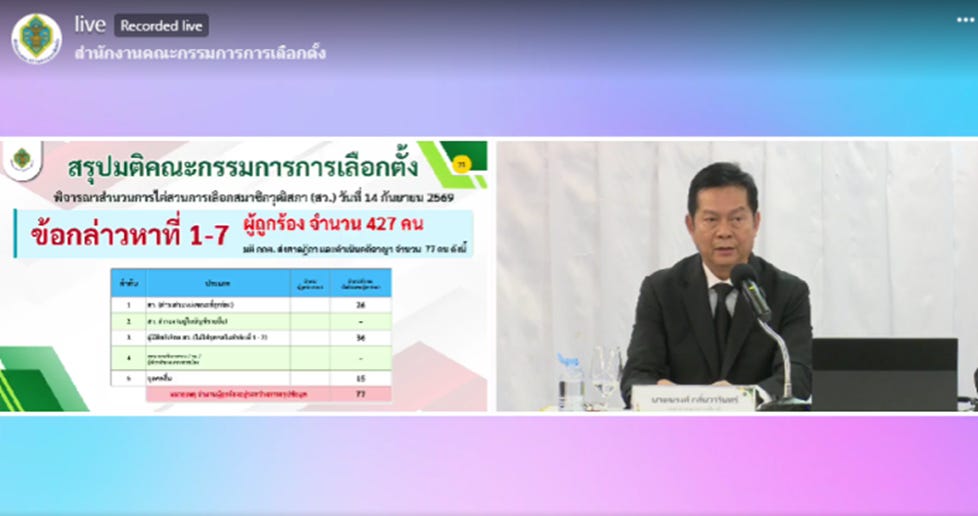
The Election Commission holds a press conference on its consideration of the investigation into the 2024 Senate election. (Source: Election Commission of Thailand, September 14, 2026)
Kunravee Sukhimoke | September 29, 2026
BANGKOK — The Election Commission (EC) has decided to pursue criminal proceedings against 77 people, including 26 senators, over alleged irregularities in the 2024 Senate election.
The charges range from assisting or consenting to assist candidates and violating campaign rules to giving or receiving money, property, or benefits in exchange for applying or voting.
The cases began with 75,722 pages of information and evidence submitted by the Department of Special Investigation (DSI) to the election commission in February 2025. (Also read: Thailand’s Allegations of Senate Election Collusion Raise concerns Over Democratic Legitimacy and Freedom of Expression)
The evidence concerned allegations of organizing networks of candidates, setting payments, preparing voting lists, making payments, and arranging transportation for Senate voters.
Did the “Big Fish” escape the Senate collusion case?
After the election commission resolved to prosecute 77 of the 427 respondents, no politicians, party executives, or members of parliament (MPs) were referred to court.
Key figures named in the case files, including Anutin Charnvirakul, Newin Chidchob, Paradorn Prisannanantakul and Chaichan Chidchob, were also not referred to court on these charges.
The decision differs from the earlier opinion of Central Investigation and Inquiry Committee No. 26, which recommended legal action against 229 respondents.
iLaw questioned whether the commission’s decision would focus only on some candidates and senators while excluding political figures named in the case files.
It called for transparency and independence, so the public can know whether the Senate selection was conducted honestly and fairly.
Anutin, meanwhile, assigned his legal team to file a defamation complaint against iLaw director Yingcheep Atchanont after iLaw said it had evidence linking nine people in the Bhumjaithai Party to the Senate collusion case.
Anutin said the legal action was intended to protect his reputation, not to SLAPP (Strategic Lawsuit Against Public Participation) critics.
“Collusion” requires money or systematic organization
Chuwat Rerksirisuk, a political analyst, told Voice TV that coordination among candidates alone was not sufficient to establish fraud in the Senate election.
It must also be determined whether money, systematic organization, or asset transfers were involved.
Chuwat said that supporters or people sharing views with the People’s Party who gathered at a hotel before the Senate election had so far not been linked to any “money trail” or evidence of payments. Such gatherings should therefore be distinguished from collusion involving financial incentives, power, coercion or networks of vested interests.
However, if the commission considers the hotel gatherings constitute an offence involving hosting or organizing events, similar gatherings at other hotels, there should be an investigation to ensure the same standards are applied.
“The question is, why are these issues not being considered in the blue Senate group (a term used for senators linked to the Bhumjaithai Party), but are being considered only among people’s-sector senators and orange senators (some of whom have been linked to the People’s Party)?”
Chuwat said that if legal action appeared discriminatory, it could become a “political game.” What matters, he said, is that the EC must demonstrate that its investigations are independent and apply the same criteria to all groups.
The 2018 Organic Act on the Acquisition of Senators establishes the “self-selection” system, which allows candidates to make prior arrangements with one another.
Opposition must tell the complete picture of the story
In October, the People’s Party plans to submit a no-confidence motion against the Bhumjaithai-led government over the use of political power, independent agencies and links to business interests, including the Senate election collusion case and scrutiny of those involved.
Amid public debate, questions have arisen over which position the Pheu Thai Party will take as a coalition partner.
Phumtham Wechayachai, former deputy prime minister and adviser to the Pheu Thai Party, told Voice TV that a no-confidence debate is a normal parliamentary process and that the opposition has a duty to scrutinize the government within its authority.
However, Phumtham said that if the People’s Party, as the main opposition party, chooses to debate the issue, it should tell the whole story rather than only “half the truth.” It should also address its own actions, particularly its earlier decision to support Anutin Charnvirakul as prime minister, which affected the course of the Senate collusion case.
“It must also be acknowledged that the root of the problem was something people had already warned about: if power were transferred in this way, the process would also change in that direction.”
Regarding legal proceedings involving the use of power and the justice system, Phumtham said he had fully performed his duties and that it was now up to other agencies to proceed.
Phumtham also referred to the period when he worked with Tawee Sodsong, saying that pursuing the case was relatively isolating. Even the opposition at the time, the People’s Party, did not come forward to help or support him.
“While I was in office, I did everything I could. Now, it is the responsibility of other agencies tasked with carrying out the justice process,” Phumtham said.