

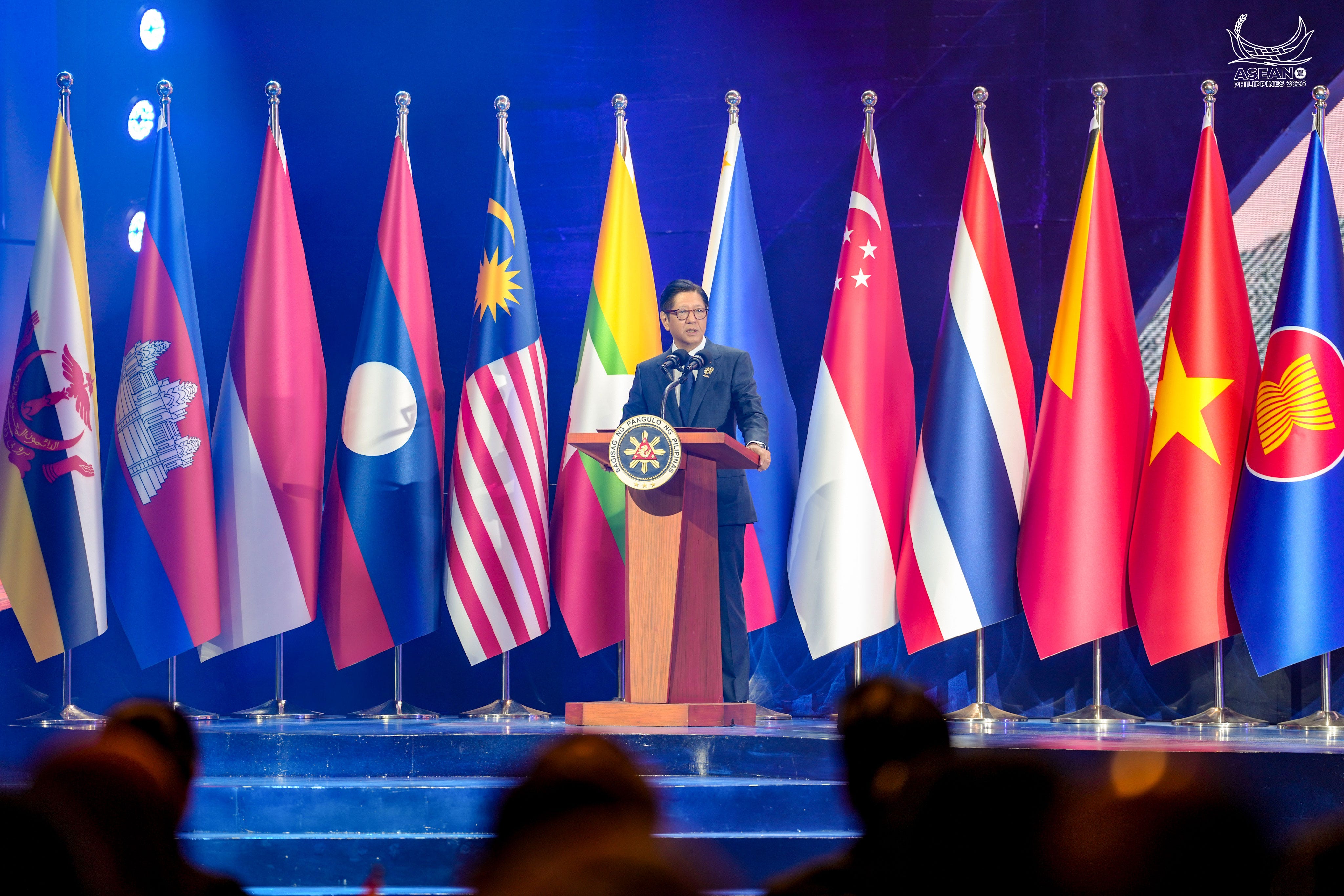
Philippine President Ferdinand Marcos Jr at the opening Ceremony of the 48th ASEAN Summit and Related Meetings. Official Handout.
Rommel C. Banlaoi | May 29, 2026
At the recently concluded 48th Summit of the Association of Southeast Asian Nations (ASEAN) in Cebu, regional leaders adopted the ASEAN Leaders’ Declaration on Maritime Cooperation amidst the Hormuz crisis. By reaffirming the United Nations Convention on the Law of the Sea (UNCLOS) as the universal legal framework, ASEAN underscored its commitment to rules-based order in the maritime domain. The call for the early conclusion of a binding ASEAN-China Code of Conduct (COC) also reflects the urgent need to manage disputes peacefully and prevent escalation in contested waters in order to avoid a Hormuz situation in the South China Sea.
Equally significant is the endorsement of an ASEAN Maritime Centre in the Philippines, envisioned as a hub for coordinating maritime security, safety, and governance. President Ferdinand Marcos Jr. emphasized that the center is not designed to confront any state but to advance cooperative navigation and shared responsibility in the seas. (Also read: ASEAN: Finding relevance in a burning world)
For ASEAN, the challenge now lies in translating this declaration into concrete action. Effective implementation is imperative to avoid a Hormuz scenario in the South China Sea, where unchecked tensions could jeopardize freedom of navigation and regional stability. (Also read: ASEAN calls for cessation of hostilities in the Middle East)
Instability in the Strait of Hormuz reminded the world of the fragility of maritime chokepoints. In 2025, an average of 20 million barrels of crude oil and petroleum products per day transited Hormuz, which was equivalent to about 25% of global seaborne oil trade.
When the US–Iran War erupted, traffic immediately collapsed by over 90%, cutting global supply by 100 million barrels per week. Brent crude prices spiked above $106 per barrel, insurance premiums tripled, and 20,000 seafarers were stranded. These disruptions reverberated across global energy markets, threatening supply security and worsening the lives of billions of people worldwide. (Also read: Viable alternative to Middle East oil)
The South China Sea is no less vital. In 2025, it carried US$5.3 trillion worth of trade annually, equal to 24% of global maritime commerce. It handles 40% of global crude oil shipments and 34% of LNG flows, making it indispensable for Asia’s energy security. For China, more than 60% of maritime trade passes through these waters; for Japan, nearly 42%; and for Southeast Asia, the South China Sea is the lifeline of energy imports and exports.
These figures underscore why the South China Sea must not follow the catastrophe in Hormuz. It shows the world of the inconvenient truth that military actions only breed insecurities. The antidote in the South China Sea must, therefore, be amity and cooperation, not hostility and confrontation.
Thus, ASEAN needs to reaffirm this role. ASEAN’s cooperative vision can be reinforced by its broader security architecture. The ASEAN Regional Forum (ARF) has long been a venue for preventive diplomacy, bringing together 27 participants, including major powers, to build confidence and reduce tensions. The ASEAN Defense Ministers’ Meeting (ADMM) and the ADMM-Plus, which includes external partners such as the US, China, Japan, India, and Russia, are crucial in promoting transparency, joint exercises, and practical maritime security cooperation.
All these mechanisms demonstrate ASEAN’s ability to convene diverse actors and keep the South China Sea within a framework of dialogue rather than confrontation, amity rather than hostility.
But ASEAN cannot succeed alone. Major powers must acknowledge that maritime stability in the South China Sea is a shared responsibility that transcends strategic rivalry. The United States and China, as two most influential actors, bear a special duty to ensure that their competition does not undermine the collective interest in safeguarding vital trade routes. Their cooperation remains indispensable to preventing miscalculation and ensuring freedom of navigation. (Also read: Dialogue with China Is Imperative: Trump–Xi Summit Proved It)
It is therefore important to build resilience together. ASEAN states, with support from external partners, should diversify strategic dependencies by investing in alternative energy corridors, renewable sources, and cross-border power grids. Shared infrastructure for overland trade and energy diversification can strengthen resilience while fostering mutual trust among nations.
Hormuz is an early warning. The South China Sea must avoid it. Cooperation among ASEAN members and major powers is a credible safeguard against crisis at sea. The lessons of Hormuz remind the world that unchecked rivalry and unilateral actions can easily escalate into maritime insecurity with global repercussions.
ASEAN’s centrality can provide an important anchor for regional stability. By reinforcing ASEAN centrality, member states can ensure that dialogue mechanisms remain inclusive and balanced, preventing the marginalization of smaller powers. It is therefore imperative to pursue legal frameworks, preventive diplomacy, and confidence-building measures in tandem with UNCLOS implementation in order to promote and maintain good order at sea.
It is also vital to strengthen maritime security cooperation among states. Joint patrols, coordinated humanitarian assistance, and transparent naval engagements can transform the South China Sea from a contested maritime space into a cooperative security community.
The world cannot afford another Hormuz in this region; instead, the South China Sea must evolve into a model of shared responsibility, demonstrating that multilateralism and trust can prevail over confrontation and mistrust.
The conclusion of the COC remains the most decisive step in promoting good manners and right conduct in the South China Sea. Beyond being a legal instrument, the COC symbolizes a collective commitment to civility, restraint, and respect for international norms. By institutionalizing behavioral guidelines, discouraging coercive actions, and encouraging cooperative practices, the COC can nurture a culture of responsibility among claimant states and external powers alike.
Finally, pursuing cooperation between the Philippines and China is also paramount. As frontline stakeholders, both countries must demonstrate that bilateral goodwill can complement multilateral frameworks, ensuring that the South China Sea does not follow the perilous trajectory of Hormuz but instead becomes a beacon of peace, cooperation, and shared prosperity at sea.
Rommel Banlaoi, PhD, is the President of Philippine Society for International Security Studies and Director of Philippines-China Studies Center at Diliman College.