


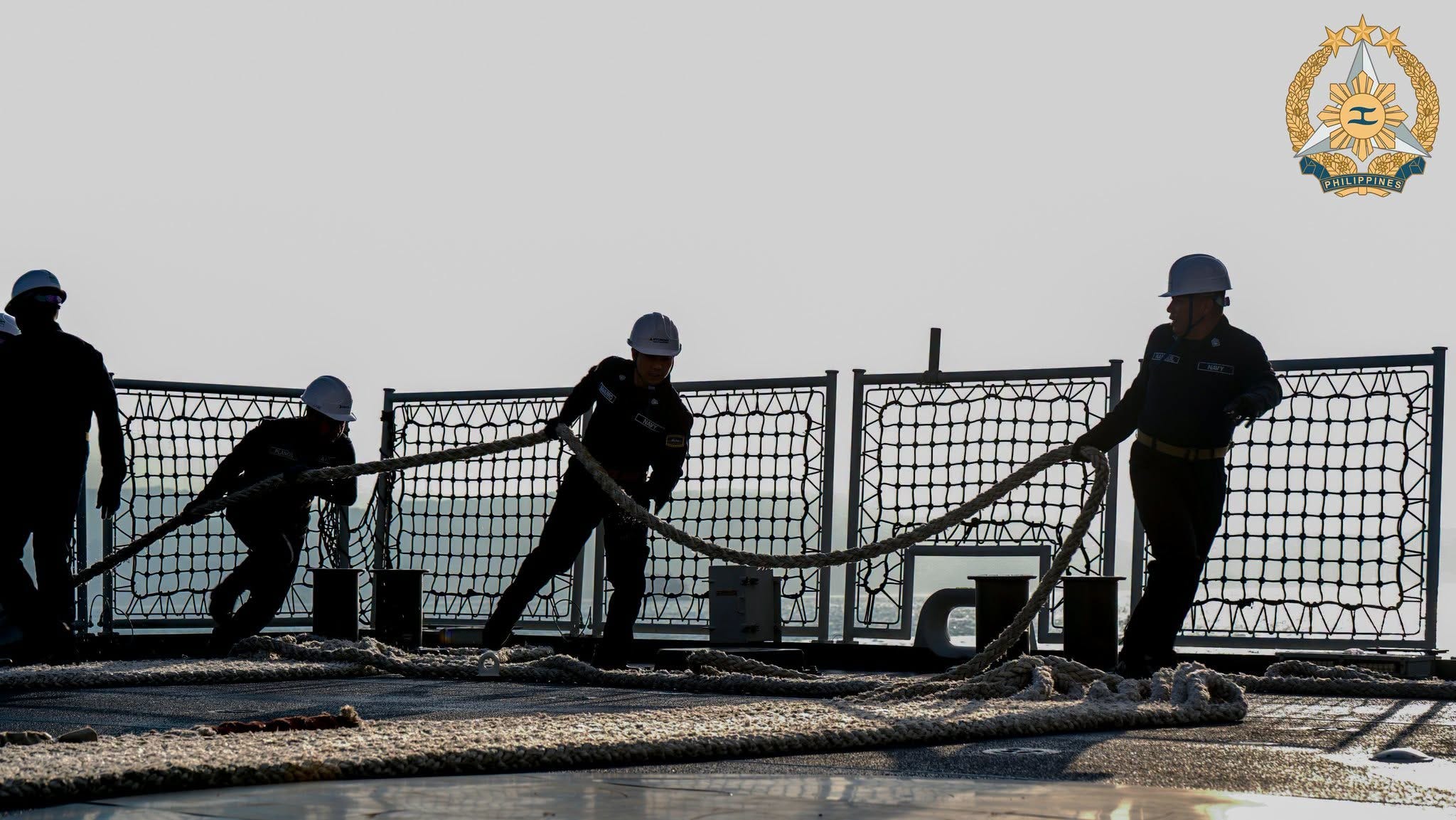
BRP Diego Silang (FFG7) personnel securing the mooring line for the 19th Multilateral Maritime Cooperative Activity (MMCA) in the West Philippine Sea last August 19 to 25, 2026. Official handout.
Rodney J. Jaleco | September 14, 2026
WASHINGTON D.C.(Sept. 12, 2026) — Crafting the Philippine defense budget — now working its way through Congress — has become inseparable from wrestling with the problem of corruption, particularly billions in ghost flood control projects that have still to be fully investigated and prosecuted. Winning that battle could be crucial for the country’s security.
The defense budget has to fund both current operations — including a proposed 5 percent increase in soldiers’ pay and extension of the subsistence allowance — and the long-term Armed Forces modernization law that’s due to expire in 2028. But the initiatives are plagued by declining appropriations even as external threats, especially from China, continue to grow.
The Dept. of Budget & Management allocated from P324.6 billion to P328.8 billion for defense, about eight percent more than last year’s budget but lower than the P350 billion sought by Defense Secretary Gilberto Teodoro Jr. About P75 billion will go to pay hikes and another P31 billion to extend the subsistence allowance for about 246,000 active-duty troops.
About P50 billion is earmarked for modernization, a 25 percent increase over this year’s expenditure, but far short of the P127 billion Teodoro had requested. Most of it will go for the amortization of weapons procured from previous years (the military actually owes P57 billion in 2027 for installment payments on hardware bought on credit). (Also read: The military modernization fund faces big challenges)
Under the Re-Horizon 3 schedule, modernization initiatives would revolve around three structural pillars: air and naval capability upgrades (procurement of advanced fighter aircraft, submarines and long-range surveillance systems); core command systems (acquisition of IT, communications, drone technology and electronic warfare capabilities); and bases and infrastructure support. (Also read: Philippines’ strict requirements for supplying defense equipment)
Some have criticized the modernization plan for its overemphasis on expensive big-ticket equipment, reportedly ignoring the changing nature of modern warfare with the emergence of unmanned platforms. The government has also lagged behind promoting the growth of private investments in defense industries, deemed by some as crucial to sustaining long-term modernization goals.
Implementation has been hampered by severe funding shortfalls. Horizon 1 (2013-17) left 17 unfinished projects; the AFP delivered only about a quarter of 97 projects between 2018 and 2022 which covered Horizon 2), leaving 78 projects technically unfinished, delayed or unawarded. These unfinished projects were either rolled into Re-Horizon 3 or surviving on a multi-year back-payment backlog.
Among the still to be realized Horizon 2 projects are the procurement of 12 multi-role fighter jets (e.g., American F-16 Falcon or Swedish JAS-39 Gripen); launch of the diesel-electric submarine program, two additional Miguel Malvar-class frigates, six offshore patrol vessels and balance of the nine Acero-class fast patrol boats; and infrastructure support for radars to be supplied by Japan that’s still waiting for the funds to build them.
Faced with these financial difficulties, the Philippines has been forced to rely on the help of allies like the United States and Japan to fill some of the gaps. The US Congress incorporated the First Island Chain Security Cooperation Initiative that bundles $1.5 billion in military aid to boost the defense of the Philippines and Taiwan in the proposed 2027 National Defense Appropriations Act.
A separate Philippine Enhanced Resilience Act aims to provide another $2.5 billion in military assistance spread over five years. But these two huge packages are also being subjected to formidable political headwinds — the Pentagon’s unprecedented $1.15 trillion ask from Capitol Hill is buffeted by the uncertainty over the US war against Iran. (Also read: AFP playing catch up on drones, faces fresh challenges with laser weapons)
The public works scandal and the ongoing impeachment of Vice President Sara Duterte for an entirely different corruption issue has triggered a fiscal reform mood in the Philippines. The flood control scam didn’t directly affect the AFP but it blew up the entire public works budget model tha the AFP modernization was competing with.
Until investigations conclude — including with the recent arrest of former House Speaker Martin Romualdez for alleged P7.4 billion in kickbacks — Congress is under probation, a “prove it first” mode.
The public is in a sour, sensitive mood over big budgets. This isn’t the first time the military is asking for a very big share of taxpayers money — it certainly won’t be the last — and despite demonstrated dangers from across the frontier, it’s still up to the state to convince citizens they’ve finally stemmed the venality.
