

By: Manuel Mogato | Published: October 3, 2025
Reading Time: 6 minutes
Changing a corrupt regime will not succeed without one of the three most critical ingredients – the people, the church, and the military.
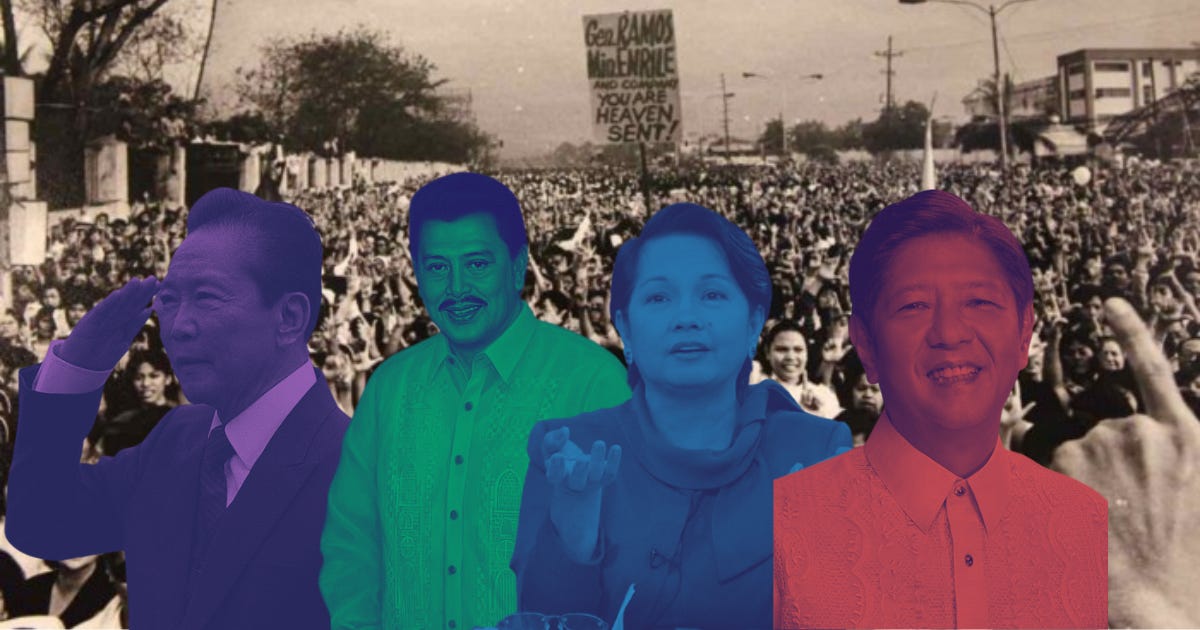
This was the Philippine template, proven in February 1986 and replicated in January 2001, at the exact place along EDSA.
In the last days of the dictator in 1986, a faction in the military plotted a classic coup d’état to install a defense minister sidelined by those preparing to succeed Ferdinand Marcos Sr. in case he dies.
He was very sick.
The coup plotters were exploiting the people’s anger, who believed Marcos had stolen the snap elections through massive vote padding and ballot snatching.
But the plot was discovered. Army Captains Jake Malajacan and Ricardo Morales were caught trying to lead a group that would assault the presidential palace.
That forced then-Defense Minister Juan Ponce Enrile to break away from Marcos, admitting he helped rig the elections to favor the ailing president.
Luckily, a respected general, Fidel Ramos, sided with him, and they decided to dig in at Camp Aguinaldo.
Just a stone’s throw away, General Fabian Ver was consolidating his forces to quell the mutiny.
That was when the archbishop of Manila, an influential Roman Catholic prelate, Cardinal Jaime Sin stepped in and called on the people to rally behind Enrile and Ramos.
Subscribe to the API Newsletter
Bite-sized updates sent straight to your inbox.
Success!
First Name
Last Name
By signing up, you agree to our User Agreement and Privacy Policy & Cookie Statement. This site is protected by reCAPTCHA and the Google Privacy Policy and Terms of Service apply.
By the third day of the standoff, the balance of forces had tilted in favor of Enrile and Ramos.
One by one, military commanders in the field pledged loyalty to the Armed Forces vice chief of staff, leaving a few commanders supporting Ver.
The Roman Catholic Church and the people prevented what could have been a bloody confrontation between two military factions – one loyal to Marcos and the other belonging to the Enrile-Ramos group.
Fifteen years later, on a cool January month, it was a cohesive military that ended a three-day standoff between a corrupt leader, Joseph Estrada, who was later convicted of the crime of plunder, and the people demanding he step down from power for taking bribes and kickbacks.
Once again, Cardinal Jaime Sin supported the people movement.
The military sided with the people.
The late General Angelo Reyes withdrew support from Estrada, bringing with him the entire Armed Forces leadership in a display of unity.
The power was handed over to Estrada’s vice president, Gloria Macapagal Arroyo, who nearly suffered the same fate due to corruption issues.
In 2006, under the weight of electoral fraud and the NBN-ZTE kickback scandal, a faction of the military was getting restive as people began to march on the streets to demand accountability.
The move to remove Arroyo, the most unpopular leader in the country’s history with a minus 50 rating, did not succeed.
The military and the civilian population were divided and the Church was lukewarm.
A fourth ingredient was necessary — a viable and credible successor is needed.
Broadcaster Noli de Castro who was elected vice president was reluctant to replace Arroyo. Many didn’t trust him to handle the job.
On September 21, President Ferdinand Marcos Jr faced a situation similar to what his father, Estrada, and Arroyo had before.
The people were angry at the magnitude of corruption in government as lawmakers, public officials, and private contractors colluded to steal billions of government funds.
What saved Marcos Jr was the fourth ingredient – Vice President Sara Duterte did not have the support of the Church, the military, and a large majority of the population.
A variation of EDSA Dos was being planned. The members of the Armed Forces of the Philippines (AFP) were trying to avoid shooting at each other, so the top brass wanted to preserve the military’s unity and cohesion.
If the military were to take an action, it should move with precision in cadence with the people.
But a top Army commander had rejected the vice president as Marcos Jr.’s successor.
Some civilian sectors, including a large group of retired generals, were ready to support a military action, provided the vice president would not be installed as the next leader. Only a few of the die-hard Duterte supporters wanted the vice president to take over, including a large Christian sect.
They wanted a civilian-military council of 30 people to rule until elections are called, without the participation of traditional politicians and political dynasties who were behind the corruption.
However, Roman Catholic bishops rejected both extra-constitutional measures and the vice president’s rise to power. The bishops wanted the military and the angry population to wait for the 2028 elections for a smoother transfer of power, hoping a politician with a good heart and clean hands would rise.
Without a Cardinal Sin, the Roman Catholic Church was still searching for a voice. Sin’s successor in the Archdiocese of Manila – Gaudencio Rosales, Luis Antonio Tagle, and Jose Advincula avoided politics.
Caloocan bishop, Cardinal Pablo David, appeared to be slipping into the shoes of Cardinal Sin. He was the most vocal critic of former President Rodrigo Duterte’s war on drugs policy.
Does the Church’s voice carry weight? It remains to be seen. There is still danger of an extra-constitutional move, similar to what had happened in January 2001 could happen.
Although the destabilization threats had been reduced after the attempt was aborted on September 21, former Senator Antonio Trillanes, one of those who led a mutiny in 2003, said the situation remains fluid and there is a low level threat against Marcos Jr.
It will depend on how fast the government can resolve the corruption issue — file criminal charges against all involved in the anomalies in government infrastructure projects, and jail them soon.
It will also depend on how credible the fact-finding investigation done by the Independent Commission on Infrastructure.
There must be transparency to assure the public that there is no cover-up in the inquiry. A sweeping investigation, on the other hand, could threaten Marcos’ political capital as his allies might abandon him.
Marcos is threading on unchartered waters. He had opened a pandora’s box and it might reach his doorstep.
The extra-constitutional measure remains attractive and an option if Marcos doesn’t show results fast enough.
The post A template for regime change appeared first on asiapacificinsights.com.