


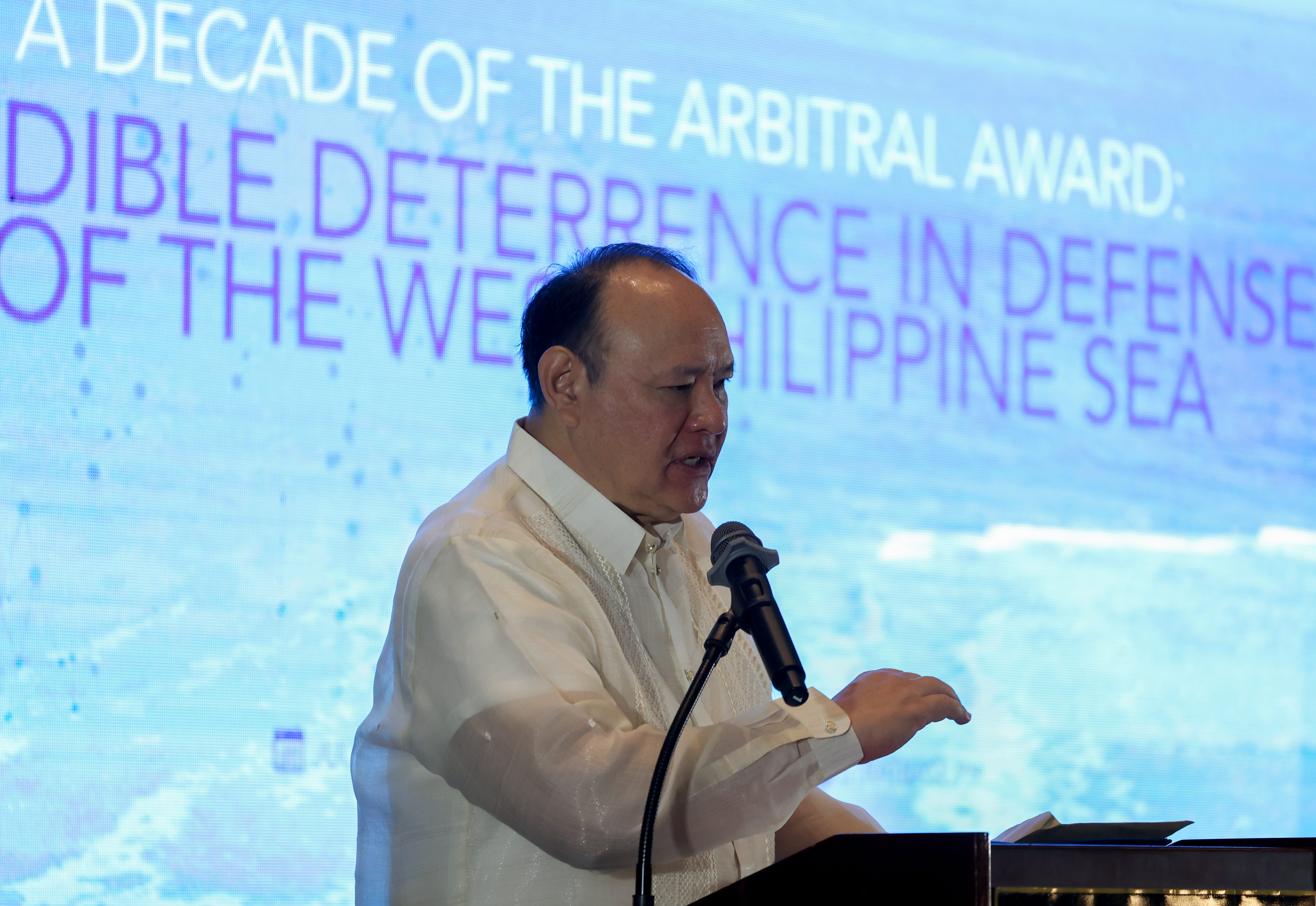
Defense Secretary Gilberto Teodoro Jr speaking at Stratbase Institute’s high-level conference that commemorated that 10th anniversary of Friday, July 10, 2026. Official handout.
Manuel Mogato | July 13, 2026
MANILA — Defense Secretary Gilberto Teodoro Jr called on like-minded countries to build a “coalition of resistance” against China’s growing influence in the region, as the Philippines marks the 10th anniversary of the landmark legal victory in the West Philippine Sea.
Speaking to journalists at a peace walk in Rizal Park to commemorate the victory at the Permanent Court of Arbitration in The Hague, Teodoro said the Philippines must sustain its deterrence posture to protect the country’s maritime interests.
“This is an everyday effort,” Teodoro said. “We should not stop this effort even for a brief second. I cannot overstress the importance of building up our deterrent capabilities at the soonest possible time.”
China claims almost the entire South China Sea, where $3 trillion in trade passes annually. Brunei, Malaysia, the Philippines, Taiwan, and Vietnam also have conflicting claims over the strategic sea lanes, believed to contain rich deposits of minerals and energy resources.
Teodoro said the deterrence efforts may not be enough to stop China from encroaching into the maritime zones of other coastal states in the region, as Beijing continued to strengthen its armed forces. (Also read: Teodoro: West Philippine Sea should unite Filipinos, not divide them politically)
“We have to resist China,” he said. “It will not deter China, which is determined, and the deterrence of China will take several other measures.”
He suggested building “a coalition of resistance” as more countries supported the Philippines’ position on the West Philippine Sea.
“The nine-dash-line is false,” he stressed. “On that basis, a lot of countries have already converged to deny China the space that it had before. Particularly space in the information arena that is really important for building a coalition of resistance.”
Teodoro said the past administration accommodated and appeased China, and Beijing had taken advantage of that policy.
But the 2016 arbitral decision had awakened Filipinos’ consciousness of the importance of their maritime zone as an archipelagic state.
“The West Philippine Sea victory made us realize the importance of our maritime domain, our seas, including the Philippine Rise,” he said.
The Philippines decided to seek arbitration at the International Tribunal for the Law of the Sea in 2013 after China seized control of Bajo de Masinloc a year earlier, denying Filipino fishermen access to a disputed shoal, a rich fishing ground.
Three years later, the arbitration court in The Hague awarded the Philippines economic entitlements and nullified China’s expansive nine-dash-line claims.
China ignored the ruling and continued to call on the Philippines to resolve the dispute through bilateral negotiations.
However, the award prompted the international community to support the Philippines on the maritime issue, but no third country backed China’s claims.
As a result, six states — Australia, Canada, France, Japan, New Zealand, and the United States — had entered into status of forces agreements with the Philippines to boost its maritime domain awareness and strengthen deterrence posture. (Also read: At least 10 like-minded states affirm their support for the Philippine position on the West Philippine Sea)
Teodoro said it is important for the Philippines and like-minded countries, including the European states, India, and South Korea, to isolate and discredit China’s narrative in the disputed seas.