

Stratbase Institute | July 10, 2026
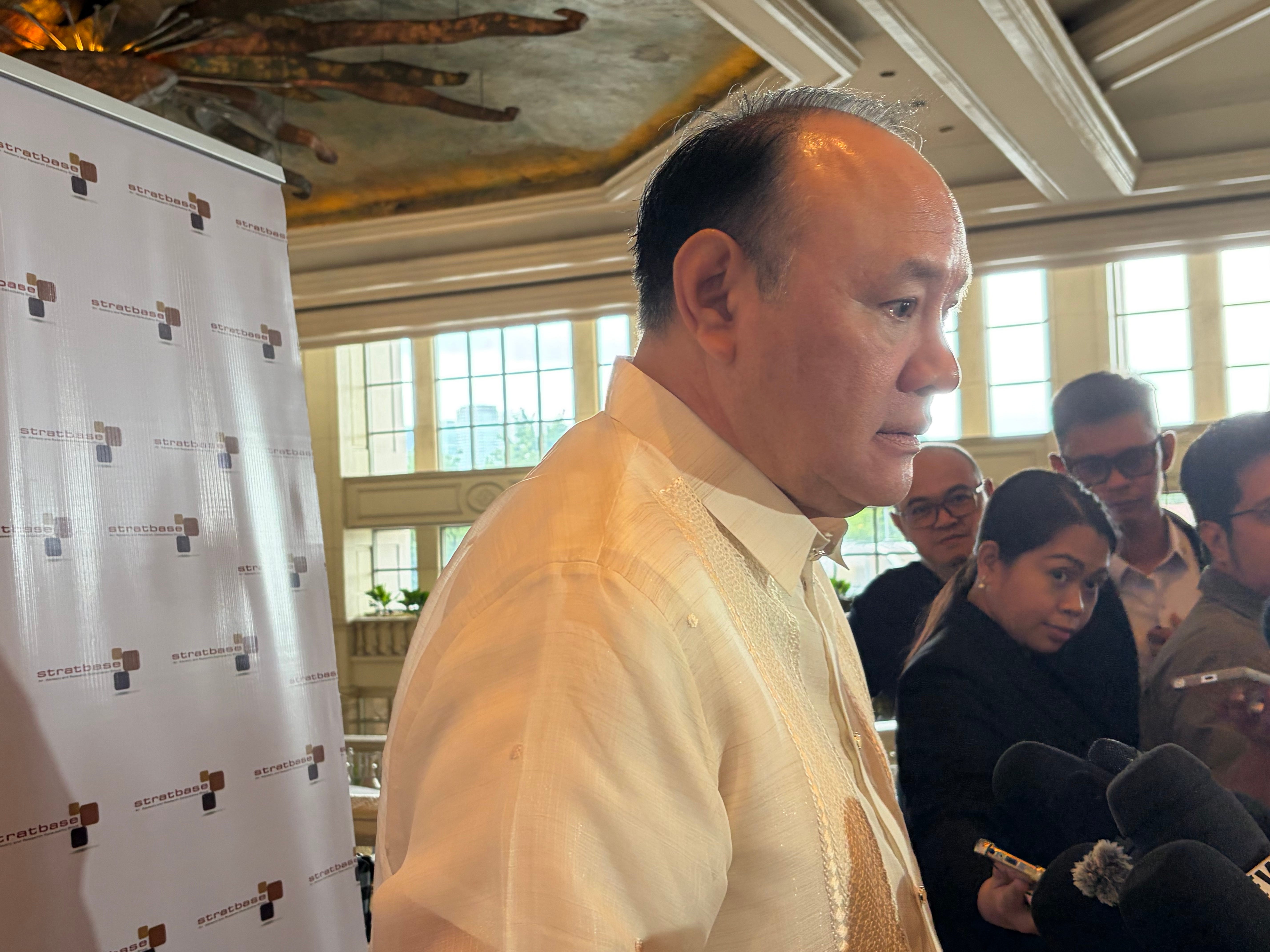
MANILA — Defense Secretary Gilbert Teodoro Jr. on Thursday urged Filipinos to treat the West Philippine Sea as a matter of national interest rather than partisan politics, stressing that the country’s sovereign rights and territorial integrity should never be subject to political division.
Speaking during the 10th anniversary commemoration of the landmark 2016 Arbitral Award organized by the Stratbase Institute, Teodoro said the award that invalidated Beijing’s sweeping claims over the South China Sea “was not only an award for the Philippines, but an award for the world.”
Though there may be critics seeking to dismiss the award as a mere “piece of paper,” the defense secretary called on Filipinos to “unite around core principles involving the country’s sovereignty...We cannot afford consensus but we need convergence. We need purpose against a determined adversary whose relentlessness is uncaring for its own people.”
This as China continues to undermine the historic award that invalidated its sweeping nine-dash line claim in the South China Sea and affirmed the Philippines’ sovereign rights within its exclusive economic zone. The case was brought before the Hague by the Institute’s former chair and Foreign Affairs Secretary Albert del Rosario in 2013.
Teodoro noted that this mere “piece of paper” has since become the foundation of a broader national effort to defend the country’s maritime rights and had strengthened international support for the Philippines.
“It has formed the basis of a national effort to be aware of its entitlements, to be aware of the importance of our maritime rights, not only for us but for future generations of Filipinos,” he said.
Teodoro added that the ruling had also transformed the country’s defense posture and encouraged cooperation with allies and partners.
“It has motivated an armed force to shift from a mono-theater focus to a multi-domain, multi-theater armed force. It has been a paper of convergence of several countries who find common cause with the Philippines, from our Pacific neighbors, to the Indian Ocean, to Europe,” he said.
“As proof of the potency of this piece of paper,” he said, “this year’s Balikatan exercise was the largest in history. And we do not credit anyone but we credit the power of law expressed and enunciated in words,” he said.
This sentiment was echoed by Stratbase Institute President Victor Andres “Dindo” Manhit, who lamented that previous rhetoric dismissing the ruling in previous years weakened the country’s strongest legal asset.
“We must also be honest about a hard chapter in this journey,” Manhit said in his opening remarks. “When the Philippines won in The Hague, the country did not immediately deploy the full moral, diplomatic, and strategic weight the Award afforded it.”
Manhit pointed to statements made after the 2016 ruling describing the arbitral award as something to be “set aside,” “thrown away,” or “just a piece of paper.”
“Whatever the intention behind those words, they exposed an agenda that works against the national interest: to make the Philippines hesitate in defending its own legal victory, and to give external pressure room to erode what the law has already secured,” Manhit said.
“This is not a partisan observation. It is a factual one, and it is precisely why institutions like ours exist – to make sure that no single administration’s posture can determine the permanent value of a national asset like this Award,” he added.
For the next 10 years, he said, the country must work to preserve the gains of the award by building a modern, integrated, multidomain defense posture supported by the government, the private sector, civil society, and international partners.
He noted that the Institute has stood at the forefront of these efforts by gathering together like-minded government leaders, experts, diplomats and civil society actors, and this collective principled stand “translated into practice, year after year: visiting forces arrangements, joint and multilateral maritime patrols, defense and cyber dialogues, intelligence-sharing, coast guard cooperation, and defense modernization support.”
Manhit highlighted the Philippines’ expanding network of Visiting Forces Agreements (VFAs), noting that the country has now concluded such agreements with six nations—the United States, Australia, Japan, New Zealand, Canada, and, most recently, France, which became the first European country to sign a VFA with Manila earlier this year.