

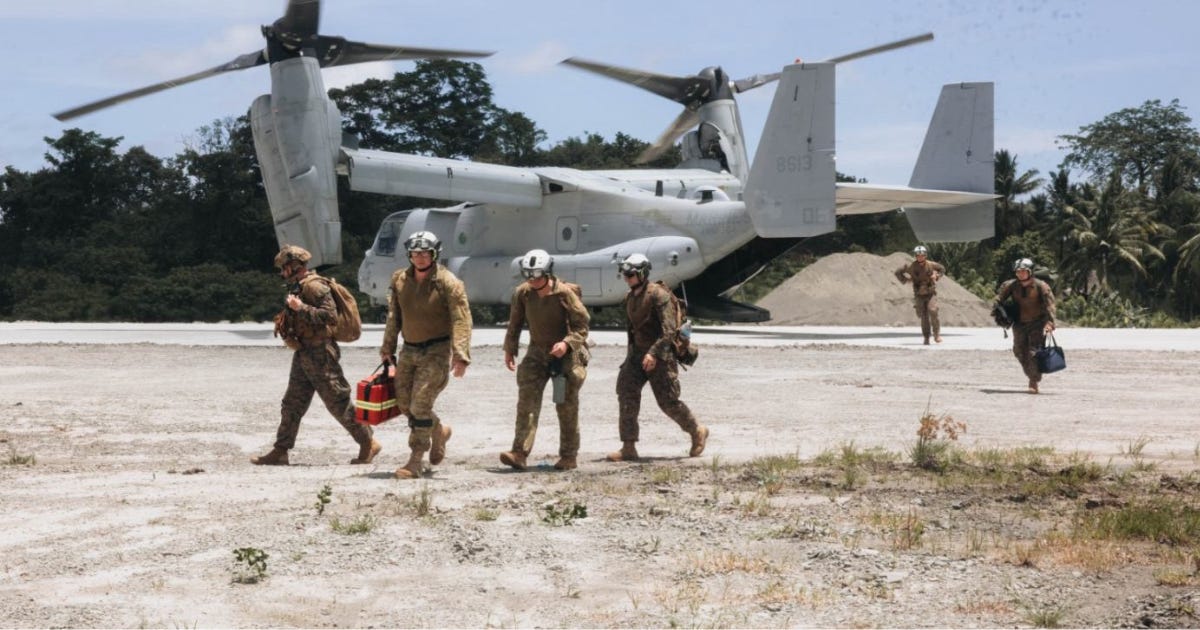
U.S. Marines and Australian soldiers exit an MV-22B Osprey during a coastal security operation for Exercise Balikatan 25 near Puerto Princesa, Palawan, May 5, 2025. Photo from Armed Forces of the Philippines.
By: Manuel Mogato | Published: May 8, 2025
Reading Time: 6 minutes
MANILA — Is the United States seriously preparing for a massive Chinese invasion of what it claims is a renegade province?
Senior US military leaders have been predicting a Chinese invasion of self-ruled Taiwan by 2027 to complete China’s reunification.
After the Chinese Communist Party (CCP) gained dominance in China in 1949, Beijing first annexed Tibet in 1950, which had been part of China from the Yuan to Qing dynasties.
Then, the British gave up control of Hong Kong in 1997, and the Portuguese returned Macau to China in 1999.
Only Taiwan remained, an island where Chinese nationalist forces under General Chiang Kai-shek occupied after their defeat in a civil war after World War II.
President Xi Jinping did not rule out using force to recover Taiwan, opposing efforts to declare its independence.
Since coming to power, Xi has been planning to retake Taiwan, sending waves and waves of People’s Liberation Army (PLA) fighters, bombers, and combatant vessels around Taiwan in what appeared to be a dress rehearsal for an invasion.
Taiwan responded by scrambling its fighters and deploying naval vessels to shadow the PLA’s carrier strike group and other vessels around the island.
Washington and its allies, like Tokyo, Manila, and Canberra, were deeply concerned with Beijing’s air and maritime exercises as these activities became more frequent, larger, and closer to the island.
The United States also started preparing to defend Taiwan because the island’s democracy was not at stake, but its economy as well.
Subscribe to the API Newsletter
Bite-sized updates sent straight to your inbox.
Success!
First Name
Last Name
By signing up, you agree to our User Agreement and Privacy Policy & Cookie Statement. This site is protected by reCAPTCHA and the Google Privacy Policy and Terms of Service apply.
Taiwan’s semiconductor industry is the world’s largest, supplying computer chips to mobile phones, other consumer and home gadgets, and weapon systems, including missiles.
Washington has asked Tokyo to host the deployment of a Typhon missile launcher, mid-range capability (MRC) , which it sent to Manila in April 2024.
It also deployed long-ranged high mobility artillery rocket systems (HIMARS) to Japan’s southern islands, closer to Taiwan.
Japan also promised to provide logistics support, including food, fuel and munitions to US forces in case of a conflict.
In the defense of Taiwan, the Philippines could be the weakest link because of its limited capability and capacity.
It was only during the early years of the Marcos administration that the US gained access to local military bases in northern Luzon, two in Cagayan provinces and one in Isabela province under the expanded Enhanced Defense Cooperation Agreement (EDCA).
Batanes was not part of EDCA but US forces have started training on Mavulis and Batan islands. They also have access to a civilian airfield in Basco.
Before EDCA was signed in 2014, US military aircraft had been landing and taking off from the airport for refueling before heading to US bases in Okinawa.
During the Afghanistan and Iraq invasion in early 2000, the so-called global war on terror, US helicopters illuminated the Basco airfield to allow the fighters to land because it had no runway lights.
Apart from the Typhon missile launcher, which can deliver Tomahawk cruise missiles and Standard SM-6 conventional and nuclear missiles, reaching deep into Chinese territories, the US brought this year new weapons systems – the Navy-Marine Expeditionary Ship Interdiction System (NMESIS) and the Marine Air Defense Integrated System (MADIS).
The two new equipment would enhance the country’s deterrence capability, particularly its anti-access and area denial (A2AD), keeping away from the country’s coast hostile ships. Recently, a Chinese carrier battle group tested the country’s defense by sailing within the 12 nautical mile territorial waters in northern Luzon.
China knew the Philippines had no A2AD capability in that part of the country because the two Indian-made Brahmos missiles were deployed facing the West Philippine Sea.
The Philippines still does not have NMESIS and MADIS to deter Chinese ships and planes.
Neither weapon system was part of live-fire simulations when Philippine and US forces tested how both militaries could operate together to repulse amphibious operations during counterlanding drills, the main part of the 19-day annual combined and joint Balikatan exercises, the 40th iteration.
Philippine ground forces fired their 105mm self-propelled howitzer and 155mm autonomous truck-mounted howitzer systems.
Several Sabrah light tanks and armored vehicles were deployed on the coastlines of Aparri to anticipate a “hostile landing force” played by an amphibious task group.
The Americans sent F-16 multi-role fighters and AH-64 attack helicopters to provide air cover.
During the drills, a US P-8 Poseidon surveillance aircraft detected the amphibious landing force, alerting US and Philippine ground forces.
A week ago, a similar counterlanding drill was made in Palawan.
Past Balikatan exercises focused more on counter-terrorism, humanitarian operations, and amphibious landing drills in a scenario to retake an island.
This year, the two allies, for the first time, tested a different scenario, counterlanding operations, an excellent preparation in case of a Chinese invasion of Taiwan.
In case a conflict erupts, the Philippines would not actively take part in the defense of Taiwan but would provide logistics and humanitarian support to US forces.
The Batanes islands would be strategic and an important choke point for China’s invasion forces which would pass in the area. The EDCA sites in many parts of the country would be strategic locations to stop China’s planned invasion.
In Guam, the US has forward deployed its strategic bombers, destroyers, and nuclear submarines.
This equipment could be easily moved to forward bases in the Philippines. For instance, the squadrons of fighters from South Korea and Japan.
Thus, the recent Cope Thunder exercises were useful; a squadron of F16s and F18s was deployed during the drills.
Demonstrating the Philippines and US alliance, the two militaries were preparing to sink an old warship, BRP Miguel Malvar, about 30 nautical miles west of the Zambales coast.
Unfortunately, the decommissioned vessel sank before the drills could start, forcing the Philippines and US to call off the sinking exercise.
It could have been the third time in three years the two allies sank a World War II ship, but it was supposed to be the first time the Philippines would test its ship-installed missile systems.
An Israeli-made Acero-class fast attack interdiction craft was suppoed to fire its short-ranged ER Spike missile, and the BRP Antonio Luna tests its South Korean C-Star cruise missile.
An FA-50 light fighter and an A-29 Super Tucana were also supposed to provide close air support planes to deliver the finishing blow to the decrepit vessel.
The Philippine military displayed improved firepower during the 19-day drills, participated by almost two dozen countries as observers.
It was a rare show of an enhanced deterrence capability under the defense department’s new Comprehensive Archipelagic Defence Concept.
The Americans might be helping Filipinos test a counter-amphibious landing operation, but it sharpens the A2AD capabilities and increases deterrence.
The post Testing CADC strategy: deterrence drills appeared first on asiapacificinsights.com.