

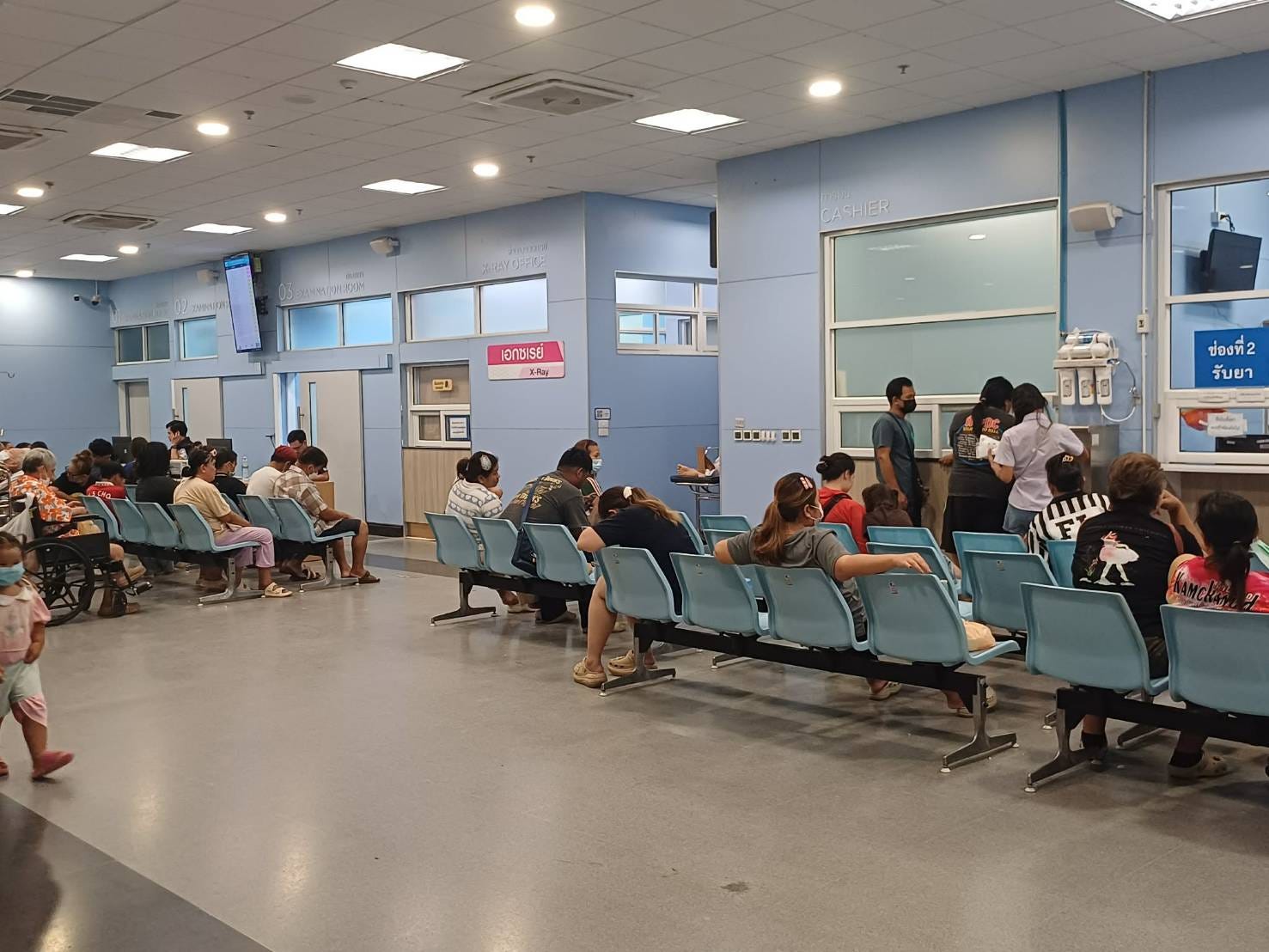
The atmosphere at a hospital in Nakhon Sawan province, where patients and their families gather to seek medical care.
Kunravee Sukhimoke | August 30, 2026
BANGKOK — Thailand’s “30 Baht Healthcare” scheme, or Universal Health Coverage (UHC) scheme, introduced nationwide about 25 years ago, has enabled millions of Thais to access healthcare without fear of higher medical bills, a heavy financial burden on their families.
For instance, a villager in Nakhon Sawan province recalled the difficulties faced before the 30 Baht scheme, when treating an illness would cost not only medical bills but also transportation and other expenses.
“I saw someone carrying a child along the road to the hospital because they had no vehicle,” the unnamed villager said. “The child had a very high fever. During the rainy season, it was often dengue fever. I helped drive them to the hospital. Back then, there was no hospital transport. Now it’s better — an ambulance can come and pick them up.”
He also recalled a patient with fluid in the lungs who needed an MRI. At the time, the patient had to travel to another province and faced high costs.
“Without the 30 Baht scheme, where would we get the money to pay for treatment? More than 20 years ago, we had to travel from Nakhon Sawan to Phitsanulok. An MRI cost 30,000 baht. That was a lot of money. Without the healthcare scheme, for some people, the only option would be death.”
However, continuing budget pressures have raised questions about how Thailand can sustain the coverage and quality of the system in the long term.
Funding fails to keep pace with hospital workload
Professor Dr. Manop Pithukpakorn, a member of the Faculty of Medicine Siriraj Hospital, Mahidol University, said the main problem facing the UHC scheme is that funding does not match the workload of healthcare providers.
“The biggest problem now falls on the service providers. It’s about money. The more they do, the more they lose,” he said.
As the number of patients increases, hospitals must provide more medicines, equipment and staff, while funding does not always increase in line with demand.
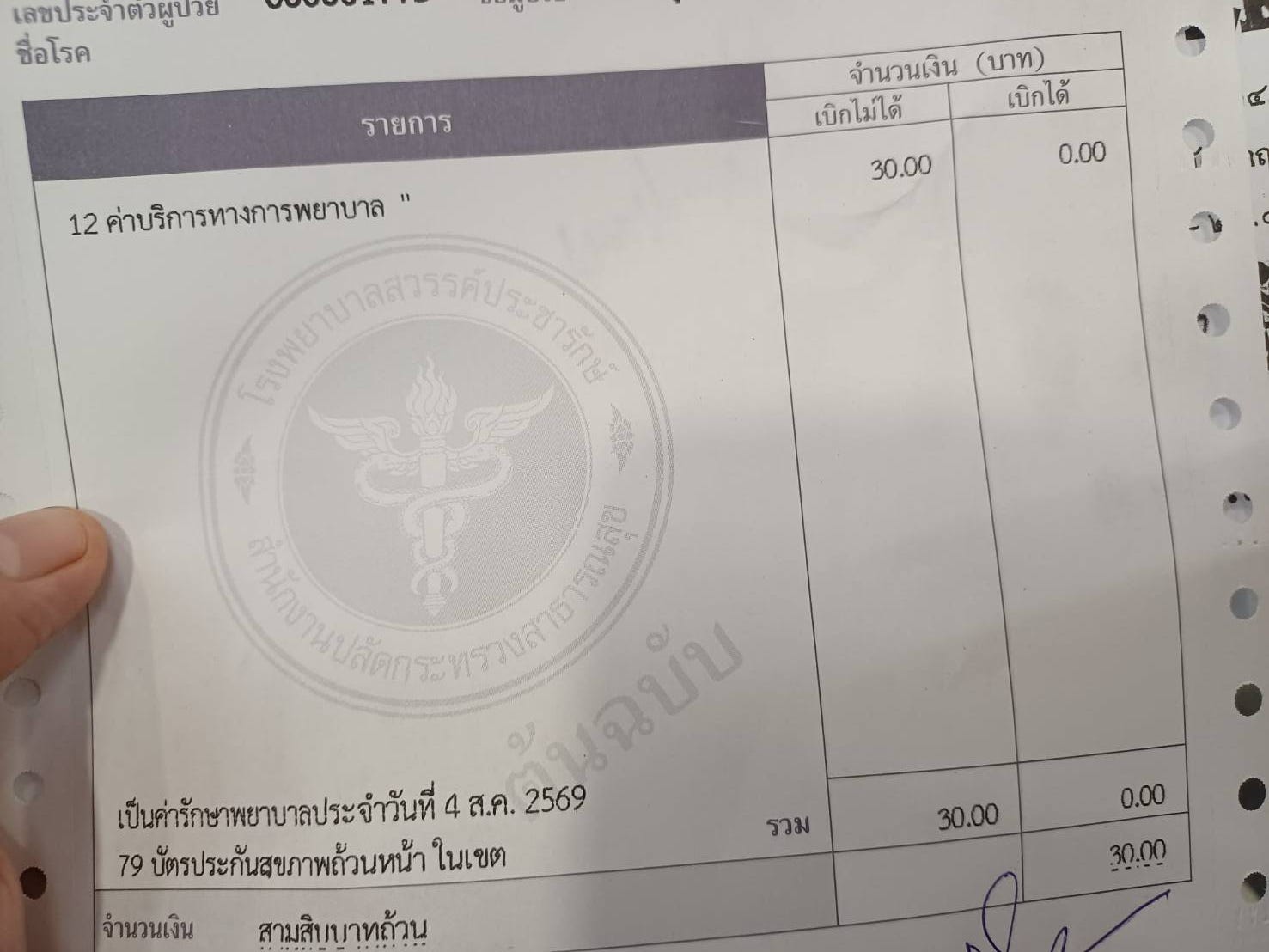
A receipt showing a 30-baht payment for medical services under Thailand’s Universal Health Coverage (UHC) scheme, reflecting the low-cost healthcare access provided to eligible patients.
Manop outlined three possible options: increase funding to match demand, limit unnecessary services, or allow some form of copayment.
Former Deputy Prime Minister and former Deputy Minister of Public Health Surapong Suebwonglee said it is important to distinguish between copayment, a fixed fee such as the 30-baht charge, and co-insurance, in which patients pay a percentage of their medical costs.
For example, a 10% co-insurance payment on a 10,000-baht medical bill would cost a patient 1,000 baht. On a 100,000-baht bill, the patient would have to pay 10,000 baht.
For higher-income patients, such costs may not be a major obstacle. But for poor households, percentage-based payments could prevent people from seeking treatment or bring back the problems that existed before universal healthcare — avoiding hospitals because of cost or falling into financial hardship because of medical bills.
“Proposals such as amending the National Health Security Act to increase the representation of healthcare providers on the board are not the answer,” Surapong said.
Surapong said the challenges facing the UHC system also include doctor shortages, heavy workloads for healthcare workers, disease prevention and hospital management.
Public hospitals should undergo greater scrutiny of their financial accounts, including revenue and expenditure, and doctors, nurses and other healthcare workers should also receive compensation that reflects their workloads and current living costs.
He cited Ban Phaeo Hospital, a public organisation, as an example of a hospital with greater flexibility in managing its staff and finances, and said the model should be expanded.
Planning for the future with insufficient data
Budget problems in the UHC scheme typically resurface between July and September, the final months of Thailand’s fiscal year.
“It comes back every year, in July, August and September, because that’s the end of the fiscal year. The government’s fiscal year starts on October 1 and ends on September 30.”
Surapong explained that Thailand’s health budget is prepared roughly 18 months in advance, requiring the government to forecast future patient numbers and healthcare costs even though actual demand may change significantly.
Fragmented health data compounds the problem. Although hospitals collect large amounts of information, the data is not fully connected, making it difficult for policymakers to see the full picture of healthcare use and spending.
Surapong has proposed “The 30 Baht AI policy is about connecting all the data … and using AI to forecast what will happen in the next year and a half.”
The goal is to give the government a clearer picture of patient numbers, illnesses and healthcare costs to improve long-term budget planning.
Thailand’s healthcare system and politics
When it was first introduced, the 30 Baht scheme was widely feared to place such a heavy burden on the healthcare system that it could lead to financial collapse. It ultimately became one of Thailand’s major healthcare policy achievements and a model studied and adapted by other developing countries.
The policy also transformed Thai politics. The Thai Rak Thai Party campaigned in the 2001 election on the 30 Baht scheme, village funds and OTOP (One Tambon One Product), winning more than half of the seats in parliament and helping establish “policy-based politics” as a central part of Thai elections.
“It was the first time in Thai politics that a political party used policies as a tool for campaigning... After that, every party had to try to offer policies to tell voters what they would do,” Surapong said.
The government expanded the 30 Baht scheme nationwide on October 1, 2001, just seven to eight months after Thaksin Shinawatra took office as prime minister.
“Thai people’s lives changed forever. People who had never dared to go to the hospital because they had no money... and people who had gone bankrupt because of medical treatment — that disappeared.”