

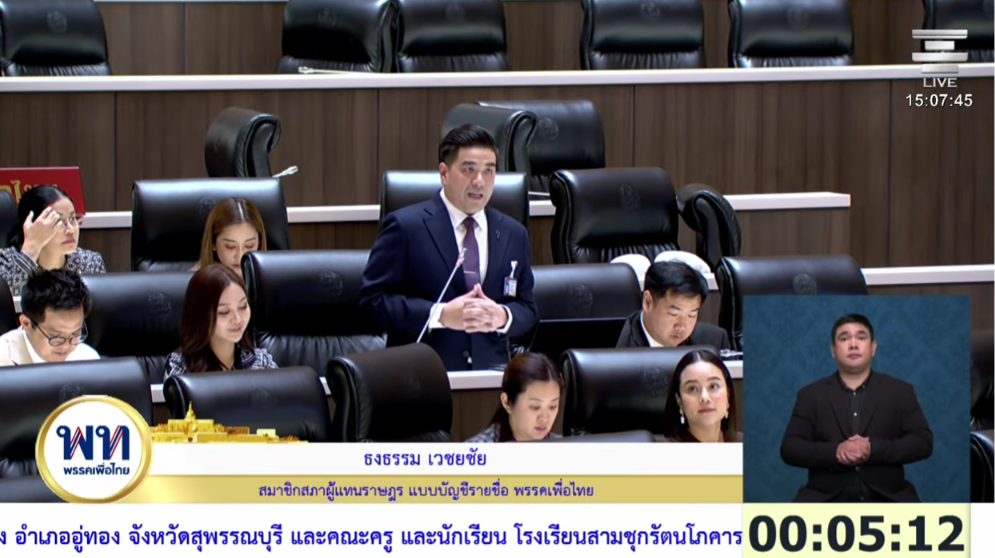
Thongtham Wechayachai, a Pheu Thai Party list MP, told parliament on July 8, 2026, that the bill was a practical first step based on areas of agreement. (Photo: Parliamentary Radio and Television Station)
Kunravee Sukhimoke | July 9, 2026
Bangkok — Thailand’s parliament passed a landmark amnesty bill on Wednesday that would benefit activists convicted in political cases over the past 20 years.
However, the bill excludes controversial offences under Section 112 of Thailand’s Criminal Code, corruption cases, and cases involving deaths or serious injuries.
Section 112, known as the royal defamation law, remains a highly divisive issue. Supporters say it protects the monarchy, national security, and public order, while critics argue that its harsh penalties and broad interpretation may restrict freedom of expression.
A Two-Decade Political Conflict
“When discussing amnesty, cases linked to Section 112, which many view as arising from political movements, should also be given an opportunity,” said Nuttawut Saikua, former chair of the parliamentary committee, in a Voice TV interview.
However, he acknowledged that including Section 112 cases could have reignited political tensions. The committee therefore expanded the bill’s scope from more than 10 to over 30 offence categories to cover more politically related cases.
The bill covers political cases from 1 January 2005 to 16 July 2025, spanning more than 20 years of political unrest and applying to people across Thailand’s political spectrum, often referred to as “all colours.”
The groups include the People’s Alliance for Democracy (PAD), the United Front for Democracy Against Dictatorship (UDD), the People’s Democratic Reform Committee (PDRC), and the Ratsadon movement.
“No side involved in two decades of conflict will get everything, and no group will lose everything,” Nuttawut said, describing the amnesty effort as an attempt to ease long-running political divisions.
A First Step Forward
The People’s Party and its supporters oppose the bill for excluding Section 112 cases. However, some lawmakers say it would allow thousands affected by political cases to return to normal life sooner.
Thongtham Wechayachai, a Pheu Thai Party list MP, supported the bill, saying moving forward with what was possible now was more important than waiting for a process that could take nearly another year.
“A real first step is worth more than a perfect step that never happens,” he told parliament.
He said the government should “move as far as possible in the first step” based on areas where consensus already exists, while leaving more sensitive issues for future discussions when society is ready.
“Democracy does not mean everyone has to think the same way. It means people with different views can still move forward together,” he said.
Amnesty and Section 112
Last year, the House of Representatives rejected the principles of the public amnesty bill and the draft proposed by the Move Forward Party, now known as the People’s Party.
The House, however, accepted drafts proposed by the Bhumjaithai Party, the Thai Teachers for the People Party, and the United Thai Nation Party. These versions excluded offences under Section 112 but included the offence of rebellion under Section 113.
In 2013, the Pheu Thai Party previously introduced an amnesty bill covering political events from 19 September 2006 to 8 August 2013. The proposal covered most political cases but excluded Section 112 offences.
The bill sparked major protests during Yingluck Shinawatra’s administration, with critics arguing it could have benefited Thaksin Shinawatra, Thailand’s 23rd prime minister.