

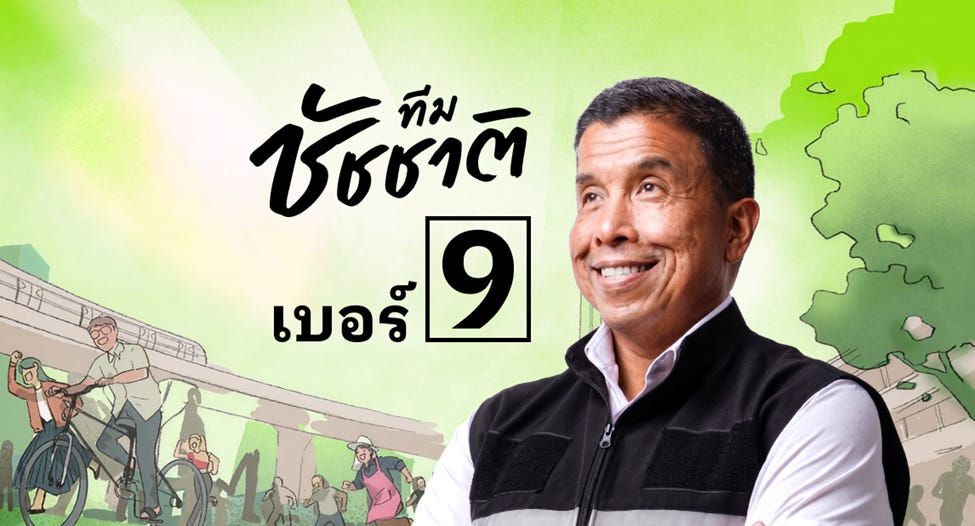
Chadchart Sittipunt, an independent candidate running for a second term as Governor of Bangkok (Source: Team Chadchart)
Kunravee Sukhimoke | July 3, 2026
BANGKOK — The incumbent governor of Bangkok and mayor of Pattaya, two special forms of local administrative units, were re-elected to second terms in the June election.
“The next 4 years will not be easy and will be even more challenging as expectations are higher,” Chadchart Sittipunt said after leading in the Bangkok governor election results for a second term. “The election is only the beginning; we must move forward and decide what we will do next.”
He emphasized that the next mission is to accelerate 261 projects, prioritize them, set key performance indicators (KPIs), and push for tangible outcomes within the first 100 days.
The election results clearly showed that Chadchart won as an independent candidate with around 1,537,748 votes (65.77%), breaking his own record, garnering 1,386,215 votes in 2022, driven by his widely recognized performance during his previous term.
Chadchart’s political path is also connected to national politics. He had previously served as Minister of Transport and was once nominated as a prime ministerial candidate by the Pheu Thai Party in the 2019 general election.
Meanwhile, the Pattaya mayoral race concluded with Poramet Ngampichet of the “Rao Rak Pattaya” (We Love Pattaya) group winning a second term as mayor after securing 19,319 votes, reflecting voter approval of his performance in office.
Poramet was also supported by Sontaya Khunpluem, a prominent local political figure, former Mayor of Pattaya, and former leader of the Palang Chon Party, who played a key role in mobilizing the local political network and is also well known at the national level.
From the capital city to a coastal town, the election was more than a local contest. It also reflected Thailand’s political structure, where local and national politics remain closely intertwined through on-the-ground networks, influential individuals, and long-established voter bases.
National momentum vs. local governance performance
In Bangkok, Chaiyawat Satawornwit, a candidate from the People’s Party running for Governor of Bangkok, came in third with fewer than 200,000 votes. In the Bangkok Metropolitan Council election, the party managed to retain a reasonable presence, winning 22 out of 50 districts.
Political analysts argued that one key factor was the candidate’s lack of clarity in engaging with Bangkok’s local context from the beginning, which made his readiness as an executive candidate less convincing than expected.
At the same time, a campaign strategy heavily focused on anti-corruption messaging was seen as insufficient to drive voter support, compared to competition that required more concrete policy proposals and more positive, locally grounded communication.
In Pattaya, Ittiwat Wattanasatathorn, another People’s Party candidate for mayor, finished in second place with 11,566 votes, trailing the winner by nearly half and failing to secure any seats in the city council.
However, when the arena shifted from national-level elections to local executive races, the outcomes became less consistent.
Looking back at the previous general election, the People’s Party once generated strong “Bangkok landslide” momentum by winning all parliamentary seats in the capital. In Pattaya as well, the party had previously been able to gain some footholds.
Overall, the picture suggests that the People’s Party still maintains a place in the “legislative arena,” where the focus is on lawmaking and government scrutiny. However, in the “executive local arena,” which relies heavily on on-the-ground teams, the party faces a significantly more difficult challenge.
In the 2025 Provincial Administrative Organization (PAO) elections, the People’s Party won just one of Thailand’s 76 provinces—Lamphun—where Weeradej Pusipit, an heir to a prominent local business and political family, was elected PAO president.
All of this reflects another layer of Thailand’s local political battlefield, where outcomes are not determined by national momentum alone, but also by local structures, entrenched networks, and long-standing voter bases. (Also read: Influence Without Office: Thaksin and Thailand’s Unfinished Political Equation)