


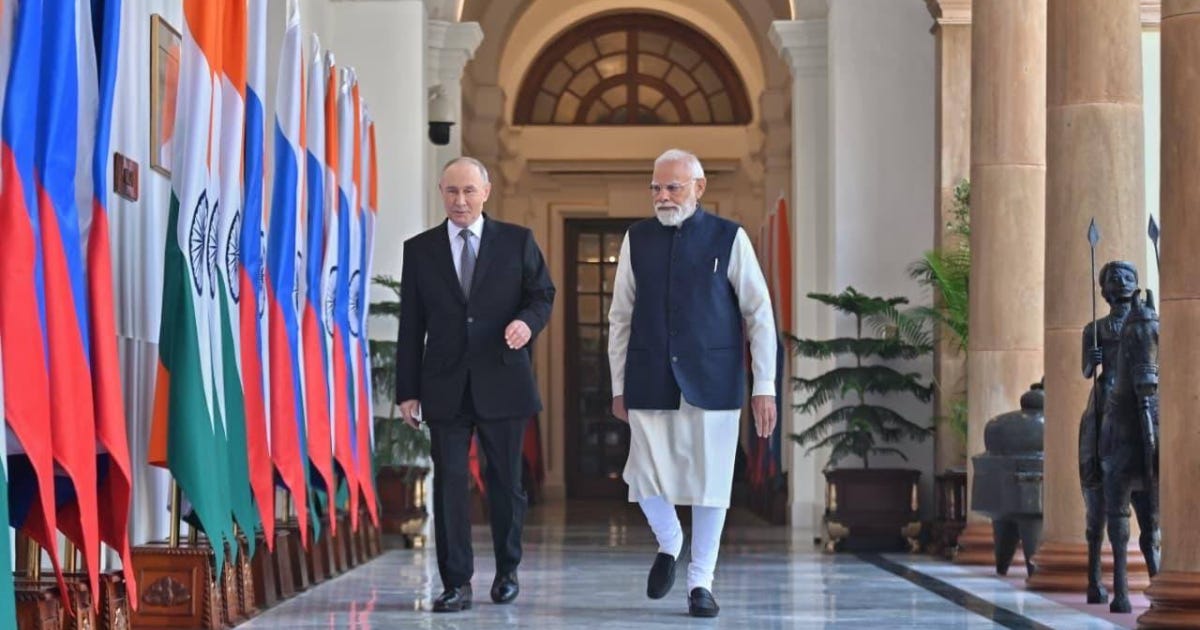
Indian Prime Minister Narendra Modi and Russian President Vladimir Putin at the Hyderabad House during the 23rd India-Russia Annual Summit. Photo from Ministry of External Affairs.
By: Pirzada Shakir | Published: December 24, 2025
New Delhi — Prime Minister Narendra Modi and Russian President Vladimir Putin concluded their long-awaited New Delhi summit without the major defense announcements many had expected.
Hopes of fresh S-400 orders or movement on new fighter aircraft quietly faded, with both sides instead shifting the spotlight to trade, energy and connectivity.
Putin’s first visit to India since the Ukraine war carried symbolic weight, but the substantive outcomes were firmly economic. (Also read: Escalating Russia-Ukraine War: There is No Substitute for Peace)
The two leaders signed a Program for Economic Cooperation (PEC) until 2030, reaffirming a shared target of raising bilateral trade to 100 billion dollars and expediting negotiations on a free trade agreement with the Eurasian Economic Union.
India and Russia signed new agreements on labor mobility, migration and people-to-people exchanges.
They also pushed ahead on civil nuclear cooperation, energy supplies and fixes to ongoing payment hurdles.
The combined effort points to a strategy to “sanctions-proof” the partnership despite global headwinds.
Senior officials from both sides said the summit strengthened an “old, tested partnership” suited to a tense international environment, even as politically sensitive defense deals were kept off the table.
“It serves no purpose, to announce the big ticket defense ideals publicly. But if you read that joint statement, there is one of the paras, which directly deals with the co-production, joint production, transfer of technology and all that,” said Anil Trigunyat, former Indian diplomat and fellow with Vivekananda International Foundation.
Amid sanctions and geopolitical scrutiny on India–Russia ties, Trigunyat said “strategic balancing” is “necessary.”
He added, “I think we are also nearly finalizing the trade deal with the USA. We have also started importing gas from the USA. We have been placing orders for whatever we need and from wherever.”
Despite earlier hints from officials and analysts about movement on additional S-400 regiments or exploratory S-500 discussions, the joint statement kept defense language broad and avoided new commitments.
Analysts say major constraints, including Russia’s war-driven production pressures, India’s sanctions exposure, and payment hurdles arising from limited dollar access or insufficient rouble balances, shaped this outcome.
Prof. Sanjay Kumar, an economist based in Delhi, said “Russia’s defense industry is operating under a binding capacity constraint [due to the Ukraine war], making the India–Russia defense partnership behave like a dynamic system under sustained shocks.”
He further said: “Under current dynamics, big-ticket defense platforms have no near-term stable pathway. Only a redesigned system, co-production plus sanctions-proof financing, opens a realistic window in the late-2020s.”
Kumar added, “Indian banks cannot transmit large payments without breaching external-risk thresholds. Rupee settlement mechanisms cannot clear Russia’s procurement needs.”
Under such a constrained architecture, Kumar said that moving ahead with “large procurements would create a financing gap with no stable clearing path.”
Official briefings described the defence discussions as “general,” highlighting legacy cooperation rather than new platforms. Analysts view this as tactical restraint, not a downturn: foundational cooperation, from submarines to missile systems, remains intact, but neither side benefits from spotlighting defense under heightened Western scrutiny.
The silence on Su-57 fighters, frigates, drones or additional air-defence layers is therefore seen as a pause rather than a rupture.
Moscow has signalled readiness for greater technology transfer and joint production in India, aligned with India’s “Make in India” initiative.
International Affairs & Defence Expert Major General (Retd.) Sanjay Soi argues that India has not distanced itself from Russia but has diversified its defense procurements to the USA, France, Israel and others.
He said that no explicit mention of defense deals “should not be seen as something missing. Maybe some more deliberations are going on because a lot of other deals were signed. If we were distancing away from Russia then those deals would not have been signed.”
He added that the government’s strategy is “good because it was more focused on self-reliance, and we are also trying to collaborate with the countries that are helping us in joint venture production.”
“However, at the same time, to meet the immediate gap, we are procuring defence material from different sources, keeping in view our requirements. Whatever we get best from whichever country we are getting from them and wherever we are getting at a better price and better quality,” Soi explained.
Earlier, Defense Minister Rajnath Singh’s meeting with his Russian counterpart Andrey Belousov in New Delhi on December 4 saw both sides agree to expand defense cooperation, with emphasis on joint manufacturing in India of spares, components and aggregates for Russian-origin platforms already in Indian service.
By foregrounding a 2030 economic roadmap and labor agreements, India and Russia are now attempting to build non-defense ballast into a relationship long dominated by arms sales.
Energy, discounted crude, LNG, nuclear cooperation and new connectivity routes are being positioned as the next anchors of the partnership.