

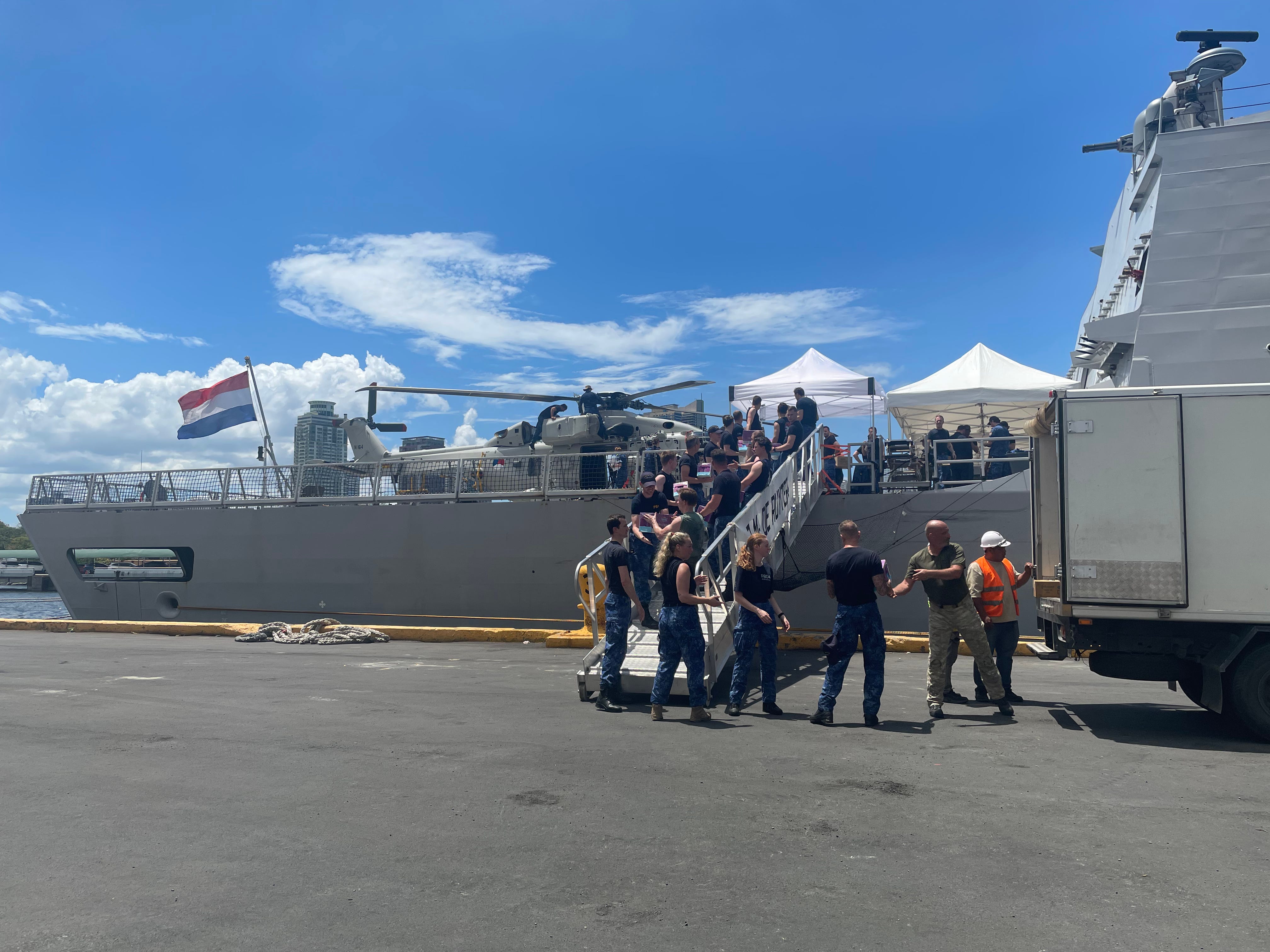
The crew of HNLMS De Ruyter restock supplies shortly after arriving in Manila for their port call on Friday, May 22. Photo by Anna Mogato.
Anna Mogato | May 23, 2026
MANILA — The Netherlands is back in Manila after four centuries, not for the spice trade in the 17th century, but to promote security and freedom of navigation in one of the world’s most volatile sea lanes, the South China Sea.
On Friday, one of its guided-missile frigates, His NetherLands Majesty’s Ship (HNLMS) De Ruyter, made a brief port call to Manila as part of its five-and-a-half-month naval deployment, a military and diplomatic mission called Pacific Archer.
A command and air defense warship, HNLMS De Ruyter, was also fitted with subsurface warfare weapons systems, a SMART-L ELR radar that can track ballistic missiles, and an NH90 helicopter.
Its commanding officer, Commander Rodger de Wit, said that the primary goal of the frigate’s visit is to ensure security in the important trade routes, as well as to strengthen the economic, diplomatic, and security ties between the Netherlands and the Philippines.
“The Indo-Pacific region, and especially Southeast Asia, is really important for Europe and the Netherlands, because a huge chunk of its trade goes by sea, from here to Europe, and keeping stability and freedom of navigation, in this area, is a vital role for us to keep the trade flowing towards Europe,” de Wit told journalists in Manila.
““[For] The Netherlands, we are strong supporters of freedom of navigation, and the UN Security Council for the resolution of the law of the sea. So we are strong supporters of that, and it doesn’t matter if that’s the North Sea, the South China Sea, or wherever. So we, and that’s the reason why we’re here as well, are to promise that freedom of navigation and keep the seas open and to keep the trade going,” he added.
The frigate will take part in a bilateral exercise with the Philippine Navy next week before heading to the 30th Rim of the Pacific (RIMPAC) exercise scheduled for next month near Hawaii.
De Wit said the exercises will be mainly on communication and maneuvering drills “to see how interoperable we are, and how easily we can work together.”
“So of course that’s very valuable because that provides us a lot of lessons, how we can operate with other partners [in this region].”
De Wit said the Netherlands supported the Philippines’ position against China in the West Philippine Sea after Manila won a landmark ruling in The Hague that nullified China’s excessive nine-dash-line claim in almost all of the South China Sea. (Also read: Philippines rejects China’s protest on construction activities in South China Sea)
“I think the main importance is that we have a continuing presence in this area,” he said. “The idea here is we have a stable and continuing presence in the area to support this region and promote the vital role of this area to the Netherlands as well.’
The Netherlands will deploy a frigate to the Indo-Pacific region every two years and hold joint exercises with the countries in the area.
In June, the Netherlands will be joining the Kamandag exercises as an observer. The Kamandag is an annual land and maritime exercise involving multiple Philippine allies such as Australia, the US, the United Kingdom, and Japan.
“I think the visit of the frigate is the first step in the process [of a visiting forces agreement],” Netherlands Ambassador to the Philippines, H.E. Marielle Geraedts, said.
“We are considering our options, but it depends, of course, on the situation worldwide, if we are needed in our areas as well. But I think this visit underlies the very important position the Philippines has in the Indo-Pacific [region].”