


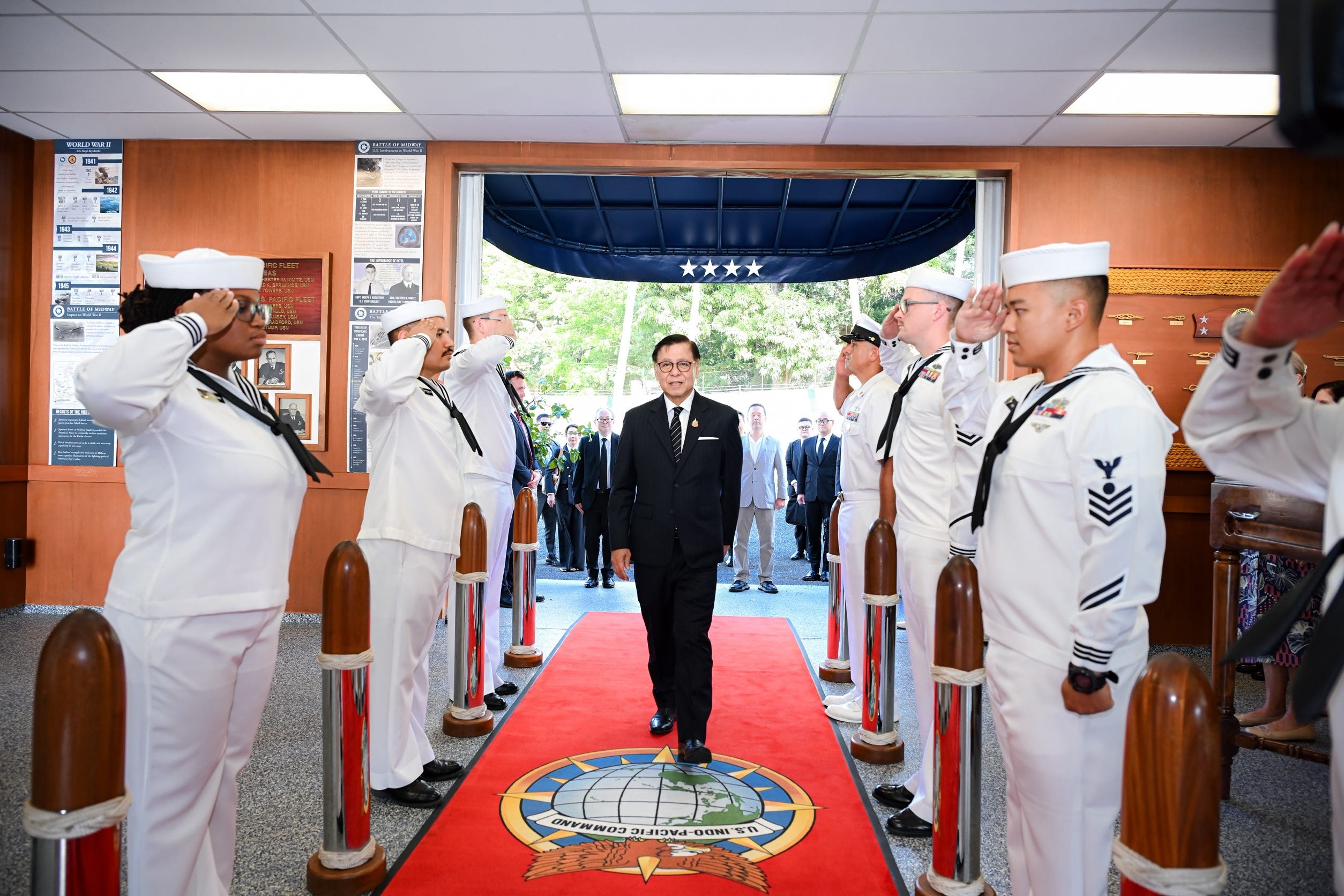
Thai Deputy Prime Minister and Foreign Minister Sihasak Phuangketkeow welcomed by US Navy at Pearl Harbor-Hickam Joint Base last July 6. Photo from Ministry of Foreign Affairs.
Prapapoom Eiamsom | July 19, 2026
BANGKOK — When Thai Deputy Prime Minister and Foreign Minister Sihasak Phuangketkeow visited Hawaii last week, the mission went far beyond routine bilateral diplomacy.
Marking the first official visit by a Thai foreign minister to Hawaii—the headquarters of the U.S. Indo-Pacific Command (USPACOM)—in fifteen years, the Hawaiian trip carried profound strategic weight.
Occurring against the backdrop of escalating maritime tensions with Cambodia, the visit signaled an effort to restore equilibrium to its relations with Washington and Beijing. (Also read: President Marcos says Cambodia, Thailand reached agreements, discussed ways forward in talks arranged by the Philippines)
The diplomatic push followed months of friction between Bangkok and Washington.
During the recent Strait of Hormuz closure crisis, the Thai Foreign Ministry publicly expressed frustration, viewing the U.S. as an unreliable partner after Washington failed to assist Thai shipments when the tankers carrying fuel products were blocked.
This logistics bottleneck led Bangkok to turn to Beijing and Moscow for emergency energy and fertilizer relief. (Also read: Securing China’s ‘front door’: Peacemaking mission in mainland Southeast Asia)
Despite this recent disillusionment, Thailand remains one of the oldest U.S. treaty allies in Asia, and the visit to Hawaii was designed to demonstrate that the structural foundations of this alliance endure. According to official statements from the Ministry of Foreign Affairs, bilateral talks centered heavily on military modernization and cybersecurity.
Crucially, the U.S. has agreed to facilitate low-interest credit lines to help Thailand procure advanced defense technology.
Concurrently, both nations pledged to co-develop security frameworks to combat the transnational online scam syndicates plaguing Southeast Asia—a security threat whose financial damage is increasingly felt within the United States.
Sihasak explicitly clarified that the visit does not mean Thailand is taking sides in the U.S.–China rivalry. Instead, he framed the outreach as an exercise in strategic independence, invoking the centuries-old tradition of Thai diplomacy often described as “bamboo bending with the wind”—a highly flexible, non-aligned posture designed to navigate major-power competition without breaking.
This engagement with Washington is also a direct effort to balance Thailand’s defense procurement portfolio, which had skewed heavily toward China over the past decades.
Following the 2014 military coup in Bangkok, U.S. legal restrictions under Section 508 of the Foreign Assistance Act severely restricted military engagement and arms sales to Thailand.
This policy bottleneck forced Bangkok’s military-led government to pivot aggressively toward Beijing.
Data from the Stockholm International Peace Research Institute (SIPRI) highlights this stark imbalance: Chinese arms imports to Thailand between 2016 and 2022 reached $394 million, nearly doubling the $207 million in U.S. arms imports over the same period.
By leveraging new U.S. credit lines to upgrade its army, navy, and air force systems, Thailand is diversifying its defense supply chains.
This diplomatic calibration was also on display at the 23rd IISS Shangri-La Dialogue in Singapore, where Thai defense representatives actively met with U.S. and French counterparts to strengthen Western security ties—a notable move given that the disputed areas with Cambodia are tied to colonial-era borders mapped during French rule.
To understand the significance of Thailand’s outreach to the U.S., one must look to the Gulf of Thailand. Tensions between Thailand and Cambodia have spiked following Bangkok’s unilateral termination of the 2001 Memorandum of Understanding (MOU 44), which previously governed the $300 billion Overlapping Claims Area (OCA).
With Cambodia initiating a compulsory conciliation process under the United Nations Convention on the Law of the Sea (UNCLOS), the geopolitical stakes have risen dramatically.
Thailand has spent decades developing highly sophisticated oil and gas extraction infrastructure in the Gulf, whereas Cambodia lags significantly in domestic offshore energy production.
If Cambodia succeeds in securing a favorable Joint Development Area (JDA) or resource-sharing agreement in the disputed waters, Chinese state-owned energy firms—which hold deep concessions and infrastructure footprints in Cambodia—stand to gain direct access to these vast hydrocarbon reserves.
Furthermore, China’s development of Cambodia’s Ream Naval Base—Beijing’s first naval outpost in mainland Southeast Asia, situated right on the Gulf of Thailand—gives the Chinese military a vantage point overlooking the disputed maritime zone. This presence fundamentally alters the local balance of power.
By reinforcing its defense alliance with the U.S., Thailand is ensuring its maritime security is backed by formidable counter-leverage. (Also read: Philippines remains confident that the Code of Conduct on the South China Sea will be finished this year)
The Hawaii visit proves that Thailand’s relationship with the U.S. is not just about hosting the annual Cobra Gold joint exercises; it is a vital shield, ensuring that as Thailand sits across from Cambodia at the UNCLOS conciliation table, it does so with the diplomatic, technological, and strategic weight of a balanced global posture.