

COL Dencio S. Acop (Ret), PhD, CPP | February 25, 2026
PERTH, Australia — The just-concluded RP-US Bilateral Strategic Dialogue contains agreements that robustly advance the interests of both countries in the Asia-Pacific region. Began in 2011, it is the 12th such dialogue in the series. The BSD is the most comprehensive engagement which addresses the short and long-term interests of the Philippines and the United States across all spheres of collaboration given the current political, security, and economic challenges.
It also presents the best opportunity for each country to maximize the realization of its strategic bilateral priorities in partnership with a key ally. Historically, the dialogue this year also commemorates 80 years of diplomatic relations since the former colony gained its independence (1946) following the end of World War II. Further, it coincided with the 75th anniversary of the “iron-clad” alliance between the two countries etched in their 1951 Mutual Defense Treaty. 2026 likewise presents expanded opportunities for the alliance with like-minded partners as the Philippines chairs ASEAN. All advantages now enabled by the dialogue, clearly articulated in the resulting Joint Statement minus the obvious details, are meant to deter China’s aggressive assertions in the South China Sea.
China, bent on reacquiring Taiwan and an open challenger to American dominance in the 21st century, is expected to oppose the fruits of the dialogue with its own counteractions. Meanwhile, the Philippines, long bullied by China, has just received a welcome boost from its historical ally, which also refuses to go down in decadence even if such is the documented destiny of all historical empires.
Support from the United States into the Philippines intensified and accelerated ever since that crucial meeting in July 2025 between Secretaries Ma. Theresa Lazaro and Marco Rubio, the foreign affair leads of the two nations, on the sidelines of the ASEAN-related Foreign Ministers’ Meeting. It includes a total of 500+ military exercises and exchanges, some of which have already been executed the last two years, and the rest planned for 2026. This alone indicates constant presence and preparative actions through a series of rapid escalations. It also inherently includes logistical build-up paralleling troop deployments in both quantity and quality.
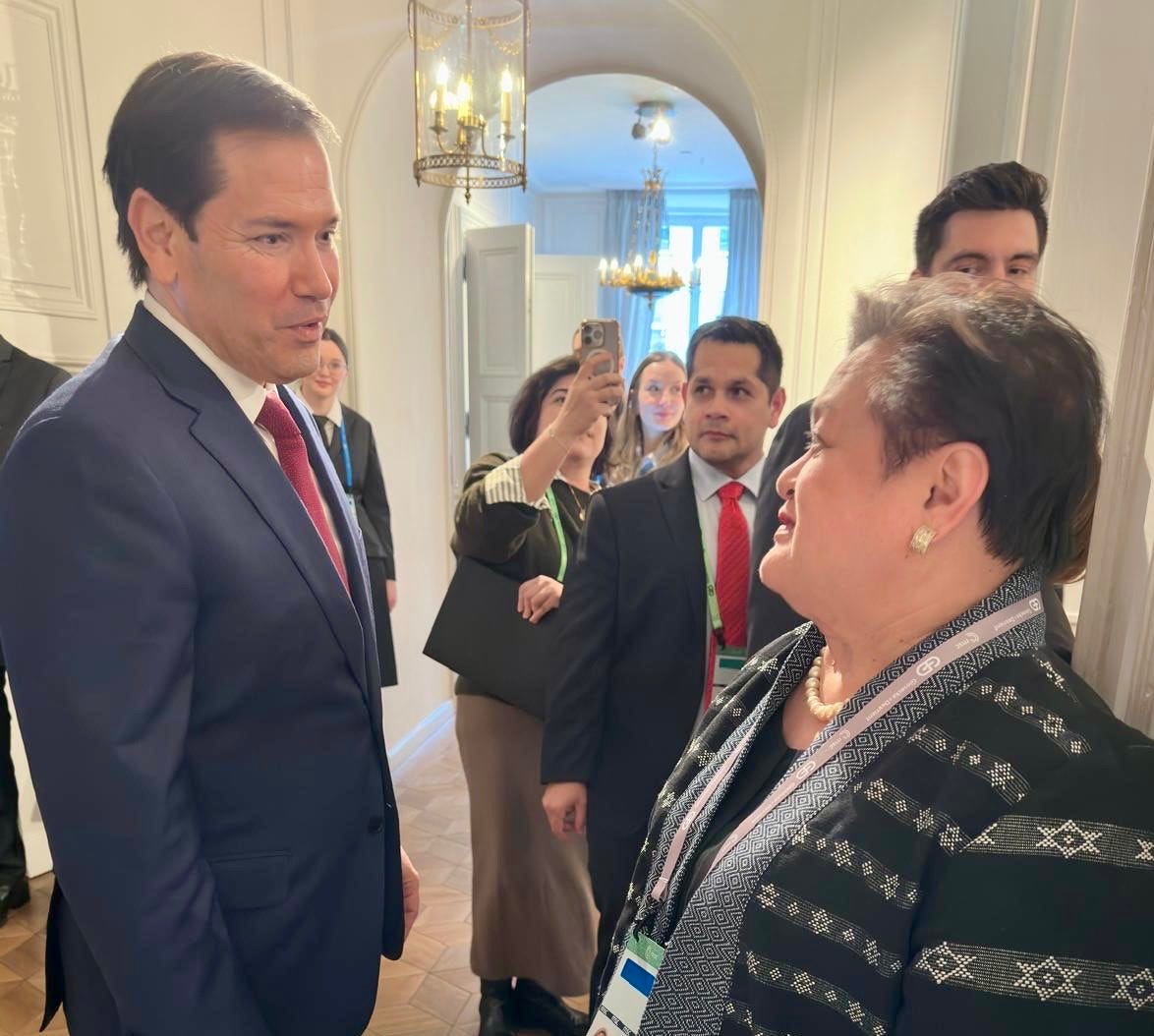
Foreign Affairs Secretary Ma. Theresa Lazaro and US Secretary of State Marco Rubio stop for a quick chat at the sidelines of the Munich Security Conference last February 13, 2026.
For instance, there is the deployment of high-end capabilities like the Navy-Marine Expeditionary Ship Interdiction System (NMESIS) and what more perfect way to operationalize such than the annual RP-US Exercise Balikatan. The combined military to military exercise has been an ongoing engagement to develop and sustain interoperability between the two forces through the years when the US bases were still around. It was momentarily stopped following the departure of the bases in 1992 but subsequently resumed in 2000.
My familiarity with the exercise goes back to 1984 where I was part of the participating Philippine contingent (with the Philippine Constabulary Special Action Force) that did cross-training with the US Army First Special Forces Group based out of Okinawa. The security focus at the time was jungle warfare as the Armed Forces of the Philippines conducted search and destroy (and later a more holistic approach) counterinsurgency missions against the communist New People’s Army.
Then in 2000, the first time the exercise resumed after years of hibernation, I was again a participant (with ISAFP), this time with counterintelligence as head of force protection for the participants. This time, the AFP needed US assistance as it began its modernization to a conventional army (against China) after the NPA had been reduced to a criminality level of threat that could be addressed by local law enforcement.
Thus, the NMESIS was deployed to the Philippines as part of RP-US Exercise Balikatan 2025. Thereafter, other escalations followed in rapid succession. There was the largest and most complex Balikatan exercise ever staged by the two countries. As mentioned by the Joint Statement, we’re seeing indicators of executive policy decisions appropriating US resources to security-related programs and projects in the Philippines. For instance, a Department of War budget of $144 million was cited for infrastructure development of EDCA (Enhanced Defense Cooperation Agreement) sites already in the archipelago. There are nine such sites, most of which are located on the major island of Luzon closest to Taiwan. On top of these sites are the long-standing Subic naval and Clark air bases which will soon be connected by a freight rail through the Luzon Economic Corridor (LEC) project.
Military planners will quickly identify this development as means to move mission-essential logistics in the event of armed hostilities. Apart from NMESIS (180 km range), MRC/Typhon (450 km range) and HIMARS (500 km range) missiles along with Gray Eagle drones (4,630 km range) are being deployed through the archipelago. The effective ranges of these missiles and drones can cover the Taiwan Strait and Taiwan, only 250 kilometers from northern Luzon. Reportedly, US military personnel surveyed a possible forward operating base just 193 kilometers south of Taiwan.
Increased deployment of US troops, missiles, and drones were the highlights of the Joint Statement. Aside from the 9 EDCA sites, there are already three layers of US troop formations operating in the Philippines: a 60-man advance contingent led by a star-ranked officer to Task Force-Philippines in October 2025; a Marine Rotational Force – Southeast Asia; and early this month an Army Rotational Force – Philippines (led by a lieutenant colonel) with its scope still unknown.
At this point, there are at least three things to watch out for: (1) Whether Army-Rotational Force-Philippines gets combat capabilities soon – or merely stays coordination – only; (2) Whether the Philippines’ 3rd BrahMos missile battery arrives early this year completing a supersonic anti-ship shield; and (3) How Beijing responds – expect diplomatic protests and possibly more South China Sea provocations. The AFP’s top general has already sounded the alarm to prepare for a cross-strait conflict.
Thanks to the recently concluded BSD, AFP chief General Romeo Brawner Jr. now has a fighting chance in leading the local army against regional power China. What I find most comforting about the BSD is the fact that it is holistic – addressing not just security concerns but the comprehensive nature of what is at stake for the international rule of law which happens to put a spotlight on the Philippines due to its geopolitical importance.
Furthermore, the BSD’s adherence to international law and order gives its proponents a moral ascendancy which I think is always critical towards winning the hearts and minds of humanity in the advent of confrontation that leads to war. It was moral ascendancy that spelled the difference between the Allies and the Axis powers during World War II. First, the Joint Statement said the BSD strengthens the alliance to reestablish deterrence in the Indo-Pacific.
More specifically, the joint declaration emphasized the importance of respect for international law to prevent conflict, keep sea lanes open and not subject to “arbitrary control by one country”, “collective defense critical to denying and deterring aggression anywhere in the First Island Chain”, and commitment to the 1951 Mutual Defense Treaty.
Both the Philippines and the United States: (1) “Condemned China’s illegal, coercive, aggressive, and deceptive activities in the South China Sea”; (2) “Recognized their adverse effects on regional peace and stability and the economies of the Indo-Pacific and beyond”; and (3) “Welcomed improved multilateral cooperation with like-minded partners” such as Japan and Australia towards enhancing regional security.
Second, the BSD Joint Statement lauded efforts to advance shared economic prosperity. It identified sectors for intensified bilateral cooperation and collaboration like energy security, civil nuclear capacity, cybersecurity, transport, digital energy, agribusiness, health, critical minerals, and infrastructure development including supply chains as key components for enhancing the national security interests of both countries.
For instance, the Statement said the US aims to strengthen civil nuclear cooperation working with off-takers, utilities, data centers, including possible trade missions to the US “to connect leading US nuclear technology companies with the Philippine private sector” through the Fulbright program, sending experts to Manila, “develop nuclear-focused curricula and credentialing programs”, “building local capacity to construct and operate state-of-the-art nuclear reactors”, and providing State Department funds for a start-up simulator. Further, the US announced a historic $250 million to support Philippine health security.
Third, the BSD reiterated the commitment of both countries to “counter transnational organized crime and protect fundamental freedoms and the rule of law”. And fourth, the Joint Statement added that the BSD can strengthen multilateral cooperation with the Philippines holding the ASEAN chairmanship this year. Specifically, it “reaffirmed the importance of peace and stability across the Taiwan Strait”; “strongly opposed any threat or use of force against the territorial integrity or political independence of any state”; and “committed to close coordination on shared priorities through 2026 as the Philippines serves as ASEAN chair.”
ASEAN currently has 10 members. Originally composed of just Indonesia, Malaysia, Philippines, Singapore, and Thailand during its 1967 founding, the association grew gradually over the years since, adding Brunei (1984), Cambodia (1999), Laos (1997), Myanmar (1997), and Vietnam (1995) to the list of members. Timor-Leste will soon join the group as well. Partnered with Australia, ASEAN has a combined GDP of over $3 trillion.
The 12th BSD was followed a day later by the 4th Bilateral Maritime Dialogue between the two countries which was also conducted in Manila. First held in 2022, it “reaffirmed shared commitment to uphold the rights, freedoms, and lawful uses of the sea in accordance with international law, as reflected in the 1982 United Nations Convention on the Law of the Sea (UNCLOS), that sets out the legal framework within which all activities in the oceans and seas must be carried out.”
The freedoms referred to are those pertaining to authorized sea lane navigation and overflight, unimpeded commerce, and economic opportunities. The recent BMD reinforces commitments made from last year’s multilateral conference on “Reinforcing Cooperation to Achieve a Secure and Stable Maritime Domain” conducted on the sidelines of the UN General Assembly. That gathering was attended by 35 countries including the Philippines, US, Australia, Estonia, Greece, Japan, Netherlands, Romania, and the UK among others. Next on calendar is the upcoming 10th anniversary of the 2016 Arbitral Award which upheld the Philippines in its conflicting claims with China.
As a result of the fast-moving security – related developments in the South China Sea, the Philippines has reportedly become America’s most important military partner in Asia.
Given all this, how is Beijing expected to respond? Some analysts think its active diplomatic protests will intensify. Others assess more South China Sea pressure will continue and even mount. The removal of the PLA’s top two leaders indicates a consolidation of unopposed power by Xi Jinping. While military action against Taiwan is most tempting for Xi, it might not be that easy given some risk factors. This critical point will be discussed in detail in my next article.