


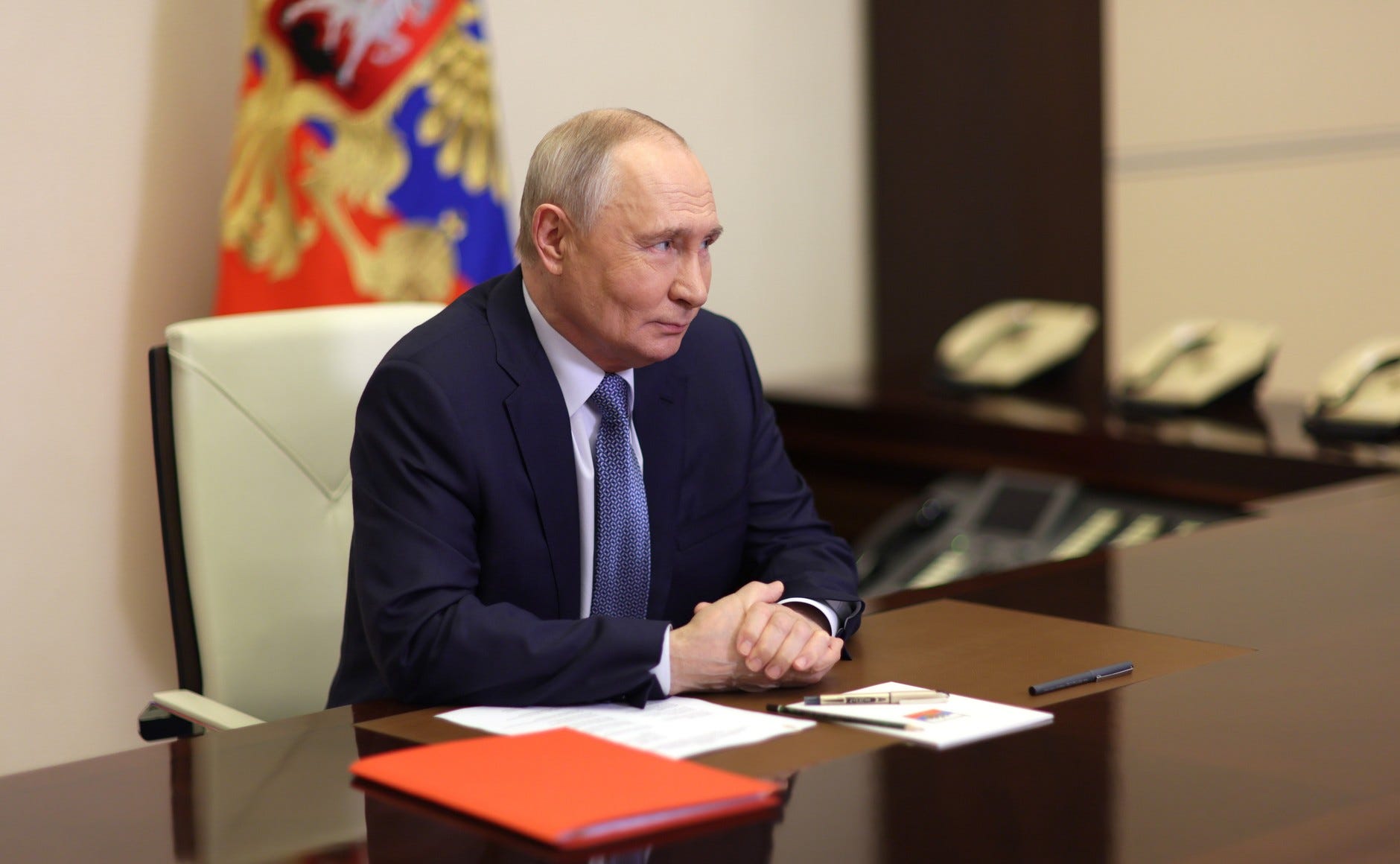
President Vladimir Putin meeting with permanent members of the Security Council (via videoconference). Photo handout.
COL Dencio S. Acop (Ret), PhD, CPP | April 24, 2026
My study paper at the Intelligence School when I took my Strategic Intelligence Course had been on Ukraine. Humility aside, it was the top paper. When Russia invaded Ukraine in 2022, the points I raised in the study were validated. Not only were they validated as they proved intractable, but the points raised also illustrated that Ukraine’s strengths were foundational to its resilience, overcoming its vulnerabilities, and welcoming to the modern innovations of today. Astute leaders planning to invade Ukraine would have thought twice about pushing through with their offensive unless they were well convinced that decisive victory could be attained within a reasonable amount of time and casualties. If he wasn’t in such haste and rage, Vladimir Putin could have read Ukraine’s most probable course of action and made it his own. But, overtaken by overconfidence, much of it owing to Russia’s nuclear arsenal which Ukraine had none, the Russian leader thought Ukraine was ripe for the taking in just a few days. It must be recalled that Ukraine had given up its stockpile of nuclear weapons to Russia in exchange for its trusted support (along with that of the United States) after the collapse of the Soviet Union. But Ukraine was more than just an adjunct of Russian power. It was itself a power. That is why the Ukraine invasion could never have been Putin’s Six-Day War. Ukraine as Russia’s Second Afghanistan War is more like it. This updated assessment illustrates this.
MILITARY GEOGRAPHIC INTELLIGENCE
VULNERABILITIES:
Prone to attacks from its neighbors
Historically, Ukraine has been prone to attacks from its neighbors. Its 4,558 kms of land boundaries and some 1,959 kms of sea borders with neighboring countries have, in the past, made Ukraine susceptible to consistent intrusions oftentimes resulting in its occupation by foreigners (Russia, Poland, Turkey, Hungary – 14th – 18th centuries). Ukraine’s strategic position at the crossroads between Europe and Asia, along with its fertile plains have likewise contributed to its attractiveness to nearby and other states conducting commercial traffic. Once attacked, Ukraine’s accessibility from the Black Sea and its inland waterways, primarily the Dnieper River, have, in the past, facilitated the incursion by any invading force into its territory. Today, such intrusions are not so simplistic without inviting criticism from the international community. Nevertheless, the potential has always been there given Ukraine’s geography.
Vulnerabilities associated with its climate
Ukraine’s extreme winter conditions, especially along the Black Sea areas in the south, limit the country’s productive economic and military activities. Ukraine has long, harsh winters in the south which practically interrupt the otherwise normal traffic of regular economic and military routines in these affected areas.
Susceptibility to border disputes and other border-related issues
Ukraine’s long borders, land or sea, with its neighbors invite disputes especially if there are economic benefits to be derived. A case in point was Ukraine’s dispute with Romania over a continental shelf issue in the Black Sea under which significant gas and oil deposits were discovered. Ukraine’s long borders with neighboring countries have also invited smuggling of humans and goods, including illicit drugs. And, of course, there is neighboring Russia.
Environmental vulnerabilities
Environmental concerns abound in Ukraine. These include inadequate supply of potable water, air and water pollution, deforestation, and radiation contamination in the northeast from the 1986 Chernobyl Nuclear Power Plant disaster. Of these, the most serious concerns are those associated with radiation fallout from the Chernobyl accident which persists to this day.
CAPABILITIES
Strategic location
Due to its location at the crossroads between two continents, Ukraine has easy access to mutually beneficial trade with resource-rich neighboring countries across Europe and Asia.
Military capabilities associated with geography
The Carpathian Mountains in the west and the Black Sea in the south afford Ukraine these natural defenses. In the past, countries like Turkey, Poland, and Romania would have invaded sooner and easier had it not been for the natural obstacles posed by these terrain features. The Black Sea has also provided a natural haven for Ukraine’s navy (surface and sub-surface). Another geographical advantage are the numerous inland waterways (4,400 kms total length) practically traversing the entire territory of Ukraine linking its major cities and acting as an excellent alternate means of transport in peace and war. Still another natural feature that favors ground materiel is Ukraine’s vast plains which cover nearly two thirds of the country’s surface. This terrain feature is very favorable to battle tanks and other armored assets of which Ukraine has vast amounts. Of course, the opposite is also true. While Ukraine’s vast plains are conducive to the army’s defense, they are likewise advantageous to the enemy’s offense. Finally, Ukraine’s compactness has given it the advantage of developing unity / nationalism brought about by relative homogeneity in key cultural factors such as language, ethnicity, and religion.
Military capabilities associated with climate
Ukraine’s harsh and long winters may hinder economic and military progress, but these are likewise assets against a potential invader. No rational invader would dare risk the chances of victory or the mounting of casualties during an attack in winter. The French army under Napoleon Bonaparte learned this lesson when it invaded Moscow and its infantry inadvertently got caught in Russia’s long winters due to the great length of time it took to travel between France and the eastern front. The Germans too repeated this folly and learned the same lesson in World War II.
SOCIOLOGICAL INTELLIGENCE
VULNERABILITIES
Diminishing population growth rate and high migration rate
Ukraine has one of the world’s most rapidly diminishing population growth rates, characterized by a severe demographic crisis. The population has dropped from roughly 42 million before the 2022 invasion to below 36 million, driven by high war-related deaths, low birth rates, and millions of refugees fleeing abroad.
Media
Freedom of the press is both a vulnerability as well as a capability. It is a vulnerability in so far as it is utilized by powerful sectors of Ukrainian society to influence formulation and subsequent implementation of public policy that undermines, rather than promotes, their larger national interest. In Ukraine, the media, along with the political opposition and the church are influential pressure groups.
CAPABILITIES
Social Unity and Cohesion
Unity and cohesion characterize the Ukrainian people. Despite its history of having been repeatedly conquered by other nations (especially its neighbors), most recently Russia, Ukraine has managed to remain united as a people, further enhanced by its finally becoming an independent nation in 1991. It is assessed that apart from its being compact which plays a large part in Ukraine’s oneness, certain sociological factors have likewise been at play throughout Ukraine’s existence. These factors all translate into Ukrainian nationalism which has kept the country united. First, the people are ethnically almost homogeneous, with roughly 78% identifying as ethnic Ukrainians. It must be noted that Ukraine was forcibly made a part of the former USSR for seven decades, thus accounting for the Russian minority population (22%) in Ukraine’s territory. Second, the pattern of language coherence follows that of the ethnic homogeneity described. And third, Ukraine’s religious inclinations also basically align with the same identified pattern. Almost all Ukrainians are Orthodox Christians which they have been since the reign of St. Vladimir the Great in 988. Overall, therefore, the Ukrainians are among the most sociologically united peoples in the world. Their strong unity and cohesion have sustained them through extreme adversity in the past and most recently against Russia’s invasion.
Superior Literacy
Ukraine boasts an exceptionally high, near-universal adult literacy rate of about 99.97%, consistently ranking among the top countries worldwide. This fact is unsurprising given Ukraine’s huge number of colleges and universities. At one time, Ukraine had 70,000 scholars in 80 research institutes making the country a leader in education, science, and technology. When it still had its nuclear weapons, Ukraine was seventh among the world’s nuclear powers just behind the US, UK, Russia, France, Japan, and Germany. Ukraine’s superiority in literacy is an attribute serving it well especially in its current conflict with Russia. For instance, its drone technology has been one of the key factors that has kept it competitive through the ongoing war.
The Role of Media
As earlier stated, media can either be a state’s ally or enemy depending upon how it is effectively utilized. This constitutionally mandated freedom has performed the role of state enhancer in so far as it has been utilized by Ukraine to galvanize state support from defense allies, especially NATO and the US, against Russia.
ECONOMIC INTELLIGENCE
VULNERABILITIES
Weak Economy
Ukraine’s economy is currently struggling and classified as weak due to the devastating impact of the Russian invasion, which caused a 30% GDP contraction beginning in 2022. The war has severely damaged infrastructure, resulted in massive labor shortages, and created extreme dependence on Western financial aid. The government is spending roughly 60% of its budget on defense, with a significant, ongoing budget deficit. Public debt is high and expected to rise to 106% of GDP in 2026. Before the war, Ukraine was already considered an underachiever with slow growth, often hindered by systemic corruption and mismanagement, causing it to fall behind other Eastern European countries. But, despite the crisis, the economy has shown resilience, with some growth reported in 2023-2024 due to international support and adaptive domestic production, although the overall situation remains precarious.
Challenged power industry
Although Ukraine had been acknowledged as a nuclear power, its power industry has been characterized by inefficiency due in large part to centralization. Thus, Ukraine’s power industry is currently undergoing a massive, security-driven transition from a centralized, fossil-fuel-reliant system to a decentralized, secure, and resilient energy system to endure the war while aligning with EU energy standards. While losing some 35% of its consumption and over half its capacity to attacks, the system survives through European interconnection, repairs, and rapid deployment of renewable, solar, and small-scale gas generation.
CAPABILITIES
Rich in natural resources
Unlike most republics of the former USSR, Ukraine is a country that is rich in natural resources. The next most important economic component, after Russia, of the former Soviet Union, Ukraine produced more than one-fourth of total Soviet agricultural output, 50% of Soviet iron ore, and 40% of the world’s manganese ore. Ukraine’s agricultural produce includes grain, sugar beets, vegetables, sunflower seeds, beef, timber, and milk. Mineral resources include iron ore, coal, manganese, natural gas, oil, salt, sulphur, graphite, titanium, magnesium, kaolin, nickel, and mercury. Where Ukraine’s trade faltered, challenging its outward economy, the country’s self-sufficiency in resources seemed locally more promising sustaining its war effort.
Leader in nuclear energy
Ukraine remains a major leader in nuclear energy production, with nuclear power providing roughly 50%, and at times 60%, of the country’s electricity as of 2024-2025. Despite losing control of the 6-reactor Zaporizhzhia plant to Russian occupation, Ukraine still operates three other plants and plans to expand its capacity with new reactors.
Available Human Factor for a War Economy
As of early 2026, entering the fourth year of full-scale war, Ukraine’s available human factor for a war economy is under extreme strain, characterized by “catastrophic” labor shortages in technical sectors, mass mobilization, and significant demographic loss. While the labor market has shown resilience, with unemployment trending down to an estimated 16%, the available workforce is heavily skewed by the emigration of approximately 6-7 million refugees, mostly women and children. The Ukrainian government is balancing the need to fill the military ranks against the necessity of keeping the economy afloat to support the war effort, leading to a “warped” labor market where labor shortages are acute despite the ongoing war.
Russian Pipelines
Russia’s vulnerability is Ukraine’s capability as far as the former’s westward oil and gas pipelines are concerned. Apparently, the opposite is also true, evidenced by Russia’s invasion. The pipelines, for years, have kept Russia in check, at least until 2022. Aside from easy access to imported oil and gas from Russia, Ukraine had been able to bargain for some economic concessions (quid-pro-quo) vis-à-vis Russia’s use of Ukraine’s Black Sea ports (up until Russia annexed Crimea in 2014) and territory for its pipelines.
Leader in Arms Trade
Before the war with Russia, Ukraine had been among the world’s leading suppliers to the international arms trade, supplying between $200 million to $1 billion from 1992-1998, for instance, which escalated through the decades after. Today, Ukraine is no longer a top-tier exporter but has become the world’s largest arms importer. Following the invasion, it became the top recipient of major arms in 2021-2025, accounting for nearly 10% of global imports. While its domestic industry is innovating, particularly in drones, its role has shifted from a major supplier to a major recipient.
POLITICAL INTELLIGENCE
VULNERABILITIES
Transition to Democracy Still Volatile
Ukraine’s transition from centralism to democracy is headed towards the right direction but still volatile. Currently, it is challenged by the existential pressures of the war with Russia, which has halted elections and strained democratic institutions, according to the BTI 2024 Ukraine Country Report. While the country has a robust civil society and strong, democratic public aspirations, it faces significant, ongoing challenges, including wartime governance and elections, democratic consolidation, institutional challenges, and corruption reforms. Despite these challenges, Ukraine is seen as a resilient, vibrant democracy, with a strong civil society, and high public support for Euro-Atlantic integration.
International Pressure on National Policy
Another vulnerability of Ukraine is with regards to unavoidable international pressure on its national policies. International pressure on Ukraine’s national policy is heavily driven by the need for security, economic aid, and reforms, balancing dependence on Western support with intense pressure for concessions. Key pressure points include demands for anti-corruption measures, military restraint, and negotiating a peace deal, amid fears of reduced support from key allies, particularly the US. The change in US administration has been described as a pivotal point, with pressure mounting to accept a peace deal. However, the Ukrainian people and leadership are resisting premature negotiations, with many prioritizing long-term, national security. Meanwhile, the EU is being urged to take a bigger role in supporting Ukraine, preparing for potential shifts in US policy.
CAPABILITIES
Enhanced Self-determination
The Ukraine of today is a different Ukraine. It has transformed itself from a mere puppet regime of the former Soviet Union or of Russia to an independent republic capable of determining its own national destiny free of domination by another country. This is its most potent capability. Ukraine is now capable of charting its own future based on the people’s choice manifested through democratic elections and implemented according to the values and ideals institutionalized in the 1996 Ukrainian Constitution. Like any other nation in the world, Ukraine has strived to preserve its existence and sustain its power. Its national interests will always come first before those of others. Finally attaining its elusive independence in 1991, Ukraine has done everything possible to sustain this political gain. It has thereafter developed its economic production followed by the equitable distribution of the national wealth gained. To achieve these objectives, Ukraine has interacted with the community of nations. In today’s global village, no isolationist nation can survive. Ukraine signed a long-delayed friendship treaty with Russia in May 1997 settling long-term disputes including sharing of the Black Sea fleet and the Crimean issue. It turned over strategic weapons of the former USSR to Russia following an accord with both Russia and the US in 1994 in exchange for defense assurances and better trade with Russia. Because of these strategic moves, Ukraine, for a time, became an ally of both Russia and the US. Additionally, cooperation between NATO and Ukraine gathered momentum. All these changed when Russia invaded Ukraine in 2022.
Institutionalized Checks and Balances
Another notable capability of Ukraine’s political system is the structure of checks and balances that are in place. This system of checks and balances is enshrined in a constitution, the fundamental law of the land. Political power is shared by three independent branches of government: the executive, legislative, and judicial. Moreover, the system allows for multiple political parties with their own respective platforms of governance. Finally, pressure groups become the third major component of Ukraine’s system of checks and balances that fiscalize Ukraine’s management of its public affairs. They include the media, political oppositionist groups, labor, and the church. The implication of this institutionalized system of checks and balances is Ukraine’s capacity to come up with decisions that are fully representative of the national will, instead of just a few, biased minority.
(TO BE CONTINUED)
