

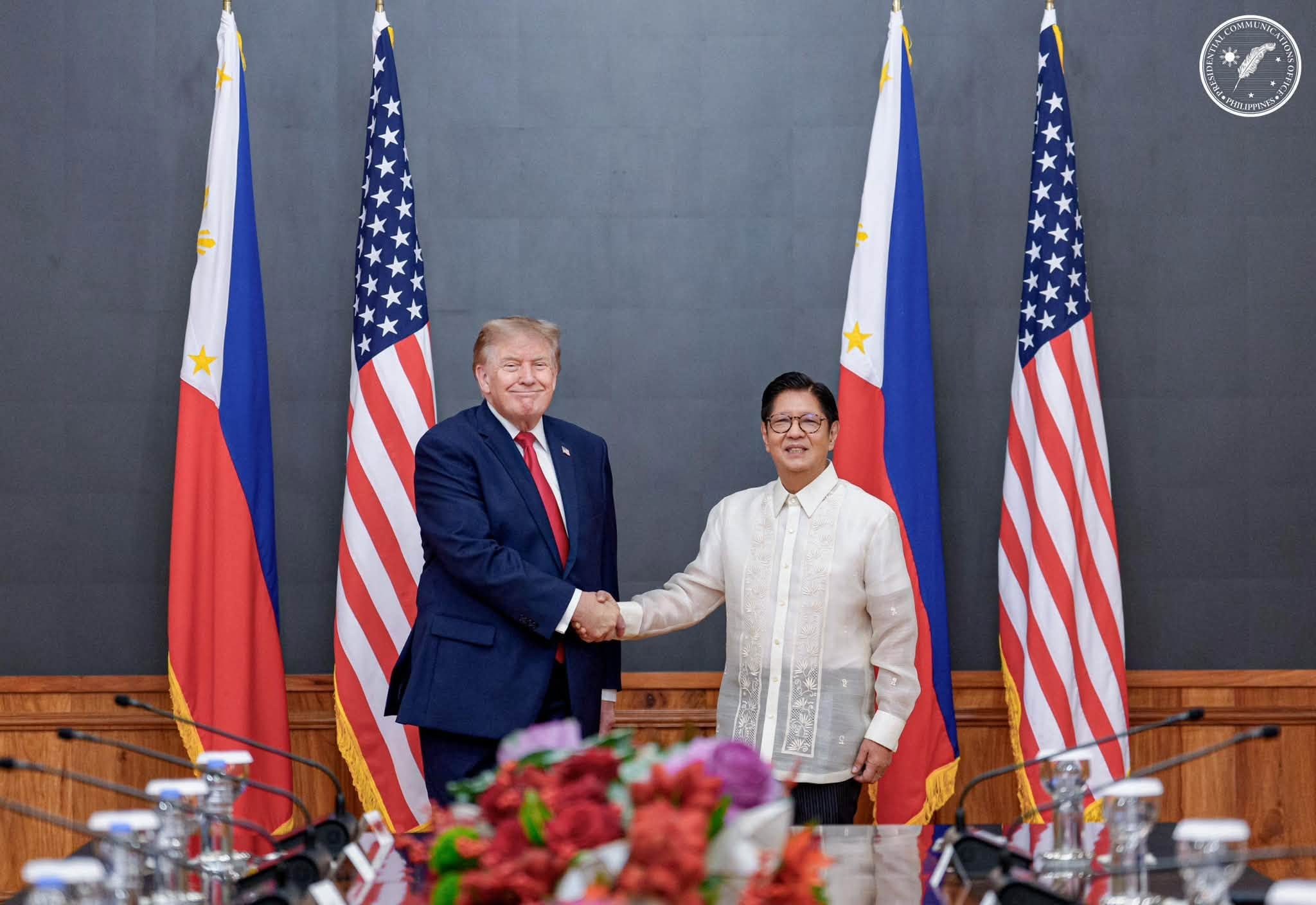
President Ferdinand Marcos Jr. and President Donald J. Trump shaking hands as they are about to start their bilateral meeting at Malacañan Palace on Wednesday, November 18, 2026. Photo courtesy of PCO (Presidential Communications Office).
Manuel Mogato | November 19, 2026
Manila — US President Donald Trump announced about $2 billion worth of security-related deals with its oldest ally and former colony, the Philippines, at the end of his two-day visit to Manila this week.
Trump, who suffered a devastating defeat in a mid-term election early this month, was on a two-nation swing in Asia for a major foreign policy trip to discuss trade and security with key allies at the ASEAN and APEC summits.
In his talks with President Ferdinand Marcos Jr. on Wednesday, Trump announced several bilateral deals that will “support tens of thousands of American jobs, bolster regional security that protects the United States from illicit activity, and support a free and open Indo-Pacific that economically benefits American companies, workers, and consumers.”
“The two leaders announced landmark deals that will strengthen the U.S.-Philippine Alliance and support American companies and workers,” according to a White House readout.
“The leaders also committed to eliminate the U.S. trade deficit with the Philippines through increased Philippine imports of American energy and agriculture products, which will support the jobs of tens of thousands of American engineers, technicians, and farmers”
Trump also announced a historic Foreign Military Financing (FMF) loan package of more than $2 billion, the largest military assistance in years, to provide the Philippines with critical defense and security capabilities from American suppliers that could generate over 7,000 American jobs.
The FMF loans were designed to advance Trump’s National Security Strategy and America First Arms Transfer Strategy.
The First Arms Transfer Strategy will ensure that the surge in allies’ spending benefits the U.S. defense industry, reindustrializing America and supporting American jobs while arming partners with the best capabilities in the world.
“The United States will utilize $400 million in FMF for the Philippine military to expand its operational reach and deterrence capabilities in the South China Sea, including long-range fires, command and control, critical infrastructure, and multi-domain drones.
U.S. authorities said the Department of National Defense (DND) signed a $37 million contract with a US firm that will deliver SI-enabled mission support, expand U.S.-Philippine defense cooperation, and improve interoperability. Another $63 million initiative will modernize its defense cloud infrastructure for SI use cases.
Washington and Manila also sealed commercial deals to set up a new $40 million fuel storage depot at Subic Bay to support U.S. military and commercial operations, and to upgrade Basco Airport to improve U.S.-Philippine operational access, disaster response, and commercial supply chains in the Philippines’ northernmost islands.
US military planes frequently landed on Basco, even if the facility is not an identified EDCA site.
Outside defense-related issues, the White House also said US companies Boeing and GE Aerospace had finalized a $12 billion sale to Philippine Airlines for up to 20 Boeing 787 aircraft with GE Aerospace engines.
Washington also promised to provide nuclear energy in the next five years.