


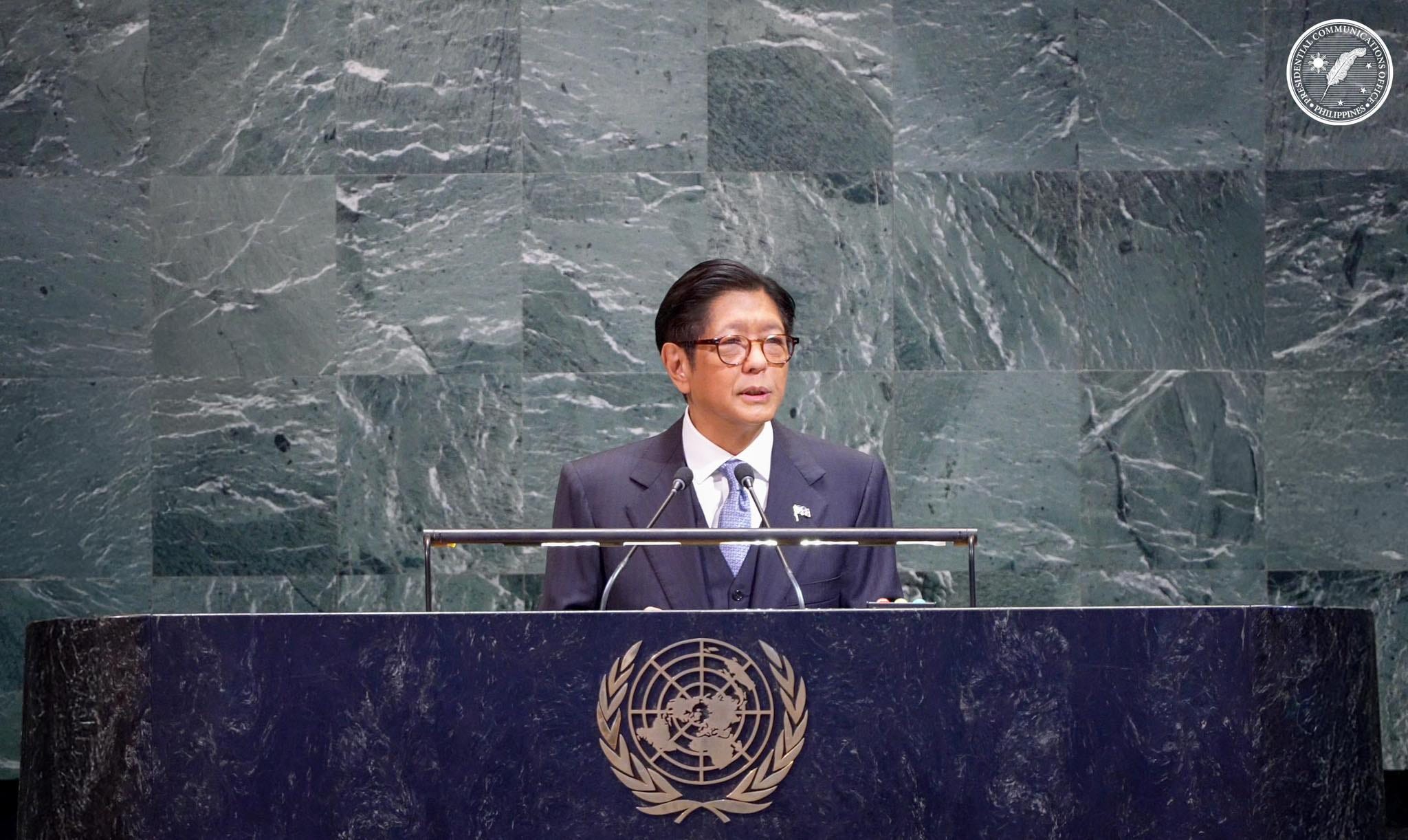
President Ferdinand Marcos Jr. reiterated the Philippine government’s adherence to multilateralism in his special address to the UN General Assembly in New York City last March 10, 2026. Photo from PCO.
Manuel Mogato | March 12, 2026
At the United Nations this week, President Ferdinand Marcos Jr. has called for restraint and adherence to international law as the conflict in the Middle East entered its second week.
A staunch ally of the United States, Marcos Jr. has called for peace to protect civilians as both the United States and Israel, on one side, and Iran, on the other, continued to exchange ballistic missiles and drones.
“This is the right opportunity, given the developments in the Middle East,’ said Angelica Escalona, the foreign affairs spokeswoman and assistant secretary.
“The UN is the most appropriate venue for our President to call for peace in the Middle East and for the safety of all civilians, especially our fellow Filipinos.”
The Philippine president’s position on the conflict is understandable. There are more than 2 million Filipino workers and permanent residents in the Middle East, particularly in Saudi Arabia and the Gulf states of Bahrain, Kuwait, Oman, Qatar, and the United Arab Emirates.
Moreover, almost 100 percent of the country’s oil imports come from the Middle East, and the closure of the Strait of Hormuz disrupted global oil supply, pushing fuel prices to more than $100 per barrel.
Crude prices have gotten back to over $80 per barrel on news that US President Donald Trump announced the war might be ending soon.
If there is one issue that the Philippines has consistently defied the United States, it usually involves conflict in the Middle East and North African states.
Marcos Jr.’s father and namesake, Ferdinand Sr, was the first Filipino leader to oppose US meddling in the Middle East and Libya.
Apart from the strategic importance of oil and the safety of Filipino overseas workers, the predominantly Muslim population in the Middle East also played a crucial role in ending the rebellion in the Muslim provinces in the south.
Thus, several times in the past, the Philippines has not supported sanctions against Libya, which brokered the peace agreement with the Moro National Liberation Front (MNLF) in 1976 and with the Moro Islamic Liberation Front (MILF) in 2014.
Since assuming power in 2022, Marcos Jr has not deviated from his father’s political, economic, and diplomatic playbook.
Whoever becomes president, the country’s foreign policy will be dictated by three issues: overseas workers, oil imports, and the Muslim secessionist problem.
Marcos has added a fourth dimension in his call for peace in the Middle East: protection of human lives, not just Filipino workers, but all people, regardless of race and religion.
As Iranian ballistic missiles rained on Israel and US allies in the Persian Gulf, including Bahrain, Kuwait, Oman, Qatar, Saudi Arabia, and the United Arab Emirates, the people are the usual victims.
Iran has targeted airports, residential areas, and oil refineries apart from military targets, like US bases and infrastructure.
On the other hand, the US and Israel have also hit civilian areas in Tehran and other cities, not only military targets, including missile launch sites and production bases, and Iranian Islamic leaders’ enclaves.
There were reports that US Tomahawk missiles had struck an Iranian girls’ school, killing dozens of students.
The US precision bombs had missed their intended targets and struck residential areas in Tehran and other areas.
This is madness. This has to stop to preserve civilian lives and property. No one will win in this war.
People in the affected states in the Middle East are not the only suffering as global oil production and supply were disrupted, sending shock waves to Europe and Asia.
Oil-dependent states, like the Philippines, take a bigger hit as petroleum prices soar; other costs, like transportation, agriculture, and power generation, also rise. It’s like a domino effect.
There is greater uncertainty as no one knows how long this conflict will last.
What are Israel’s and the United States’ goals in attacking Iran? Are the Arab states made to suffer to serve the American and Israelis’ interest?
If Israel and the United States are to be believed, the attack on Iran was a preemptive strike because the Islamic regime had vowed to destroy the Jewish state.
However, US President Donald Trump’s regime change objective betrays Washington’s goal of completely reformatting the Middle East with the US and Israel playing a dominant role, depriving independent Arab states of the ability to partner with other states within and outside the region.
The US and Israel are simply removing an “unwanted” regime in the region, hoping that a more friendly leadership will emerge.
Eliminating Iran’s Islamic leaders through air strikes and missiles is an unprecedented case, not consistent with international law.
The missiles and air strikes excuse no one, including civilians, women, and children
It is the same formula Washington is pursuing in the Indo-Pacific, forcing countries to take sides and isolating China.
Pray that a China-US confrontation over Taiwan will not happen in the Indo-Pacific region.
Such an Iran scenario could happen. China may attack US rotational forces and co-location sites in the Philippines.
If that happens, the US wouldn’t care about the destruction in the Philippines, Taiwan, and Japan as long as American cities in the continental US remained safe from ballistic and intercontinental missiles.
Marcos is on the right track in calling for peace while conflict remains limited in the Middle East. Iran has been trying to involve Turkey and Azerbaijan.
Let’s end the war now before it spreads and spirals out of control.