


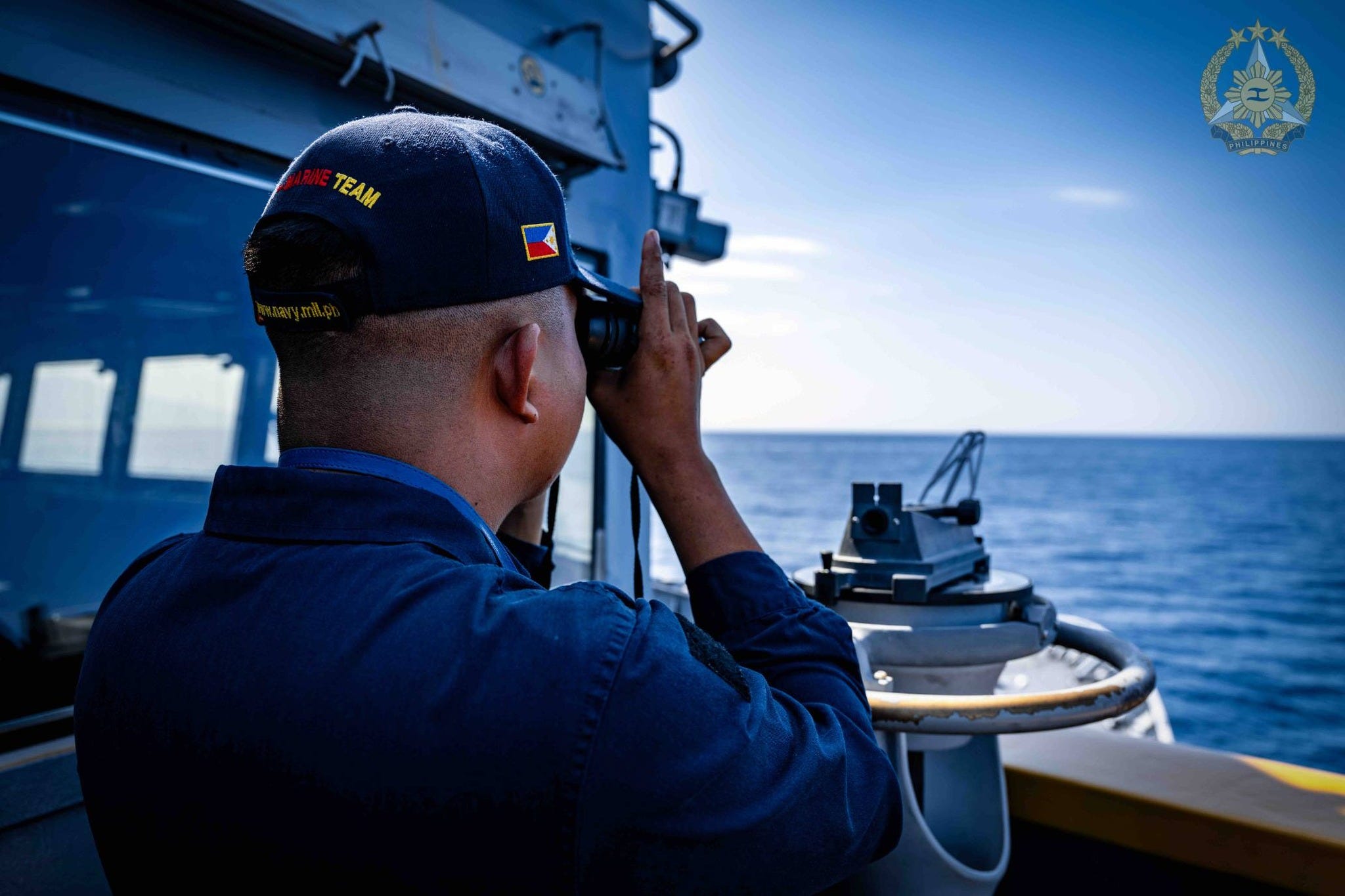
BRP Antonio Luna (FFG15) personnel scans the horizon during the Bilateral Maritime Cooperative Activity 26-3.1 last March 20, 2026. Photo by Edward Bungubung, Public Affairs Office of the Armed Forces of the Philippines.
Manuel Mogato | April 7, 2026
MANILA — In February, before the US and Israel started the war against Iran, a group of retired diplomats — foreign service career officers who had served for decades — prepared a white paper proposing a solution on how to end escalating tensions with China.
China has virtually claimed sovereignty on almost the entire South China Sea, encroaching on the Philippines’ 200 nautical miles exclusive economic zone (EEZ) guaranteed under international law – the United Nations’ Convention of the Law of the Sea (UNCLOS).
China is a signatory to the 1982 treaty but continues to violate it by sending dozens of Navy, Coast Guard, and militia vessels around Bajo de Masinloc, Reed Bank, Escoda Shoal, Ayungin Shoal, and the eight Philippine-occupied features in the South China Sea.
These Chinese actions raised the temperatures in the disputed waters, and there had been numerous incidents when Philippine boats nearly collided with Chinese vessels. (Also read: Navy rejects maritime cooperation with China)
Twice, the Chinese People’s Liberation Army-Navy locked its firing system radar on a Philippine corvette and a guided-missile frigate, and there were numerous occasions on which China has shadowed, rammed, and sprayed with water cannons fishing boats and public vessels.
In all these instances, the Philippines has exercised restraint and acted professionally to avoid messy confrontation.
As China’s illegal, coercive, aggressive, and dangerous (ICAD) operations in the vital sea lanes of communications, where more than $3 trillion seaborne trade passes every year, intensify and escalate, there is a need to defuse tensions and avoid miscalculations and accidents that may lead to a limited war.
The retired diplomats, including two who directly engaged with the Americans — Raul Rabe and Clemencio Montesa — proposed pursuing a more independent foreign policy by not relying heavily on the United States.
Washington has provided a security umbrella to Manila through the 1952 Mutual Defense Treaty and later through other arrangements, such as the Visiting Forces Agreement, the Enhanced Defense Cooperation Agreement, the Mutual Logistics and Service Agreement and the Military Assistance Agreement.
But the dependence on US support lulled Philippine leaders into complacency. They focused on internal security threats and neglected territorial and external threats.
The retired diplomats wanted the government to emulate Indonesia and Vietnam, two weaker and smaller states in Southeast Asia, that could stand up to China’s bullying.
These two countries have built capabilities that would make China think twice before launching attacks. They have fighters, submarines, and coastal defenses that could bloody the nose of any aggressors.
The retired diplomats suggested increasing defense spending to at least 2 percent of the country’s GDP and devoting a large share of the defense budget to strengthening capabilities.
Easier said than done.
About 60 percent of the annual defense budget goes to paying salaries, allowances, and pensions. Only 10 percent goes to capital outlay, which includes base development and military facilities. And the rest to maintenance and operating expenses (MOOE).
A special trust fund, not included in the defense sector budget, was created to modernize the military.
Since 2000, the trust fund has been allocated 5 billion pesos annually and 40 billion pesos this year. Another 50 billion pesos was added to the unprogrammed funds for 2026.
This was the highest allocation in the General Appropriations Act, but it was not enough to fund President Ferdinand Marcos Jr.’s wishlist of about 1.9 trillion pesos revised modernization program.
The government couldn’t allocate 100 billion pesos for the next 10 years to sustain the modernization program. It also couldn’t raise defense spending to 2 percent of GDP and cut personnel services in the budget to less than 60 percent.
The government created the problem by raising the pension for retired soldiers to equivalent of that of active-duty soldiers.
For example, a general’s pay is more than 120,000 pesos a month. When he retires, he will receive the same pension. What is highly unusual is that a soldier does not pay contributions to the pension fund, unlike all public and private workers.
Former presidents Gloria Macapagal Arroyo and Rodrigo Duterte should take the blame for showering too many favors on the soldiers and policemen in exchange for political support.
Now, removing the imbalance could fuel unrest in the uniformed services.
The soldiers and policemen must pay contributions and raise the salaries of other public servants, such as teachers and nurses, to the same level as the uniformed personnel.
The government must also remove restrictions on the defense sector so it can borrow more than the $300 million ceiling and allow much longer amortization on multi-year repayment schemes.
These structural reforms would take years, but the Philippines needs them now. Perhaps yesterday.
But decoupling the Philippines’ security alliance is a bad suggestion. On paper, it would be a good option if the Philippines were non-aligned, either with the United States or China.
However, a weak Philippines needs the United States as an added deterrence. It’s the one preventing China from attacking the country.
Although there were fears that the Philippines could be a magnet for attacks, there could be no such attack until the balance of forces shifted against the United States.
The US is ahead of China by 10 to 20 years in terms of military capabilities. It has more experience in fighting wars around the world, and its military equipment is more tested.
As long as Washington can provide security cover, Manila needs the Americans. There might be a time in the future when the Philippines has built a deterrence capability, then it may no longer need the Americans.
After all, the United States is becoming an unreliable security partner. The Iran war showed the Americans’ Achilles heel.
Its NATO allies have started defying them. Asian allies, Japan and South Korea, are taking their own steps to stand on their own without the US.
Perhaps the retired diplomats’ suggestion is necessary. The suggestions are brilliant. But not now, when the Philippines is still weak.