


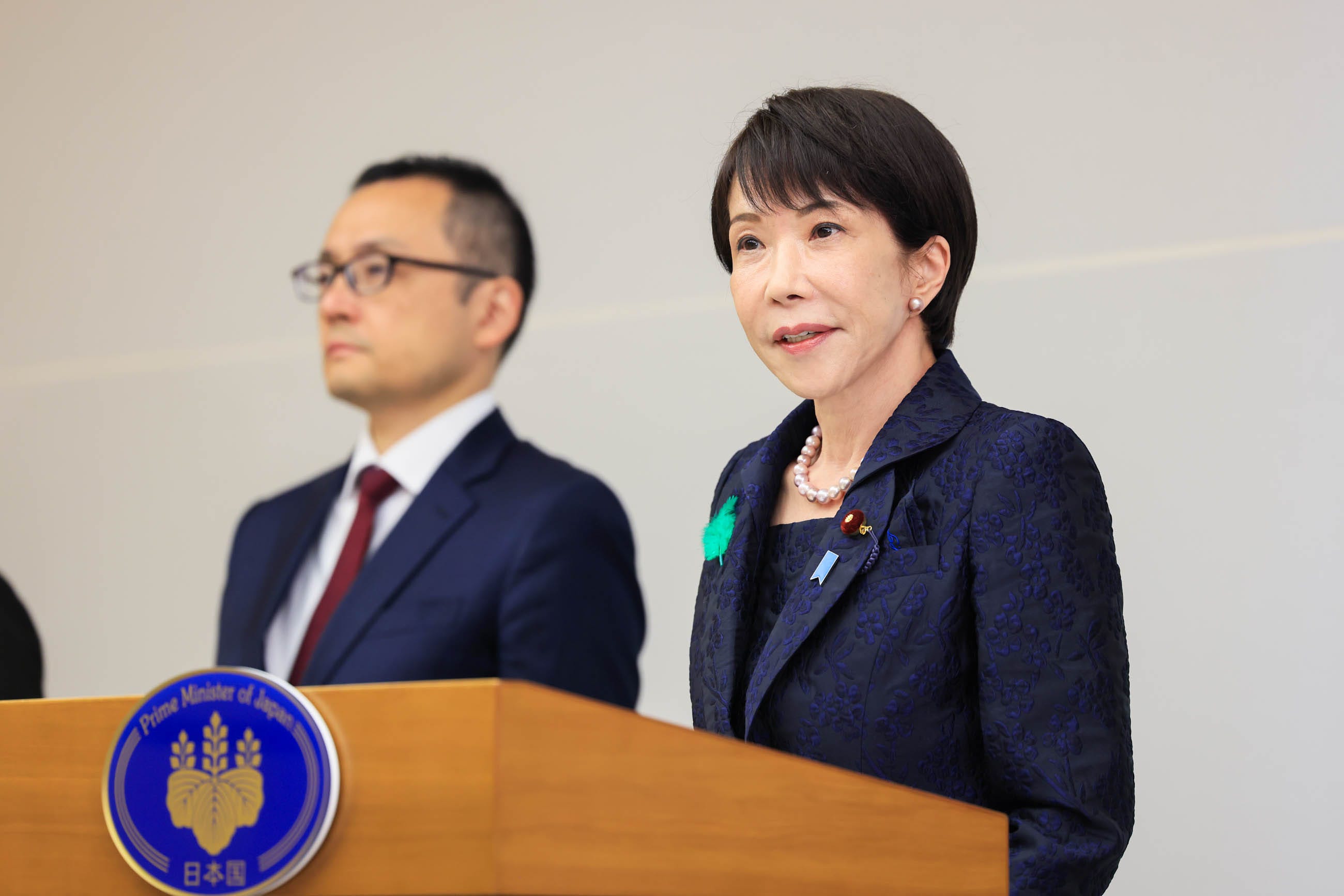
Photo taken from Japan Prime Minister Sanae Takaichi’s X account.
Manuel Mogato | April 23, 2026
TOKYO/MANILA — Japan’s Prime Minister Takaichi Sanae has eased restrictions on the overseas transfer of defense equipment, which now includes lethal weapons, a major turning point in Japan’s security policy.
At a recent Cabinet and National Security Council meeting, officials revised Japan’s three principles on the overseas transfer of defense equipment and their implementation guidelines, a move welcome by many Southeast Asian states.
The new rules will now allow Japan to export vessels and missiles to countries in Southeast Asia, helping them strengthen deterrence against China’s growing influence in the region. (Also read: Friends to all, enemies to no one)
In the past, Japan was restricted to export only rescue and transportation equipment, mostly Coast Guard equipment and radar systems.
“All cases will be subject to review by the National Security Council, and they’ll be limited to countries that have concluded relevant agreements with Japan,” according to a Japanese government statement.
Tokyo said it will also strengthen Japan’s monitoring framework for transferred weapons.
Chief Cabinet Secretary Kihara Minoru told journalist about the changes, arguing that no country can protect itself alone.
He said Japan is willing to help maintain peace in one’s country and the region.
“It is important to further promote the transfer of defense equipment and to strengthen the deterrence and response capabilities of allies and like-minded nations,” Kihara said.
Some Southeast Asian nations immediately expressed interest in transfers of Japan’s defense equipment.
The Philippines, for instance, welcomed the change in Japanese weapons export policies. It has been increasingly at odds with China over territorial issues in the South China Sea.
“Our defense partnership with Japanese has entered a new era of working together and with other like-minded partners to secure our individual and collective rights and entitlements under international law through principled advocacy buttressed by deterrence,” Defense Secretary Gilberto Teodoro Jr. said in a statement.
Teodoro said the policy change “will allow the Philippines to access defense articles of the highest quality and supportability which will not only enable us to strengthen domestic resilience but also to contribute to regional stability through deterrence in a meaningful way.”
The Philippine Navy, in an effort to boost its deterrence capability, is considering acquiring three Abukuma-class destroyer escorts that are due to be retired by Japan’s Maritime Self-Defense Force.
Japan’s Defense Minister Koizumi Shinjiro will hold talks with Teodoro during his visit next month in the Philippines to observe war games with the US and the Philippines.
Indonesia also appears to be interested in acquiring submarines from Japan.
Japan’s defense equipment transfer decision sparks debate
Japan has eased restrictions on the overseas transfer of defense equipment to include lethal weapons. Transfers to active-combat nations are still prohibited, in principle, but there are possible exceptions.
Sources close to the government and ruling parties say that they include cases such as when Japan’s ally, the United States, needs equipment to sustain its forces in the Indo-Pacific region. Another possible scenario is when a like-minded nation is invaded and becomes a party in conflict, Japan may continue to provide support.
Some opposition lawmakers have expressed concern that such moves could assist conflicts and could change Japan’s status as a peace-loving nation.