

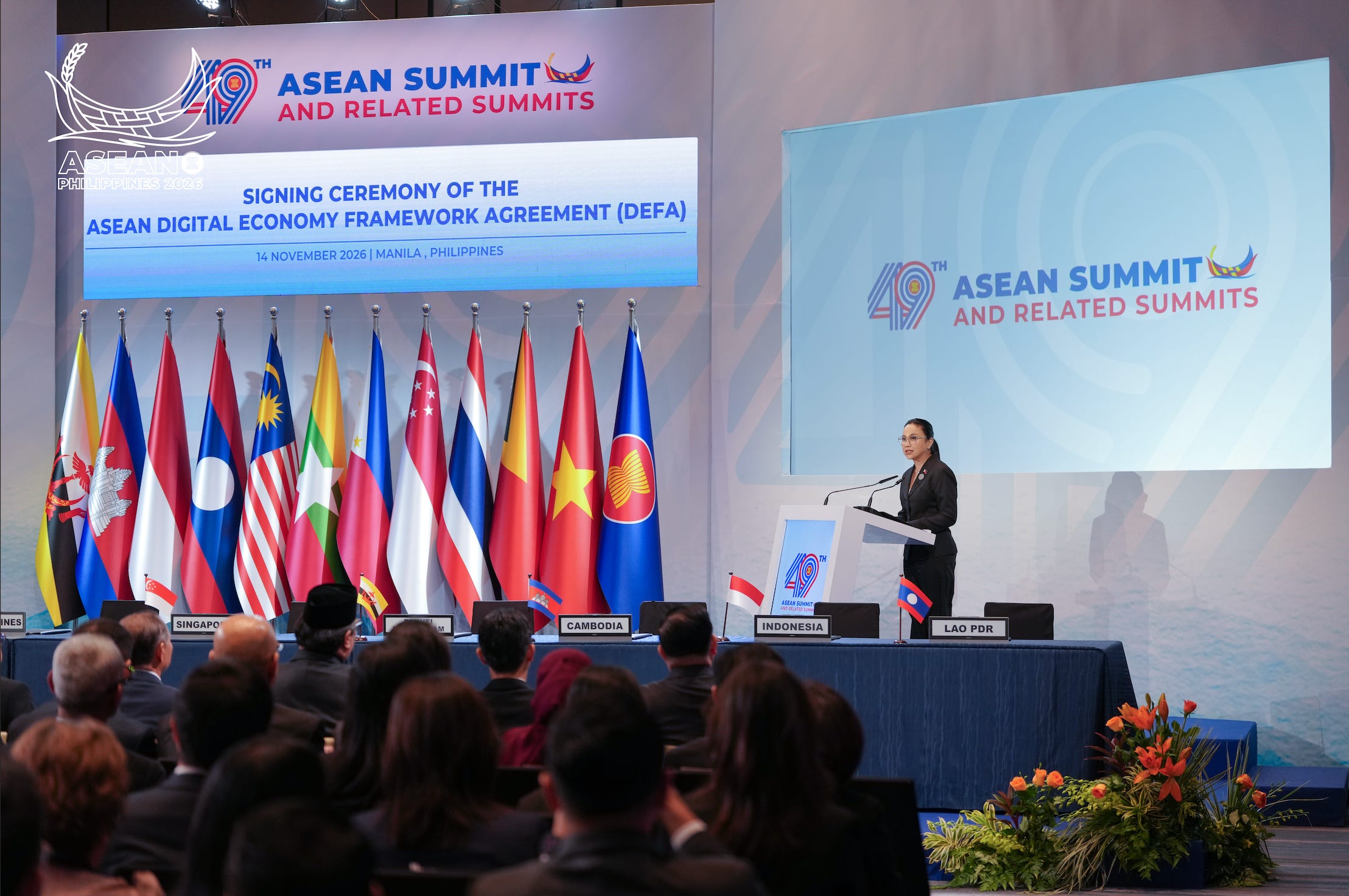
ASEAN Ministers signed the ASEAN Digital Economy Framework Agreement on Saturday, November 14. Official handout.
Anna Mogato | November 14, 2026
MANILA — The Philippine economy is expected to get a shot in the arms after the signing of strategic trade deals ahead of the 49th Association of Southeast Asian Nations (ASEAN) leaders’ Summit in Manila.
Southeast Asia ministers on Saturday formally signed the Digital Economy Framework Agreement (DEFA), a cross-border digital trade agreement that will may double ecommerce in th region.
It took three years for ASEAN trade officials to negotiate a deal allowing businesses across the Southeast Asian region to conduct business without barriers. (Also read: Philippines pushes regional agreements to boost economy)
The Department of Trade and Industry (DTI) said the DEFA, considered as the most comprehensive regional agreement on digital economy in the world, also covers cybersecurity and emerging technologies.
ASEAN projected to regional digital trade become a 3 trillion-dollar market by 2030, benefitting the Philippines’ small and medium-sized enterprises.
The Philippines pushed more economic and social development programs and agreements during its 2026 chairmanship.
Beyond DEFA, the Philippines also pushed an ASEAN Petroleum Security Agreement (APSA), an oil stockpiling plan, and a crackdown on scam hubs across the region.
About half of the ASEAN member states had ratified the APSA, which has been a recurring topic among ministers since the closure of the Strait of Hormuz in February. (Also read: Foreign Ministers highlight food, energy security in series of ASEAN meetings)
Also on Saturday, the Philippines and Canada concluded free trade negotiations when Philippine President Ferdinand Marcos Jr. and Canadian Prime Minister Mike Carney met on the sidelines of the ASEAN Summit. The Free Trade Agreement (FTA) will be signed sometime next year.
So far, Canada has had an FTA with ASEAN in effect since 2010, bundled with fellow Commonwealth states Australia and New Zealand.