


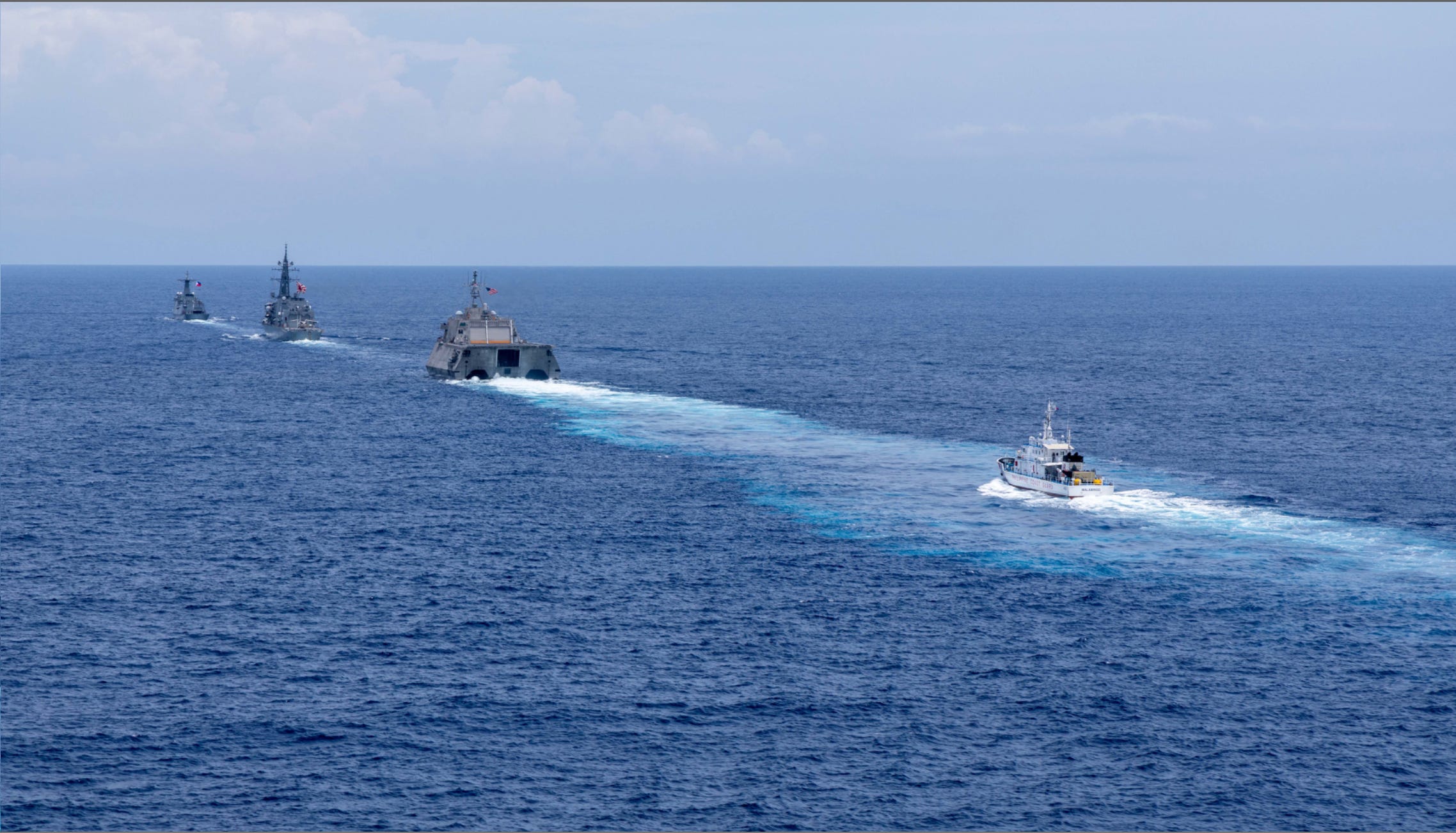
Jose Rizal-class guided-missile frigate BRP Antonio Luna (FFG 15) and Philippine Coast Guard Parola-class patrol vessel BRP Malabrigo (MRRV 4402) were joined by USS Santa Barbara (LCS 32) and Japan Maritime Self-Defense Forces Murasame-class destroyer JS Yudachi (DD 103), for a Multilateral Maritime Cooperative Activity (MCA) in the Philippines’ Exclusive Economic Zone last July 24, 2026. Photo by U.S. Navy photo by Mass Communication Specialist 2nd Class Caylen McCutcheon.
Manuel Mogato | July 27, 2026
MANILA — While Chinese Coast Guard vessels fired water cannons on Philippine Coast Guard and fisheries vessels last week in contested waters in the West Philippine Sea, an American and Japanese warships held drills with the Philippine Navy in a show of force.
The US Navy sent its Independence-class Littoral Combat Ship, USS Santa Barbara, to sail alongside a Japanese destroyer, JS Yuudachu, in the West Philippine Sea, near Bajo de Masinloc. (Also read: China’s Coast Guard vessel sprays water on Philippine vessel near Bajo de Masinloc)
The American and Japanese vessels joined a Philippine guided-missile frigate, BRP Antonio Kba, and two Philippine Coast Guard vessels, BRP Melchora Aquino (MRRV 9702) and BRP BRP Malabrigo (MRRV-4002), said Army Colonel Xerxes Trinidad, a military spokesman.
“It was the 17th multilateral maritime cooperative activity among the three allies,” Trinidad said in a statement.
Trinidad said the trilateral naval activity “underscores the enduring partnership among the partner nations in promoting peace, stability, and security in the Indo-Pacific region”.
“It likewise reflects the AFP’s continuing commitment in ensuring freedom of navigation and overflight while deterring illegal, coercive, aggressive, and deceptive activities in the West Philippine Sea,” he added.
Trinidad said the Philippine Air Force also sent an anti-submarine helicopter, a light fighter, a close air support plane, a surveillance aircraft, and a search-and-rescue helicopter.
The Americans also had MH606 Sikorsky Seahawk helicopter and an anti-submarine P8 Poseidon aircraft, he added.
Throughout the five-day activity, Trinidad said, the three allies carried out a series of advanced maritime interoperability exercises, including Communication Exercises (COMMEX), Replenishment at Sea (RAS), Division Tactics (DIVTACS), Officer of the Watch (OOW) Maneuvers, Rotary Wing Deck Landing Qualifications (DLQ), Photo Exercise (PHOTEX), Vertical Replenishment/Cross-Deck Landing, and Fly-by operations.
Trinidad said the multilateral maritime cooperative activities began in April 2024 with Australia, Japan, the Philippines, and the United States. It has been happening many times to challenge China’s growing presence and activities in the disputed waters. (Also read: Is a militarized Japan a threat to the region?)
China claims nearly all the South China Sea, a strategic sea lane, where $3 trillion of trade passes annually.
Brunei, Malaysia, the Philippines, Taiwan, and Vietnam also have conflicting claims on the energy and mineral-rich body of water in Southeast Asia. (Also read: Think tank lauds growing global support of 2016 arbitral ruling)