


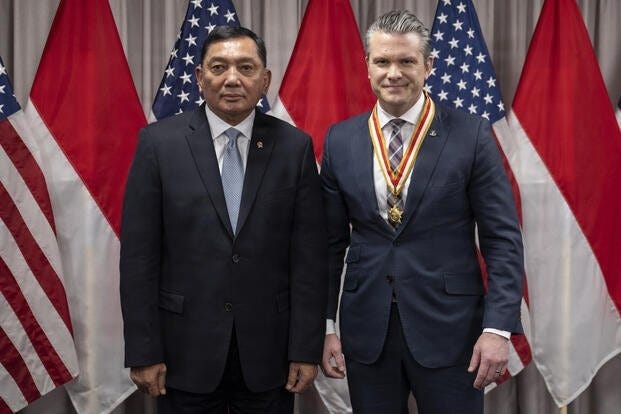
Secretary of War Pete Hegseth hosts a bilateral meeting with Indonesia Minister of Defense Sjafrie Sjamsoeddin at the Pentagon, Washington, D.C. (handout)
Manuel Mogato | April 24, 2026
WASHINGTON — The United States and Indonesia have signed an defense cooperation agreement on training, modernization, and joint operation, expanding American influence in the Southeast Asian region to counter China’s growing presence and activities in disputed waters in the South China Sea.
The agreement deepens practical military ties in modernization, training and operations while preserving full Indonesian sovereignty and avoiding any permanent U.S. bases, according to an Indonesian defense ministry statement.
The agreement focuses on three core areas: military modernization and capacity building, training and professional military education, and exercises plus operational coordination.
The two countries also plan for more complex special forces drills, advanced maritime and subsurface projects, autonomous systems work, and improved maintenance support for Indonesian equipment.
Indonesia has long hosted the multinational Super Garuda Shield drills, which in 2025 brought together thousands of troops for combined arms, amphibious operations and live-fire training across multiple nations.
The new partnership will increase the scope and frequency of such activities, making them more routine and integrated rather than one-off events.
The agreement also simplified US military aircraft access to Indonesian airspace for emergencies and routine movements.
The defense cooperation partnership was signed by Secretary of War Pete Hegseth and Indonesian Defense Minister Sjafrie Sjamsoeddin during the latter’s visit to Washington.
The agreement was structured to build on years of cooperation without locking either nation into formal alliances.
Indonesia’s “free and active” foreign policy remains intact, allowing it to engage the United States alongside partners such as Australia, China and Russia.