

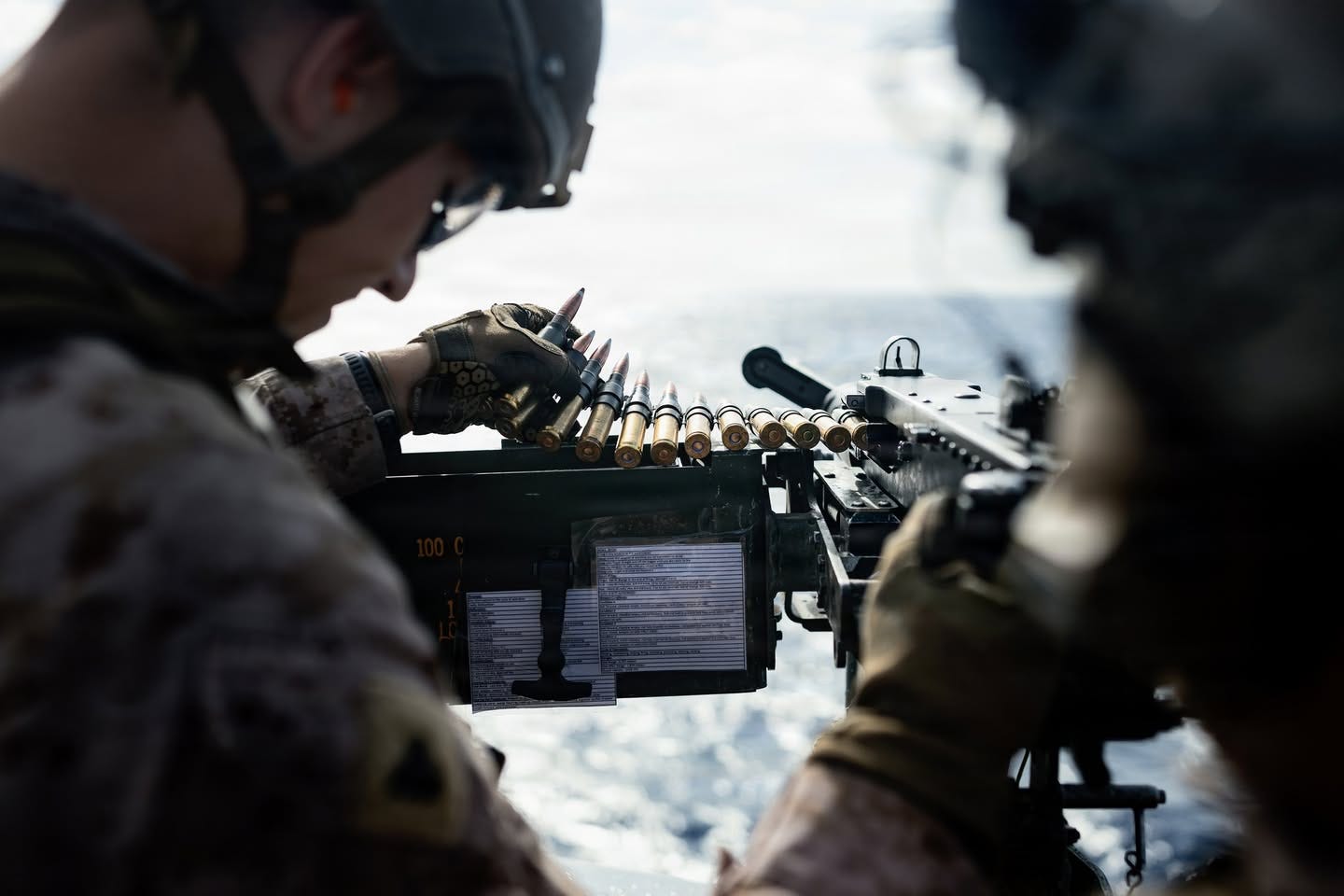
US Marines with Battalion Landing Team 3/5, 11th MArine Expeditionary Unit conduct an amphibious task force live-fire drill at the Pacific Ocean last April 3, 2025. Photo by Lance Cpl. Luke Rodriguez.
Manuel Mogato | April 7, 2026
MANILA — Ending its six months rotation in Southeast Asia, the 15th Marine Expeditionary Unit (MEU) of the I Marine Expeditionary Force (MEF), will remain in the Philippines to start a new round of exercises, starting this month.
Fresh elements from the 15th MEU, consisting of about 2,000 to 2,500 Marines have arrived in the Philippines and will take part in the large-scale, joint and combined “Balikatan” exercises that will begin on April 20.
In a statement, the 15th MEU said the next rotation of Marine Rotational Force-Southeast Asia (MRF-SEA) will “deepen integration and advance interoperability by training shoulder-to-shoulder with the Philippine Marine Corps (PMC) and the broader Armed Forces of the Philippines (AFP), with a focus on strengthening the Philippines’ defensive capabilities.”
The new Marine Rotational Force will focused effort in the Philippines, integrating Marine Corps forces in support of Task Force – Philippines and strengthening the U.S.-Philippines Alliance.
The incoming MRF-SEA commander, Colonel Robert Bunn, emphasized the evolution of the rotational force.
“This iteration of MRF-SEA reflects a deliberate shift from presence to presence with purpose,” Bunn said, adding the US Marines’ presence is at the invitation of the government of the Philippines.
It is also aligned with the Philippine-led Comprehensive Archipelagic Defense Concept. Complementing Task Force — Philippines’ focus on bilateral coordination at the joint and strategic level, MRF-SEA operates at the operational level as the Marine Corps’ forward, rotational force — integrated with Philippine forces to synchronize capabilities and enable crisis response. (Also read: US, Philippines test coastal defenses in Palawan)
“We are integrating with the AFP to strengthen combined capabilities, enable faster response in crisis, and contribute to a credible, forward posture in the Indo-Pacific. Our alliance is not symbolic – it is operational, historic and built to endure.”
He said the MRF-SEA’s integration with the AFP will be demonstrated through several bilateral Marine exercises, including Balikatan 26, KAMANDAG 10, and Marine Aviation Support Activity (MASA) 26. Each exercise is designed in partnership to directly support Philippine defense objectives, he added.
Building on the momentum set by the 15th MEU, Bunn said the next iteration of MRF-SEA will deepen integration with the AFP and improve the combined force’s ability to respond rapidly.
From October last year until March this year, the MRF-SEA of the 15th Marine Expeditionary Unit held exercises to enhance combined readiness with the Armed Forces of the Philippines and other regional partners in Indonesia, Malaysia, Brunei, and Thailand.
Under the 15th MEU, MRF-SEA also demonstrated its regional presence by participating in major exercises such as Combined Cooperation Afloat Readiness Training Brunei, CARAT Malaysia, and in Indonesia at Exercise Bhakti Kayini AUSINDO 25.
In the Philippines, the MRF-SEA exchanged best practices with Northern Luzon Command staff and enhanced shared command and control of combined operations.
In the field, Marines and Sailors worked alongside the Philippine Marine Corps during exercises Sama Sama 25 and Marine Air Support Activity 25. Together, the two Marine forces conducted four simulated maritime strikes and significantly improved information-sharing, enhancing their collective understanding of the maritime environment.
During the MRF-SEA presence in the Philippines, the US Marines rapidly transitioned from training to real-world humanitarian assistance.
Following typhoons Fung-Wong and Kalmaegi, MRF-SEA helped lead the U.S. response to support the Philippine government’s disaster relief operations.
The unit was a critical element in coordinating nearly 500 U.S. service members and dozens of aircraft that delivered 10,000 family food packs to heavily impacted communities in the Catanduanes region.
The outgoing MRF-SEA commander, Colonel Robb McDonald, said, “I am incredibly proud of what we have accomplished in this region since October and am confident that the incoming force will continue to build on our critical Alliance.”
The next rotation of MRF-SEA will deepen integration and advance interoperability by training shoulder-to-shoulder with the PMC and the broader AFP, with a focus on strengthening the Philippines’ defensive capabilities.