


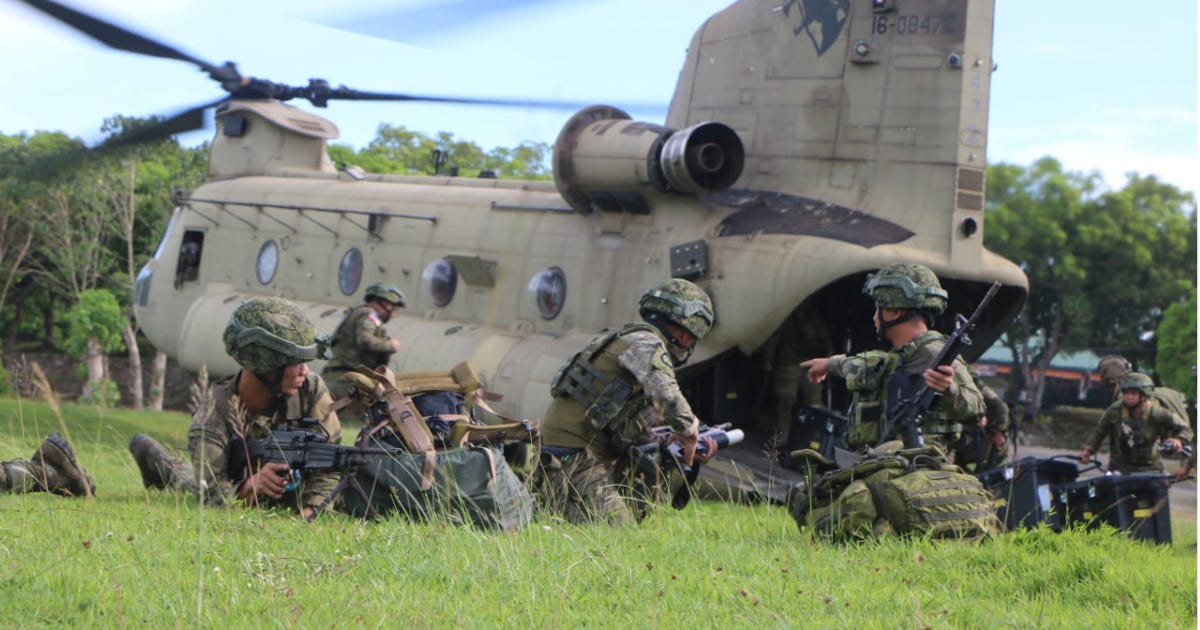
Philippine Army and U.S. Army Pacific troops conducting air assault drills during the Salaknib Phase 2 at in Upi, Gamu, Isabela last June 17, 2025. Photo from AFP FB page.
Manuel Mogato | February 27, 2026
The United States is expanding its engagement in the Philippines, deploying permanent Army and Marine troops, on a rotational basis, to hold exercises and support operations to deter an aggressive China in the Indo-Pacific region.
More boots on the ground means more facilities and military-related infrastructure as well supplies and equipment to sustain year-round deployment in nine locations in the Philippines.
Early this month, the United States announced major steps to boost its presence and activities in the Philippines, the weakest link in its first-island chain defense in the Indo-Pacific region.
The increasing tempo in Washington’s engagement was incremental, beginning with Defense Secretary Pete Hegseth’s announcement in October 2025 to activate Task Force Philippines.
Details were scant on the size and mission of the task force, except that it would have a small team of 60 soldiers led by a Marine two-star general.
The US Navy is the most visible and active component of US engagement in the Philippines. Since 2023, it has conducted more than a dozen maritime cooperative activities (MCA) with the Philippine Navy, Philippine Air Force, and the Philippine Coast Guard.
The US Navy had also taken part in nearly 10 multilateral maritime cooperative activities (MMCA) with allies and partners, such as Australia, Canada, France, Japan, India, and New Zealand.
More maritime drills and joint patrols are planned for 2026, increasing the frequency and number of activities.
The US Air Force also returned to the Philippines, reviving the annual Cope Thunder exercises and taking part in the annual joint and combined “Balikatan” exercises.
Recently, US Air Force strategic bombers held a joint air defense and air patrol operations in the West Philippine Sea. The US has also sent F-16s, F-22s, and F-35s from its bases in South Korea and Japan to hold drills and trainings in Crow Valley, an air gunnery range in Tarlac.
The US Marines has activated a Marine rotational force in Southeast Asia but based in Manila, and introduced anti-air and anti-ship missiles, through its Navy-Marine Expeditionary Ship Interdiction Systems (NMESIS) and the Marine Air Defense Integrated System (MADIS).
Finally, the US Army Pacific (USARPAC) activated its rotational force in the Philippines, a more permanent unit to be scattered in nine EDCA locations in the country.
The rotational force is made up of 50 soldiers, led by a lieutenant colonel, and will be attached with the US Task Force Philippines.
There were also no details on the real mission of the US Army, except that the unit was created to counter China’s creeping influence in the region, increase deterrence, and counter China’s A2AD strategy in the disputed waters in South China Sea.
Apart from the special Army unit, the USARPAC will send thousands of soldiers from the 25th Infantry Division, a maneuver unit, for back-to-back exercises, Salaknib and Balikatan drills in April and May.
The 25th Infantry Division will hold drills, under the US Army’s Operations Pathways 26, with the Philippines’ 5th and 7th Infantry Divisions, based in northern and central Luzon.
The 1st and 3rd Multi-Domain Task Forces (MDTFs) have also been actively involved in the Philippines. The Washington State-based 1st MDTF brought in the mid-range capability (MRC) missile launcher systems Typhon in 2024.
In addition, it also has an unspecified number of High Mobility Artillery Rocket Systems (HIMARS) deployed in Fort Magsaysay in Nueva Ecija.
On the other hand, the Hawaii-based 3rd MDTF operated special equipment, liked the High Altitude Balloons (HABs) and the ultra high-endurance unmanned aircraft systems.
It also operated the long-range hypersonic missle systems Dark Eagle, the land-based Tomahawk and SM-6 missiles, delivered through Typhon missile launchers.
In 2025, the 3rd MDTF deployed a Typhon launcher in Japan but pulled it out after a large-scale exercise.
At a recent bilateral security dialogue (BSD) between the Philippines and the United States, the Americans announced plans to deploy more cutting-edge missiles and unmanned aerial and surface drones in the Philippines.
These potential deployments would help enhance the Philippines’ credible defense capabilities, boosting its anti-access and area denial (A2AD) capabilities.
In addition, the US also announced plans to pour $144 million to improve EDCA sites, particularly the runways, allowing the US Air Force’s F35, F-16s, and F-22s to land and take off in Basa Air Base in Pampanga, Lal-lo airfield in Cagayan, Balabac and Puerto Princesa in Palawan.
All these investments, deployments, trainings and exercises are geared to harden the Philippines’ defenses and improve the skills sets of local troops to work closely with the Americans in case of a regional crisis.
The US is also in hurry to prepare the logistics hubs in the Philippines’ northern and western parts, asking other allies and partners, such Australia, Japan, and even Taiwan to pour investments into the EDCA sites to put up warehouses, barracks, and other facilities.
The US needs reliable supply chain, sufficient logistics and sustainment in case of a conflict in the region.
Thus, the Philippines does not only need to increase deterrence but also provide logistics and sustainment to US military forces.
Time is not on the side of the Americans. The EDCA sites should be operational and ready to provide support to US troops when the need arises.
The deployments are just part of an insurance that the Philippines will not be vulnerable to attacks and it could provide credible deterrence in the first island chain.
The next 24 months will be exciting as the US races to prepare the Philippines’ in its support role to US operations in the region.