

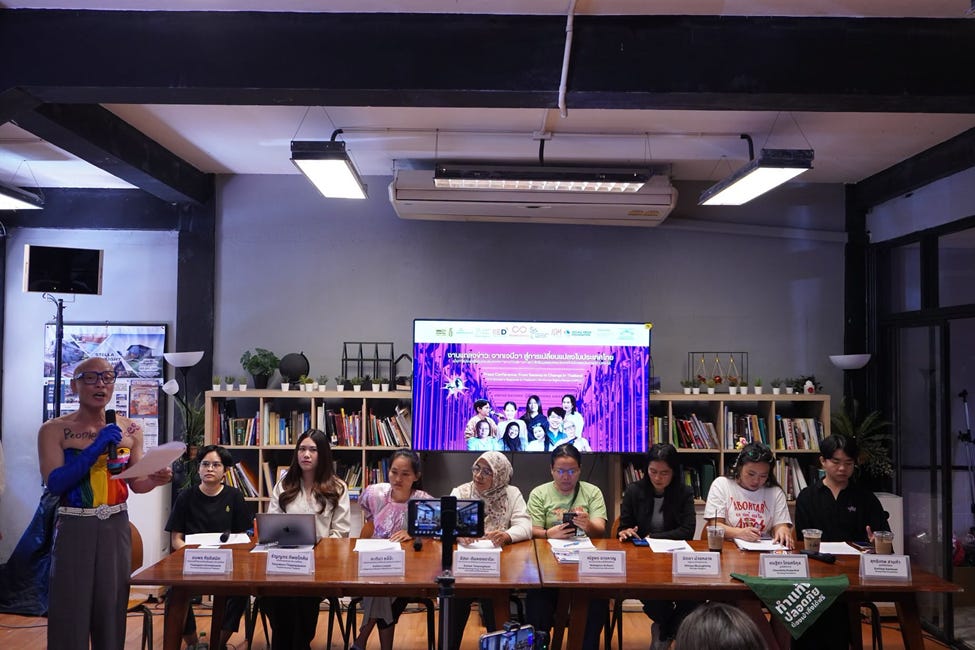
The atmosphere at a civil society forum reflecting the voices of Thai civil society following Thailand’s fourth Universal Periodic Review (UPR). (Photo: Courtesy of Amnesty International Thailand, 10 November 2026)
Kunravee Sukhimoke | November 16, 2026
BANGKOK — Although Thailand has received international recognition for developments such as the Marriage Equality Act and the law protecting the way of life of ethnic groups, these changes have yet to translate into equal rights in the everyday lives of many people.
During the fourth cycle of the Universal Periodic Review (UPR) on 9 November, Thailand received 297 recommendations from 106 UN member states. The recommendations covered a wide range of issues, including freedom of expression, enforced disappearance, refugee protection, land and environmental rights, and gender equality.
Civil society welcomed many of the recommendations, particularly those calling for an Anti-SLAPP (Strategic Lawsuit Against Public Participation) law, human rights due diligence by businesses, and protection for refugees against being returned to places where they face danger.
However, several key demands were not clearly raised at the international forum. These included the right of people in Patani to self-determination, an end to the use of emergency laws, and legal recognition of Indigenous Peoples.
Civil society groups stressed that receiving a large number of recommendations or making government commitments would not be enough without clear implementation plans. People affected by human rights violations must also be able to exercise their rights and access justice in practice.
Still Fighting for Their Rights
Despite progress in human rights legislation, many groups continue to face barriers to exercising their rights, including political freedoms, land rights, and the right of communities to determine their own futures. (Also read: Thailand’s credibility shatters after Min Aung Hlaing; gains empty concessions)
In Thailand’s southern border provinces, civil society groups called on the government to ensure meaningful public participation in the peace process, particularly for women and young people.
Asma Tanyongdao, a board member of the Manushya Foundation and coordinator of the Patani Working Group for Monitoring on International Mechanisms, said: “The government must establish a civilian-led peace process in which women and young people have real decision-making power. It must also publish a timeline for implementation developed jointly with our communities.”
Land rights remain another major concern. The case of villagers in Sab Wai, who farm land within Sai Thong National Park, reflects the conflict between forest conservation policies and people’s rights.
Nittaya Muangklang, a representative of Sab Wai villagers, said: “The government calls this forest protection, but what has happened is that we have been labelled ‘criminals’ and accused of trespassing on our own land.”
Another key issue is protecting refugees from being returned to places where they face danger. Thanyakon Thippayaphokin of Asylum Access Thailand highlighted the guarantees that refugees should receive: “It must be guaranteed that no one is sent back to face danger, and that no one is put at risk simply because they have come to Thailand seeking safety.”
The voices of affected communities show that progress in human rights cannot be measured by changes in legislation alone. People must be able to exercise their rights, access justice, and have a say in shaping their own futures.
What Must the Government Do Next?
For civil society, the UPR process does not end when the review in Geneva is over. Rather, it marks the beginning of monitoring how far the government puts the recommendations into practice.
Civil society has played an important role in bringing human rights issues to the international stage. Its work has included preparing reports, gathering evidence, and coordinating networks to ensure that the voices of affected communities are heard.
Thanaporn Kiratisamit, Policy Officer at Amnesty International Thailand, noted that although Thailand has made some progress in protecting freedom of expression, civil society collaboration remains essential in bringing these concerns to the attention of the international community.
Key priorities moving forward include setting clear timelines and budgets for reforms, ensuring meaningful community participation, ending human rights violations, and providing remedies for those affected—without waiting for the next review.
Ultimately, the value of the UPR should not be measured by the number of recommendations received or commitments made by the government. It should be measured by whether people can genuinely exercise their rights, whether those responsible for violations are held accountable, and whether communities that have long been overlooked gain greater power to shape their own futures.
For people who continue to face human rights violations, the global review will only have meaning when its promises lead to real changes in their lives.