


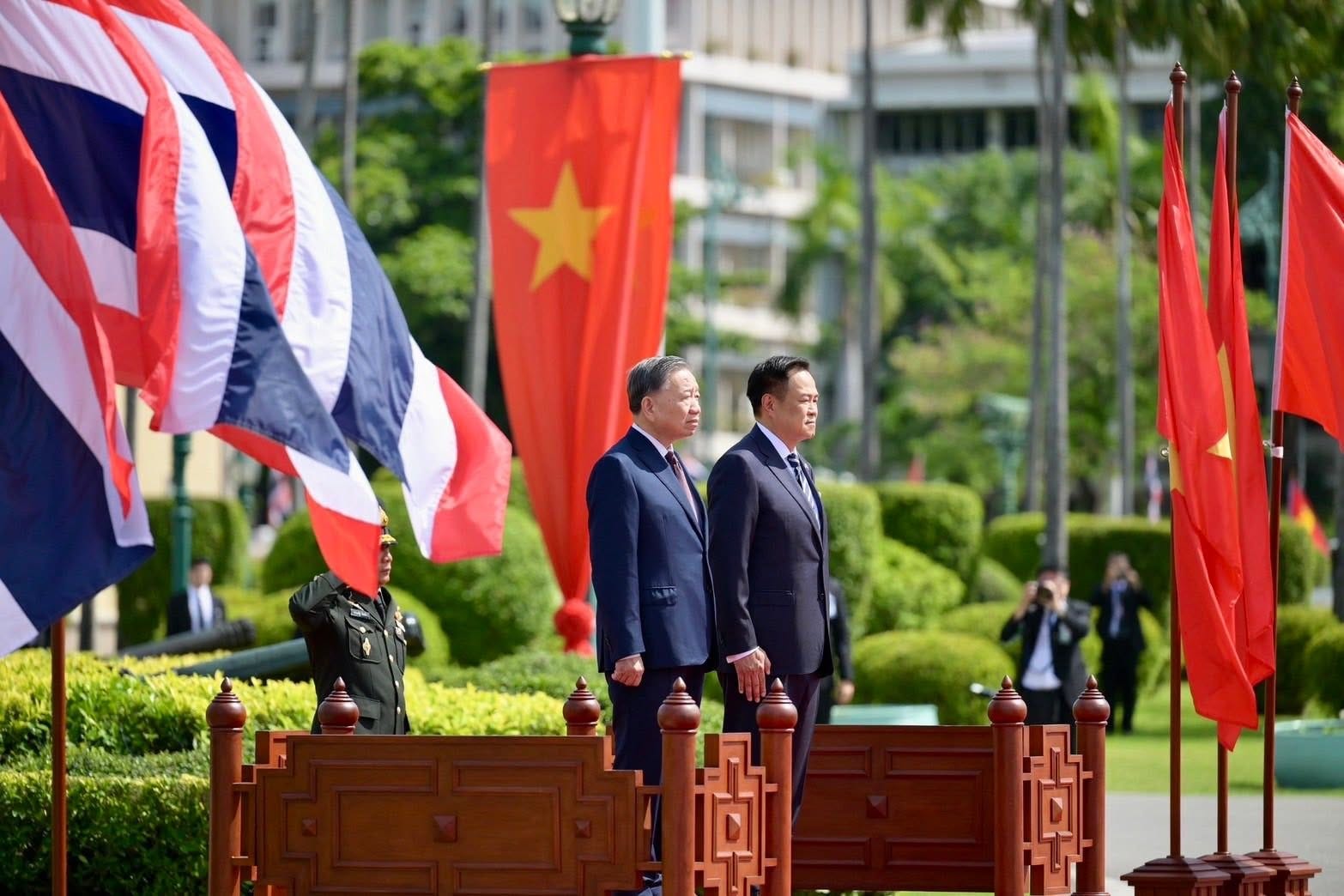
Prime Minister and Minister of Interior Anutin Charnvirakul welcomed General Secretary of the Communist Party of Vietnam and President of the Socialist Republic of Vietnam To Lam at the Government House last May 28. Official Handout.
Prapapoom Eiamsom | June 14, 2026
BANGKOKG — Vietnamese Party General Secretary and President To Lam embarked on an official visit to Thailand on May 27, 2026, marking his first trip to an ASEAN country since taking office.
Arriving as the two nations approach 50 years of formal diplomatic relations, the state visit saw ties elevated to a Comprehensive Strategic Partnership—the highest level in Vietnam’s diplomatic hierarchy.
This upgrade anchors their shared future across cultural, security, technological, and economic dimensions.
To Lam’s itinerary heavily reflected the historical depth of the bilateral relationship. Defying standard diplomatic protocol, his first stop was the northeastern province of Udon Thani rather than Bangkok.
Between 1928 and 1929, the founder of modern Vietnam, Ho Chi Minh, took refuge and conducted revolutionary activities in the northeastern Thai province.
President To Lam’s visit was not only a tribute to this heritage at the Ho Chi Minh Historical Park but also a calculated move to deepen connections with Thailand’s vibrant Vietnamese diaspora.
Numbering over 100,000 members, Udon Thani hosts the largest Vietnamese community in Thailand. This diaspora has become both financially successful and highly influential, serving as a vital living bridge that remains intensely proud of its Vietnamese roots.
This current harmony marks a striking turnaround from a deeply fractured past. Throughout the Cold War, Thailand and Vietnam stood on opposite sides of an ideological chasm; Thailand actively aided the South Vietnamese war effort, hosted US military operations, and detained North Vietnamese prisoners of war. Relations strained further in the late 1970s and 1980s when Bangkok firmly protested Vietnam’s military intervention in Cambodia following the downfall of the Khmer Rouge.
The turning point came in the late 1980s when Thai Prime Minister General Chatchai Choonhavan famously declared a policy of “changing battlefields into marketplaces.” This coincided with Hanoi’s Doi Moi economic reforms and an open foreign policy.
Thailand subsequently supported Vietnam’s entry into ASEAN in 1995. Today, the former rivals cooperate closely within vital sub-regional frameworks like the Mekong-Lancang Cooperation (MLC), the Ayeyawady-Chao Phraya-Mekong Economic Cooperation Strategy (ACMECS), and the Greater Mekong Subregion (GMS). Their joint focus spans logistics infrastructure across land corridors, Mekong River management, and maritime security in the Gulf of Thailand.
Beyond diaspora ties and historical reconciliation, trade and investments dominated the bilateral agenda. Thailand also stands as Vietnam’s largest trading partner within ASEAN and its second-largest investor from the bloc, trailing only Singapore. Multi-billion-dollar Thai conglomerates like Central Group, SCG, and Amata have deep roots in the Vietnamese economy.
At the Thailand–Vietnam Business Forum, To Lam noted that no country can grow in isolation; to sustain its target of 10 per cent annual economic expansion through 2030, Vietnam requires a strong regional partner. This sentiment was warmly mirrored by Thai Prime Minister Anutin Charnvirakul, who declared: “When Vietnam grows, Thailand grows.”
Both nations have emerged as primary beneficiaries of the “China+1” strategy, capturing a massive influx of foreign direct investment (FDI) as global firms diversify out of China. Rather than engaging in a destructive head-to-head race, their economic engines are evolving to become deeply complementary. In high-tech manufacturing, Thailand has leveraged its position as a regional electronics hub dominating printed circuit board (PCB) production and data centres.
Meanwhile, Vietnam has rapidly absorbed massive assembly and semiconductor testing ecosystems from global giants like Samsung. Without Thailand’s specialised power components, Vietnam’s advanced chips wouldn’t have the reliable electricity or physical connections to run. Without Vietnam’s design and packaging speed, Thailand’s hardware wouldn’t have the modern computational power to compete. Together, they form a highly resilient, intra-ASEAN tech corridor.
Furthermore, demographic and structural realities dictate this interdependence. Thailand is utilising Vietnam’s young, urbanising population of approximately 100 million to offset its own rapidly ageing society and stagnant domestic growth.
Conversely, Vietnam draws on Thailand’s mature institutional models—relying on Thai corporate expertise to build its retail sectors, drive sophisticated urbanisation, and secure clean energy. This was evidenced by high-level talks during the visit with Thai conglomerates, such as GULF Energy, to accelerate green power transition projects.
To formalise this intertwined future, the state visit saw the robust execution of the “Three Connections” Strategy. Designed as a blueprint for long-term development, this framework bridges the two regional powers across three distinct pillars.
First, supply-chain connectivity aims to synchronise manufacturing pipelines to smooth cross-border trade and prevent logistical friction. Second, business and local-government connectivity focuses on forging direct economic channels between provincial hubs—such as exploring direct aviation routes linking Hanoi, Ho Chi Minh City, and Danang directly to Udon Thani to spur localised investments.
Finally, strategic alignment for sustainable growth entails aligning digital transformation policies, ESG frameworks, and green energy investments to guarantee long-term regional energy security.
Moving past their Cold War rivalry, Vietnam and Thailand have emerged as inseparable strategic allies—and the twin engines driving the economic future of mainland Southeast Asia. (Also read: Philippines, Vietnam elevate defense cooperation to higher level)