


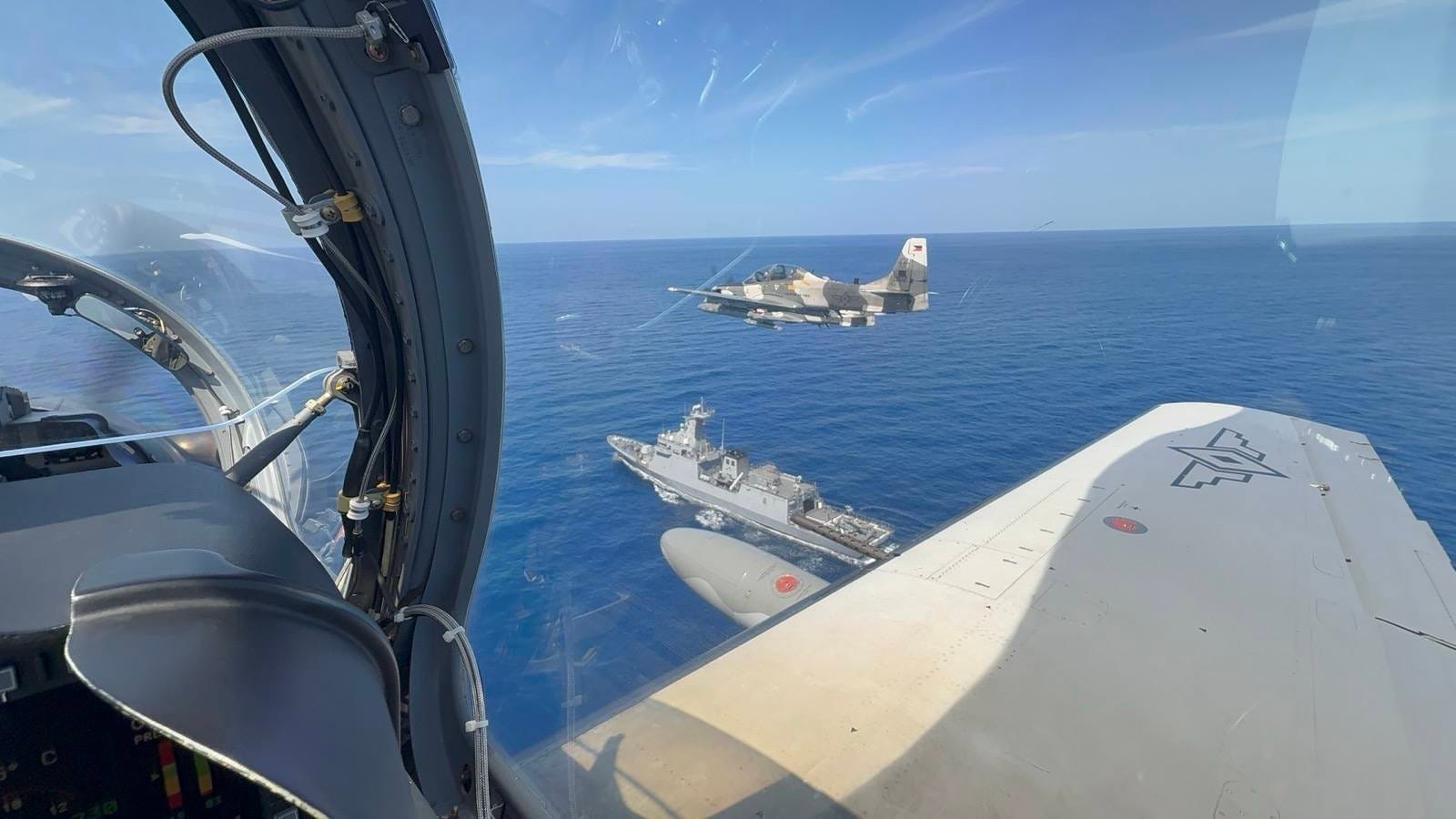
A PAF A-29B Super Tucano aircraft conducts flyby maneuvers during the 15th Multilateral Maritime Cooperative Activity over the West Philippine Sea and Luzon Strait. Photo from Philippine Air Force.
Manuel Mogato | March 27, 2026
Manila — In a recent interview with journalists, Defense Secretary Gilberto Teodoro said the Philippines needs four squadrons of multi-role fighters for a minimum credible defense capability.
However, the Philippines still cannot afford to acquire the required 48 multi-role fighters in one go at this time.
Sadly, it lacked the required resources to acquire the highly advanced multi-role fighters, which were offered to the Philippines, such as the American F-16s, the Swedish JAS-39 Gripen, and the French Dassault Rafale.
The Philippine government has allocated only $1.2 billion to the Philippine Air Force (PAF) to acquire a squadron of multi-role fighters under the 15-year, three-phased revised modernization program, which Congress approved in 2012. (Also read: The military modernization fund faces big challenges)
More than a decade later, the Philippines continued to struggle to acquire the multi-role fighter despite soft loans and a longer, multi-year repayment scheme.
Instead, it opted for a lead-in fighter trainer (LIFT) aircraft that could double as a light fighter for air defense missions in the West Philippine Sea — the South Korean F-50 Golden Eagle.
The Philippines has 11 F-50s, losing one when it crashed during a bombing mission in Bukidnon. It has signed a contract for another 12 FA-50s, which will be delivered by 2028.
In December 2024, President Ferdinand Marcos Jr. revised the modernization program and proposed a 1.1 trillion-peso program for the next 10 years, which includes allocating 400 billion pesos for 48 advanced multi-role fighters.
Aside from the platforms, the Philippines has another serious problem — it lacked trained and competent pilots to operate the much faster and more sophisticated fighter aircraft. (Also read: Why does the Air Force need a dedicated fighter trainer aircraft?)
It is not wise to acquire an F-16 or any advanced fifth-generation multi-role fighter if there are no pilots that can fly them.
A classic example is Bulgaria. It was forced to ground a fleet of F-16 because it lacked qualified aviators to operate the complex machines.
It would take several years to train pilots that could be qualified to operate a multi-role fighter.
For instance, a would-be Philippine Air Force (PAF) fighter pilot has to complete a basic flight training course of minimum 75 hours of flight simulation and another 93 hours of actual flight.
And this is just the basic to learn to fly propeller-driven Cessna of SF260 planes.
It actually takes more than a year to earn a basic pilot’s wing badge before a fighter training of another 430 hours in actual flight and simulation machines.
All PAF pilots are trained for basic flight course at Fernando Air Base in Lipa City, Batangas, the home of the former 100th Training Wing, and now the Air Education and Training Command.
After graduation, pilots move to a more specialized training as a fighter and attack pilot, a transportation pilot, and rotary pilot.
Would-be fighter pilots are trained at the 5th Fighter Wing in Basa Air Base and those flying the slower combat planes go to the 15th Strike Wing at Juliano Air Base in Lumbia airport, Cagayan de Oro.
For those who wanted to fly transport planes, like the C-130J Hercules planes or CASA C-297 medium lift planes the pilots go to the 220th Airlift Wing at Ebuen Air Base in Mactan, Cebu.
Combat Utility Helicopter (CUH) pilots also trained at the 205th Tactical Helicopter Wing also in Mactan while attack helicopter pilots trained at the 15th Strike Wing in Cagayan de Oro.
The PAF may need combat-ready 70 to 80 fighter pilots by 2028 and beyond, as South Korea delivers a squadron of FA-50s and future multi-role fighters.
Each fighter pilot requires 100 plus jet flying hours to achieve operational readiness. This translates to over 7,000 plus jet training hours.
There also appears to be a misalignment between platform acquisition and pilot generation capacity.
For instance, the Brazilian A-29 Super Tucano turbo-prop aircraft still remains highly effective for internal security operations, but does not develop jet transition competencies.
The PAF is also phasing out the remaining Siai Marchetti S-211 jet trainers, which were acquired in the 1990s.
In addition, the FA-50 expansion increases aircraft availability, but does not proportionately increase pilot production capability.
As such, the PAF is effectively scaling aircraft, but without scaling pilots.
At the same time, the current pilot training structure is being compressed — from basic propeller-driven aircraft training and directly into advanced jet platforms such as the FA-50.
This is not consistent with how modern air forces develop fighter pilots.
It introduces risk into operational units, rather than managing and mitigating that risk within the training environment.
Thus, the PAF needs a dedicated jet trainer to bridge between basic propeller-driven planes to advanced jet fighters.
It would be costly for the PAF to use the FA-50 as a jet trainer and, at the same time, as a tactical and air defense platform.
It is estimated that the PAF may spend ₱8 billion more if no dedicated trainer jet is acquired.
Moreover, it reduces the operational load on FA-50 fleets and prevents overuse of combat aircraft for training.
The Philippine Air Force needs a dedicated jet trainer aircraft to train and prepare pilots to operate sophisticated and complex fifth-generation multi-role.
At present, the Czech Republic has offered to sell 12 jet trainer aircraft, the L-39 SkyFox, which is designed as a transition from turbo-prop to a jet engine aircraft.
The L-39 SkyFox is much cheaper than the FA-50 or the KF-21 light fighters. Czech officials are also offering a 21-year soft loan and a sustainable supply chain of parts and spares.
The entry of the Czech Republic’s L-39 SkyFox will ensure that a transition aircraft will not add burden to logistics, manpower, or operational resources while preserving the integrity of both the Super Tucano and FA-50 in their primary roles.
It will also prepare combat-ready pilots for air defense and air superiority missions.
Yup it reems wiser for the PAF to acquire L29s first before transitioning them t0 the FA-50s or mult-role combat aircraft--less acqisition cost and possibly more training flying time.