

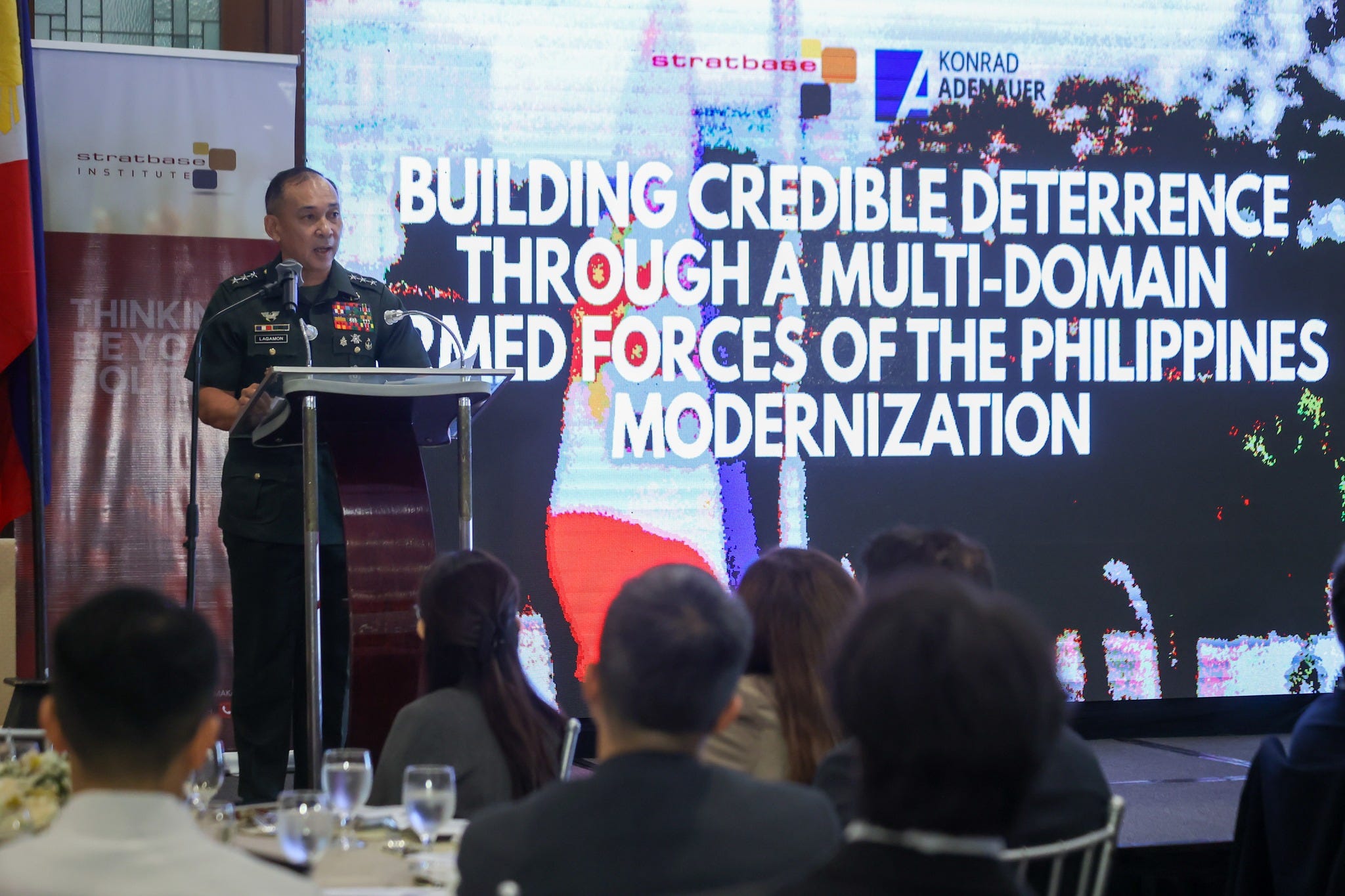
Civil-Military Operations Commander LtGen. Arvin Lagamon stood in for AFP Chief of Staff Romeo Brawner during the forum. Photo from Stratbase Institute.
Stratbase Institue | May 18, 2026
As the Philippines prepares to mark the 10th anniversary of the landmark 2016 arbitral ruling on the West Philippine Sea, senior military officials and security experts warned that the country is already facing a “political and informational war” marked by cyberattacks, disinformation, and foreign influence operations tied to tensions in the disputed waters.
The warnings came during a forum organized by Stratbase Institute and Konrad-Adenauer-Stiftung on AFP modernization, where the experts pushed to expand military modernization beyond traditional weapons platforms into cyber defense, intelligence, strategic communications, and cognitive warfare capabilities. (Also read: Learning to fight future wars in Balikatan drills)
AFP chief of staff Gen. Romeo Brawner, through his acting Deputy Chief of Staff Lt. Gen. Arvin Lagamon, said in his keynote address that the Philippines must adopt a mindset that “we are already at war. Not yet a kinetic war, but the political war, the economic war, and more importantly, the cyber and informational war is already going on,” Lagamon said.
He noted that the Philippines continued to confront China’s “daily illegal, coercive, aggressive, deceptive, destructive, and bullying” activities in the West Philippine Sea, alongside “their use of sharp power through their United Front Works and their malign information and foreign influence information.”
His remarks echoed growing concern over the role of disinformation and cognitive warfare in the country’s maritime dispute with China, which continues to dismiss the 2016 arbitral ruling that invalidated its sweeping claims over the South China Sea. (Also read: Thinking out of the box)
“Every day, efforts to undermine and discredit the ruling persist,” Stratbase President Victor Andres “Dindo” Manhit said. “In recent years, the country has faced sustained asymmetric gray zone challenges across multiple domains: Water cannons and ramming incidents in the maritime space, dangerous maneuvers and flares in the airspace, and information warfare in the digital domain.”
These challenges, Manhit said, “are expected to intensify in 2026” — thus the need for the Philippines to develop “credible capability” to assert and operationalize the landmark ruling.
“We need to transition from asserting our rights to defending our rights,” he said, as he pushed for a “long-term and adaptive defense strategy” that would outlast political cycles and deepen defense cooperation with like-minded nations.
Such partnerships, said German Ambassador to the Philippines Andreas Pfaffernoschke, would be essential as the Philippines seeks to modernize its military capabilities and strengthen regional deterrence: “It can hardly be achieved in isolation....The goal of all this is to jointly prevent military escalation through credible deterrence.”
Pfaffernoschke also expressed hopes that Germany and the Philippines could soon begin negotiations for a visiting forces agreement similar to arrangements Manila has forged with other European countries.
“We must be able to defend ourselves so that we don’t have to defend ourselves,” he added.
This is also why the AFP’s modernization program is increasingly focused on preparing the country for 21st century warfare, senior military officials said. (Also read: The military modernization fund faces big challenges)
Established through Republic Act No. 7898 in 1995, the AFP modernization program is the Philippine government’s long-term effort to upgrade the country’s military capabilities. The current revised program is scheduled to expire in 2027, and the AFP and lawmakers are already discussing a successor modernization framework.
Former AFP chief of staff Gen. Emmanuel Bautista stressed that the ultimate objective of modernization was credible deterrence — “but the caveat is (that) capability development is meaningless unless we consistently demonstrate the will to fight for our rights.”
Echoing his sentiment, Rear Admiral Roy Trinidad, spokesperson for the West Philippine Sea, warned that “the modern battlefield is the mindset of the Filipino people.”
“We need to protect the cognitive domain of the Filipino people,” Trinidad said. “Filtering, sifting through the information being put out is critical to the perception of the Filipino people...For all we know, we might be electing somebody by 2028 because of manipulation of the perception of the public.”
Brawner said the 2016 arbitral ruling remained central to the Philippines’ broader effort to uphold the rules-based international order.
“(The arbitral ruling) reinforced the importance of international law as a stabilizing force in maritime relations and as a peaceful mechanism for resolving disputes. The AFP’s modernization efforts, therefore, serve a broader purpose. They are intended to preserve peace by strengthening deterrence,” he said.