


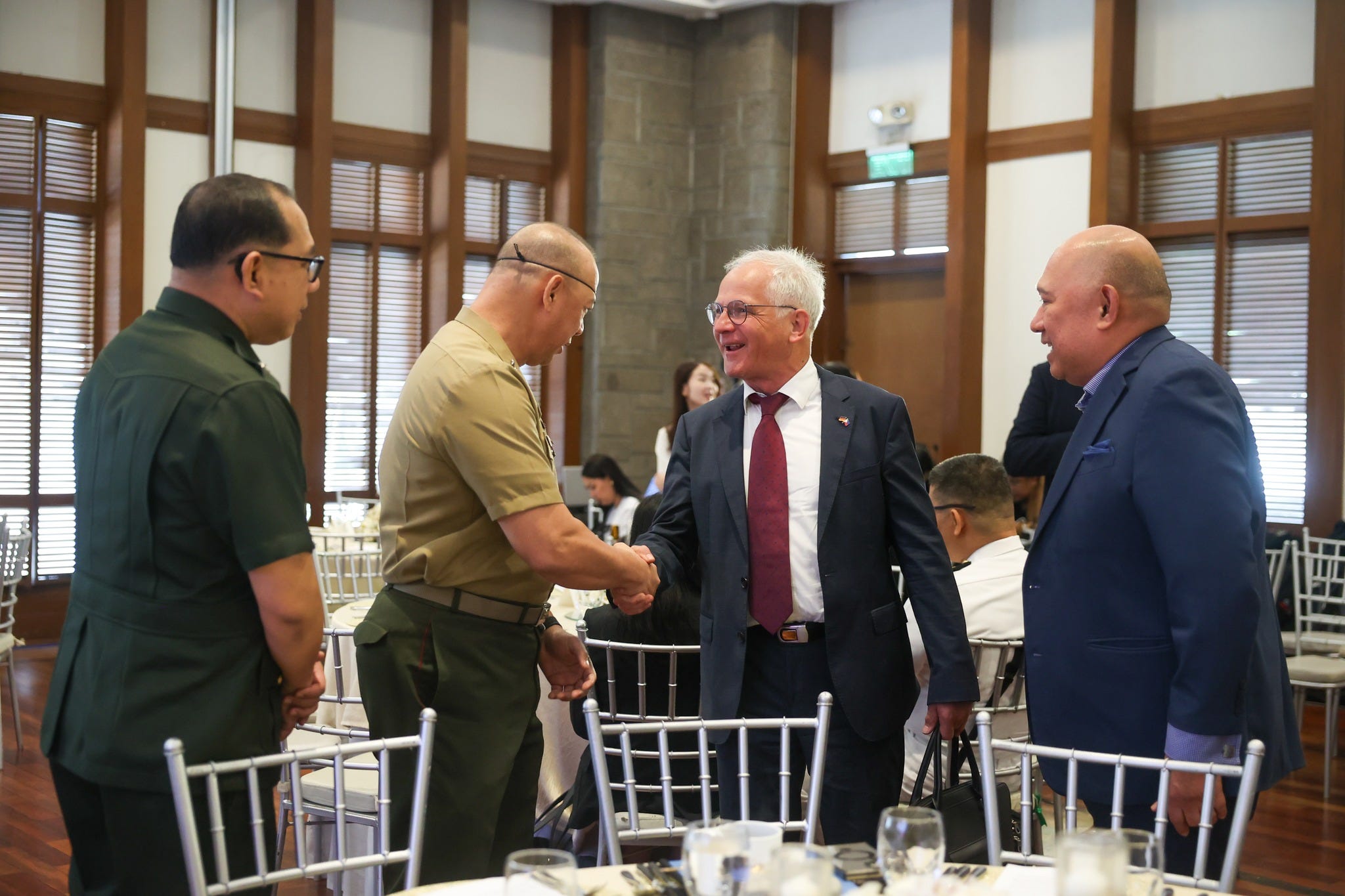
Germany’s Ambassador to the Philippines, H.E. Dr. Andreas Michael Pfaffernoschke, greets Armed Forces of the Philippines chief of Systems Engineering and Modernization Office MGen. Ivan Papera during the Stratbase forum on Thursday, May 14. Photo from Stratbase Institute.
Manuel Mogato | May 14, 2026
MANILA — Germany will begin negotiations of a status of forces agreement with the Philippines, a step in joining military exercises and training to boost deterrence in the Indo-Pacific region.
Germany is also in talks with the Philippines to transfer defense equipment.
However, Germany’s ambassador to the Philippines, Andreas Michael Pfaffernoschke, did not provide specific details on the capabilities to harden Manila’s defenses.
“We will soon start to negotiate a full visiting forces agreement, “ Pfaffernoschke said in a Stratbase Institute forum on military modernization in Makati, referring to a status of forces deal.
The Philippines has recently signed a Visiting Forces Agreement (VFA) with France, which allows Germany to deploy troops in the Philippines for training and drill.

The German ambassador said the two countries had ratified a defense cooperation agreement last year, a “proof to our shared dedication to security, knowledge exchange, and professional growth.”
“Germany has also increased participating exercises,” he said, adding Berlin sent troops to observe four exercises in Manila in 2026.
“We are in talks about also equipment being delivered from Germany,” he said, adding that Berlin was aware of Manila’s effort to invest in defense and procure equipment to strengthen its archipelagic strategy. (Also read: Reconfiguring Philippine defense forces)
“Germany sees the Philippines as an important strategic partner in Southeast Asia, and we are working with our Philippine partners in various areas to further intensify cooperation between our countries,” Pfaffernoschke added.
During the same forum, Pfaffernoschke shared Germany’s efforts to increase defense spending and restructure its armed forces as European states take a more active role in the North Atlantic Treaty Organization (NATO)’s defenses.
Berlin could no longer totally rely on Washington to defend Europe after President Donald Trump pulled out 5,000 troops from Germany and redeployed them to the Middle East. (Also read: Strengths and Vulnerabilities in Today’s Regional Hotspots)
“The recent decision to withdraw at least 5,000 soldiers from Germany is proof of a tendency that has emerged in recent years and forces us to reorganize our defense and therefore our deterrence much more with our own capacities and with our European partners,” he emphasized.
Germany, he added, has taken decisive steps to upgrade its military capacities. “The portion of GDP to be invested in defense has been increased or will be increased from 2% to 5% in accordance with NATO rules,” he said. “The immediate priority is to
increase the deterrence and defense capabilities as quickly as possible by 2029.”
As Germany strengthens its deterrence capability, Pfaffernoschke said Europe’s security is intertwined with the Indo-Pacific. (Also read: Learning to fight future wars in Balikatan drills)