


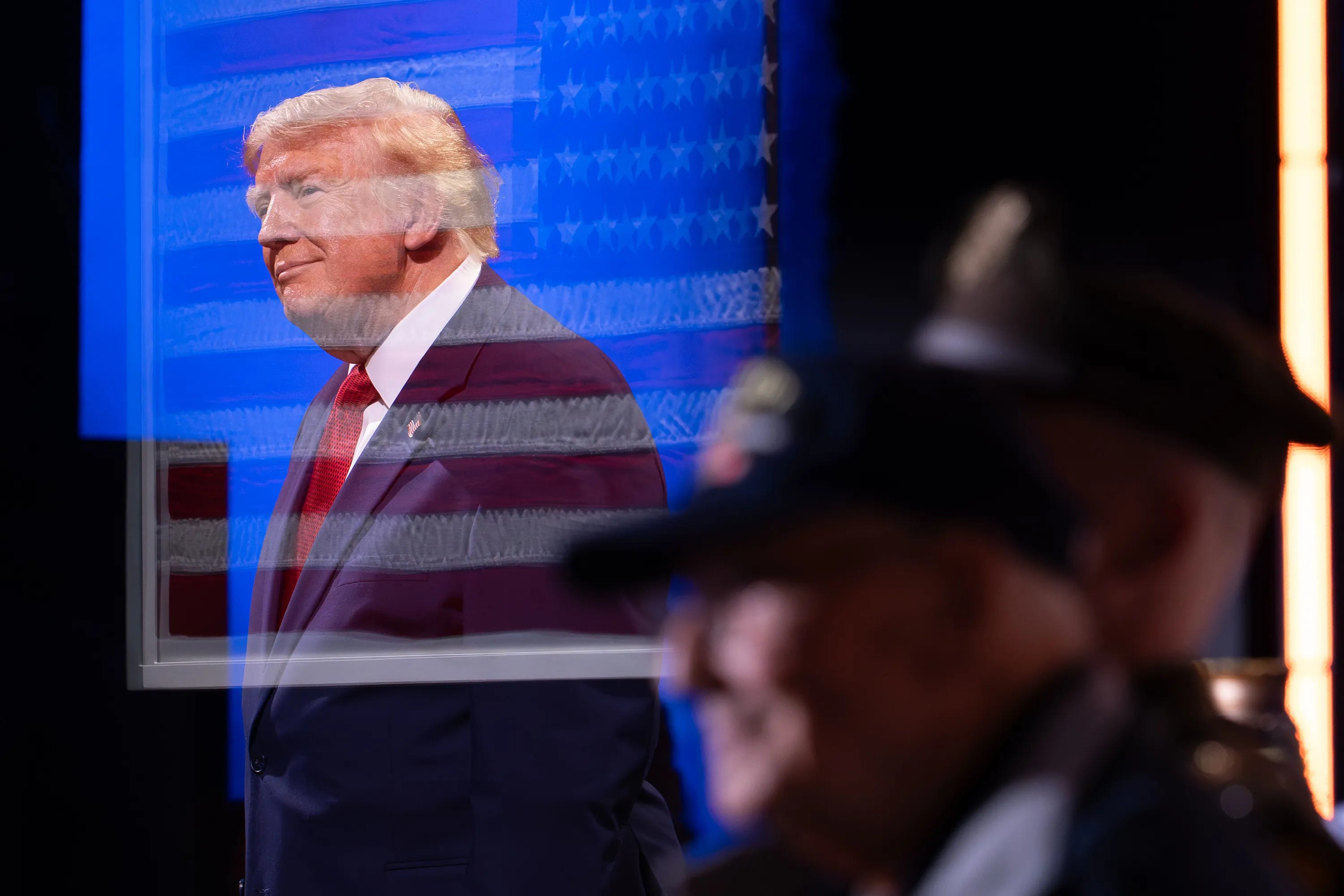
President Donald Trump at the 250th Independence Day celebration. Official handout.
Rodney J. Jaleco | July 9, 2026
WASHINGTON D.C. — America had as many reasons to celebrate the semiquincentennial of the revolutionary war of 1776 against England that led to the birth of the United States, as she had to feel trepidation.
Blistering heat and an early evening thunderstorm spoiled what should have been the culmination of America’s 250th birthday in the nation’s capital — a presidential address capped by a fireworks show with Washington’s landmark monuments offering a dramatic backdrop.
Nothing just seemed to work right for what should’ve been Pres. Donald Trump’s historical legacy. Insisting he speak to a crowd at the Mall instead of inside the White House, he ended up talking to a sparse audience in the rain, closer to midnight after many had given up waiting. Networks waiting for the big moment, filled the air instead with images of the parade of sails on the Hudson River between New York and New Jersey. (Also read: Washington has begun exploring a post-Trump America)
A quarter of a millennia of American democracy generated profound changes around the world. Many nations have embraced the best and worst of America.
The US Constitution became a template for constitutional government, separation of powers, judicial review, and protection of individual rights for nations the world over. Ratified in 1788 and taking effect in 1789, the Constitution has been interpreted, challenged, and reshaped through legislation, constitutional amendments, and decisions of the US Supreme Court.
This is certainly evident in the Philippines, an American colony for over four decades and a treaty ally for over 70 more. Many of these principles have been tested in the Philippines, as it is today when the Senate — constituted as an impeachment court akin to the US system — begins hearing the cases against Vice Pres. Sara Duterte.
The US has reshaped daily life through technological breakthroughs, including smart phones and the internet that’s allowed the rapid spread of social media; computer chips and GPS; advances in aviation, biotechnology, and artificial intelligence. Much of the modern digital economy traces its roots to American research institutions and companies.
Another American influence around the globe is increasing partisan division that’s made it more difficult to build consensus on major issues, affecting public trust in institutions and the functioning of government.
Although the US has generated enormous wealth and innovation, access to that prosperity has been uneven. Income inequality, limited social mobility in some regions, and high costs for housing, healthcare, and education remain persistent challenges.
The US has played a major role in maintaining international security, but it has also been criticized for interventions that produced unintended consequences like the US wars in Vietnam, Iraq, Afghanistan and more recently in Iran.
And as America marches - some say, lurches, forward in an increasingly volatile world, it faces difficult, fraught, convoluted challenges ahead.
Rebuilding trust in elections, government, the courts, the media, and public institutions is a pressing challenge as political polarization has intensified. (Also read: Frustrations over US unpredictability lure Thailand closer to “big brother” China)
Ensuring that economic growth translates into broader prosperity by addressing affordability, workforce development, infrastructure, and upward mobility remains a major task.
Relations with China and Russia are reshaping US foreign and security policy. Balancing deterrence, economic competition, and diplomacy is likely to define the coming decades.
Leadership in artificial intelligence, biotechnology, semiconductors, quantum computing, and space will influence both economic competitiveness and national security.
Rising national debt, aging demographics, and the sustainability of programs such as Social Security, Medicare and Medicaid are ticking concerns.
Trump’s most avid supporters believe he was divinely chosen to preside over America’s semiquincentennial celebrations. But for many, the president represents and enables what’s wrong with America, and what demands change, from reducing racial and economic inequality, strengthening democratic institutions to addressing climate change to regaining global leadership.
If there is a central American message to the world on its 250th founding anniversary, perhaps it is that America is a nation of both aspiration and contradiction. For over two and a half centuries, the US remains both an inspiration and a cautionary take — a nation whose successes are widely studied and whose failures are equally scrutinized, a nation that remains a work in progress.